
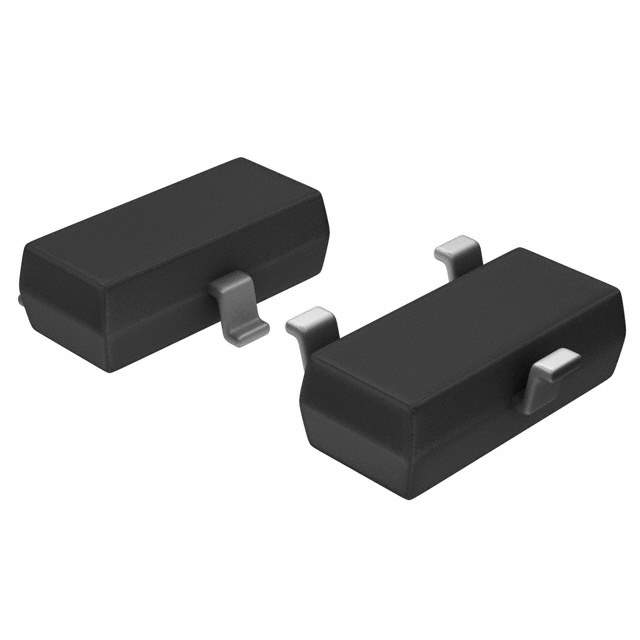
50 V, 100 mA, 200 mW, SST3 pre-biased NPN with 1 kOhms/10 kOhms built in
Quick Engineering Summary
| Field | Value |
|---|---|
| Manufacturer | Rohm Semiconductor |
| Category | Transistors (BJT) - Single, Pre - Biased |
| Package | SST3 |
| Core function | TRANS PREBIAS NPN 50V 0. |
| Key electrical range | Supply and Demand Status: Limited |
| Reported stock | 90 pcs reported — confirm on RFQ |
Active part, but only if the resistor pair is the one you want
Good for new designs.
What decides the fit is not the transistor type alone but whether the built-in network already matches the bias plan you meant to use, because a pre-biased device only saves time when its internal values line up with the circuit instead of forcing the circuit to bend around them. Here the built-in resistors are R1 = 1 kOhms and R2 = 10 kOhms. If your logic drive and pull-down assumptions were built around those values, DTC113ZCAT116 removes two external resistors and compresses the placement into SST3. If not, the convenience turns into a fixed constraint.
The rest of the fit check is about limits. The 50 V collector-emitter breakdown rating is a ceiling for higher-voltage control nodes, not a promise about switching behavior under load. The 100 mA collector current and 200 mW power rating are the real stop signs for design-in, and they keep DTC113ZCAT116 in signal switching, level shifting, and small load-drive work rather than anything that sits near either limit for long stretches. EU RoHS is compliant, MSL is 1 (Unlimited), and the lifecycle fields do not argue against a fresh design.
The ceiling is dissipation, not voltage
The constraint is heat in a small package. A 50 V ceiling looks generous, but the 200 mW maximum power and 100 mA maximum collector current do more to define the usable window because they set how much the SST3 body can tolerate before the package becomes the limiting factor.
Two listed figures sharpen that picture. Vce(sat) is 300 mV maximum at 500 µA and 10 mA, which points to low-current switching rather than heavy saturation duty. hFE is 33 minimum at 5 mA and 5 V, enough to show intended operation in the low-current region, but not enough to treat DTC113ZCAT116 like a free-form transistor stage where the base network gets chosen later.
The 500 nA maximum collector cutoff current helps on leakage-sensitive nodes. The 250 MHz transition frequency says the transistor itself is not especially slow, though it still does not replace switching waveforms when edge rate matters.
Can you keep a line running on it?
Can I get enough of it when the build starts?
That is the first buying question here, and the answer is mixed. DTC113ZCAT116 is Active, but the near-term supply picture is tight: stock is 90, supply and demand is Limited, and the listed lead time is 19 Weeks. The package format helps if the line already runs volume placement, since it comes on Reel - TR with quantity per package of 3000, but that does not solve a short pull. If this part is already on a released BOM, place the order against the real build schedule instead of assuming replenishment will be quick.
What the listing still doesn't answer
The weak point is documentation depth.
The headline specs are usable, but several concrete items are still missing. For DTC113ZCAT116, the gaps are the pinout, the package drawing, thermal resistance, and any derating curve. Those details close layout orientation, land pattern confidence, and ambient headroom.
The listing gives SST3 and also names TO-236-3, SC-59, SOT-23-3, but it does not include the drawing that settles footprint details. It also lacks switching waveforms or timing data, so the 250 MHz figure cannot stand in for real turn-on and turn-off behavior.
View the Win-Source product page for DTC113ZCAT116.
Key Takeaways for Engineers & Buyers
- Check the built-in 1 kOhms and 10 kOhms against the drive source before locking DTC113ZCAT116 into the schematic.
- Treat 100 mA collector current and 200 mW power as ceilings; keep DTC113ZCAT116 out of load paths that live near either limit.
- Place a buy early if DTC113ZCAT116 is for production now: stock is 90 and lead time is 19 Weeks.