
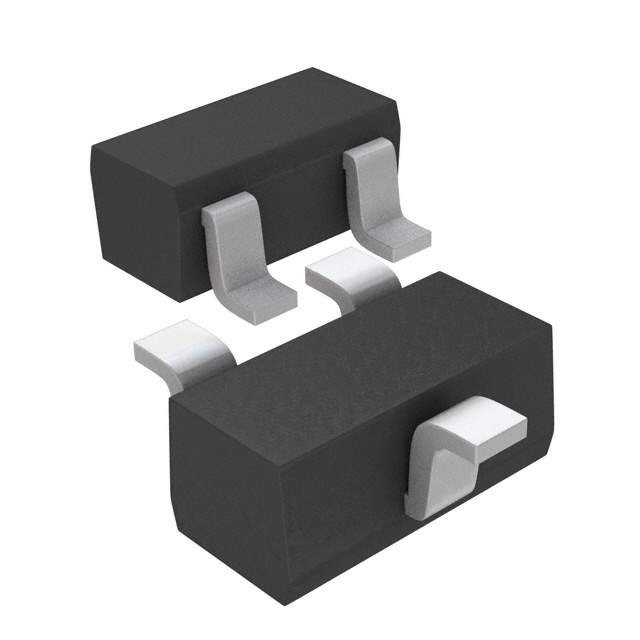
50V VCEO ceiling, 50mA collector ceiling, 150mW dissipation ceiling, EMT3 pre-biased NPN
Quick Engineering Summary
| Field | Value |
|---|---|
| Manufacturer | Rohm Semiconductor |
| Category | Transistors (BJT) - Single, Pre - Biased |
| Package | EMT3 |
| Core function | TRANS PREBIAS NPN 50V EMT3 |
| Key electrical range | Collector Cut-off Current(Max): 500nA; Frequency - Transition: 250MHz; Maximum Current Collector: 50mA; Maximum Power Dissipation: 150mW |
| Reported stock | 3080 pcs reported — confirm on RFQ |
The weak point is power, not lifecycle
150mW is the catch. DTC114EEFRATL is still Active with no lifecycle conflict, and EU RoHS status keeps compliance from becoming the issue.
The numbers cap current and voltage quickly
The constraint is limited electrical headroom. The 50V VCEO figure is a collector-emitter breakdown ceiling, so it settles whether DTC114EEFRATL can sit on higher-voltage small-signal rails, but it says nothing about switching behavior, surge tolerance, or operation near that limit.
The 50mA maximum collector current is also a ceiling, not a working point. That puts the part in light switching and bias duty, not on loads that ask for sustained collector current. Add the 150mW maximum power dissipation and the real limit becomes thermal budget in a very small EMT3 body.
One more number helps frame saturation loss: 300mV @ 500nA, 10mA for max VCE(sat). Useful, but only at that stated condition.
Wrong for adjustable bias, right for fixed logic interfacing
Don’t use this where the base network needs tuning. Use it where the resistor values are the point.
DTC114EEFRATL is a pre-biased NPN with 10k on R1 and 10k on R2, and that fixed network is the reason to choose it. In a dense SMT layout, it can remove two external resistors and simplify placement around a small control transistor. It fits housekeeping functions, enable lines, level-conditioned small-signal switching, and similar jobs where the drive source already suits a 10k/10k input structure.
If the circuit needs a different base current strategy, a different pull-down strength, or deliberate bias shaping, this part stops fitting long before the 50V headline matters. The listed hFE minimum of 30 @ 5mA, 5V shows the gain floor was characterized at modest current, which matches that role. The 500nA collector cut-off current maximum points the same way: low enough for small-signal control paths, but not a substitute for a full off-state leakage curve over temperature.
When the built-in resistor pair matches the schematic, DTC114EEFRATL is a tidy board-space play in EMT3. When it doesn’t, it’s the wrong transistor.
Can you keep a line running on it?
Can you actually buy it in a production-friendly form? Yes: DTC114EEFRATL is listed Active, packaging is Reel - TR, and stock is 3080.
That lines up with normal SMT consumption, not hand-load cleanup. Reserve it for builds that already want reel-fed EMT3 parts, and hold broader platform use until the missing mechanical and thermal details are clear.
The missing details are the real review blockers
3080 units on hand doesn’t answer the engineering questions that still matter. For DTC114EEFRATL, the gaps are concrete: no pinout, no package drawing, no thermal resistance, and no derating curve are listed here.
Those omissions matter more than another line of copy. Pinout and drawing decide footprint confidence in EMT3, while thermal resistance and the derating curve decide how much of that 150mW ceiling is usable once ambient rises. A switching part listing without those items is still only half a decision.
View the Win-Source product page for DTC114EEFRATL.
Key Takeaways for Engineers & Buyers
- Keep DTC114EEFRATL on low-current switch nodes; 50mA collector and 150mW are hard ceilings.
- Use the built-in 10k R1 and 10k R2 only where that bias network matches the drive source.
- Buy on reel for the running line; listed stock is 3080 and packaging is Reel - TR.