
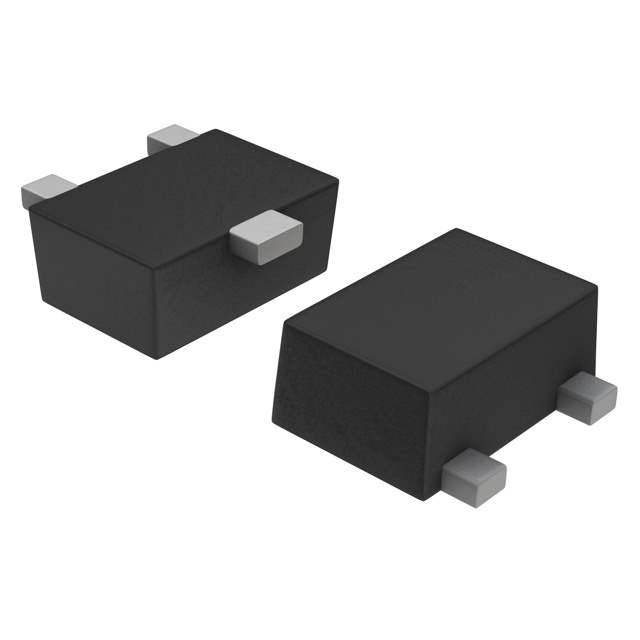
50V VCEO ceiling, 100mA collector limit, 260mW dissipation cap, SOT-723 pre-biased NPN with 10k/10k
Quick Engineering Summary
| Field | Value |
|---|---|
| Manufacturer | ON Semiconductor |
| Category | Transistors (BJT) - Single, Pre - Biased |
| Package | SOT-723 |
| Core function | TRANS PREBIAS NPN 50V SOT723 |
| Key electrical range | Collector Cut-off Current(Max): 500nA; Maximum Current Collector: 100mA; Maximum Power Dissipation: 260mW; Supply and Demand Status: Sufficient |
| Reported stock | 200000 pcs reported — confirm on RFQ |
Can you design DTC114EM3T5G into a new build?
Can I put this into a new design without creating a sourcing problem later? Yes. DTC114EM3T5G is Active, the lifecycle signals agree, and 200000 units in stock point to a part that supports ongoing production rather than a last-time buy.
EU RoHS is listed as compliant, which clears one routine sourcing hurdle. The part itself is a pre-biased NPN in SOT-723 with R1 = 10k and R2 = 10k fixed on-chip, so the appeal is straightforward: less board area and two fewer external resistors when that trade is worth more than bias-network freedom.
The small package is not the limit; the ceilings are
And that is the real filter. The 50V VCEO rating is a ceiling, not a place to operate casually, so DTC114EM3T5G fits modest signal and control rails, while this listing still leaves open how much collector overshoot or transient stress the part can tolerate in a noisier node.
The 100mA maximum collector current is also a ceiling. It supports low-current switching and interface work, but it does not make DTC114EM3T5G a general-purpose load driver. The 260mW maximum power dissipation matters just as much here, because in SOT-723 the thermal limit can end the conversation before the current number does, especially when the transistor stays on hard or drops meaningful voltage for more than a brief interval.
The listed VCE(sat) maximum is 250mV @ 300µA, 10mA. Useful, but only at that stated corner. It shows the part can pull low cleanly in a light switching condition and gives you a starting point for conduction-loss budgeting there, yet it says nothing about saturation behavior near the 100mA ceiling, where assumptions get expensive fast.
Collector cut-off current is 500nA maximum. Good for off-state behavior in high-impedance logic or bias paths. It still leaves temperature-conditioned leakage unanswered, because that detail is not shown here.
The fixed 10k/10k network decides where it fits
The weak point is flexibility. Choosing DTC114EM3T5G also means choosing R1 = 10k and R2 = 10k, so it belongs in designs that want a known built-in bias network, not in designs that need to tune base drive around source impedance, edge rate, or noise margin.
That same fixed network is the reason to use it. In compact digital gating, level conditioning, and simple low-current switching, DTC114EM3T5G can remove two external resistors and keep placement tight in SOT-723. The minimum hFE of 35 @ 5mA, 10V supports that small-signal role at the stated test point, but it does not make the part a broad analog gain choice.
What the missing datasheet items still decide
200000 units help, but pinout, RθJC, and switching-time data still decide whether DTC114EM3T5G is a quick schematic win or a board-spin mistake.
View the Win-Source product page for DTC114EM3T5G.
Key Takeaways for Engineers & Buyers
- Keep DTC114EM3T5G on rails that stay inside the 50V VCEO ceiling.
- Budget collector load against the 100mA and 260mW ceilings before using DTC114EM3T5G as a switch.
- Lock reel usage and feeder setup for SOT-723 TR to avoid package-line surprises.