
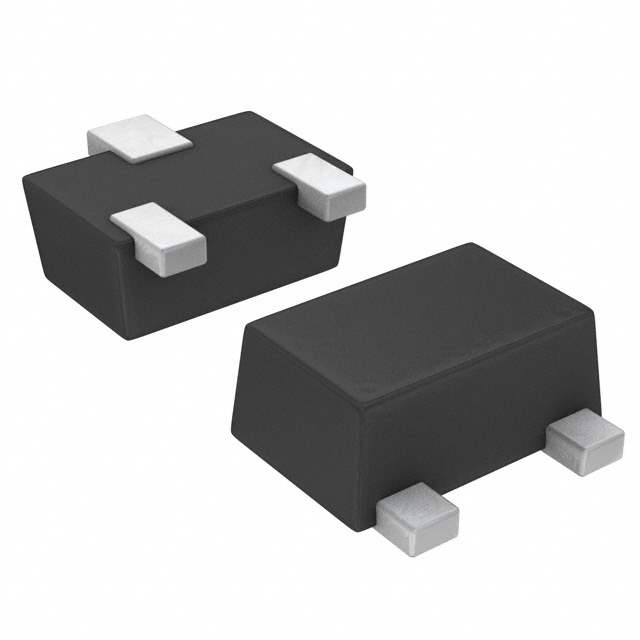
50V VCEO ceiling, 50mA collector ceiling, 150mW dissipation ceiling, VMT3 pre-biased NPN
Quick Engineering Summary
| Field | Value |
|---|---|
| Manufacturer | Rohm Semiconductor |
| Category | Transistors (BJT) - Single, Pre - Biased |
| Package | VMT3 |
| Core function | TRANS PREBIAS NPN 50V VMT3 |
| Key electrical range | Collector Cut-off Current(Max): 500nA; Frequency - Transition: 250MHz; Maximum Current Collector: 50mA; Maximum Power Dissipation: 150mW |
| Reported stock | 1152000 pcs reported — confirm on RFQ |
Can you start a new build on this device?
Can we put this into a new build without creating a sourcing problem later? Yes—if the circuit actually wants a pre-biased NPN rather than a general-purpose small-signal transistor. DTC114EMT2L is Active, the lifecycle signals agree, and the stock figure of 1152000 supports a running line better than a niche clean-up buy. EU RoHS is compliant.
The real catch is functional. This device includes 10k for R1 and 10k for R2, so you are selecting a transistor and bias network together. That helps in dense logic-level gating or pull-down stages, but it rules out designs that need a different base resistor ratio or expect to tune drive current later.
50V is useful, but it doesn’t make this a power switch
50V sets the collector-emitter breakdown ceiling. Current and heat still cap the job at 50mA collector and 150mW dissipation.
The real fit is compact biasing, not load driving
The constraint is dissipation. A 150mW ceiling in VMT3, paired with a 50mA collector ceiling, puts this device in signal-path switching, level translation, and simple interface conditioning where the integrated resistor pair saves parts and routing, not in anything that behaves like a load driver.
The 300mV max VCE(sat) at 500µA and 10mA is the other number that carries weight, because it ties the switching-loss conversation to an actual test point instead of guesswork. If the use case is a lightly loaded logic pull-down around that condition, DTC114EMT2L is an easy fit. If collector current climbs toward the 50mA ceiling, the listing gets much less comforting, because the saturation figure is not given there and the package leaves little room for thermal slop.
The built-in 10k and 10k network narrows the fit in a useful way. It works where predictable default bias matters and two extra placements do not. It does not fit circuits that depend on custom base drive, analog linear operation, or resistor trimming. In practice, that makes DTC114EMT2L a board-level housekeeping part for control signals, and that distinction matters more than the 50V headline because a high-voltage node can still be the wrong place for it once current and power are counted honestly.
The buy call is easy; the review gaps are not
Weak point first: the missing details are the ones that decide edge behavior and layout confidence. There is no pinout here, no package drawing, no thermal resistance, and no switching data beyond a 250MHz transition frequency. For a pre-biased transistor, that leaves too much unsaid about footprint release, heat path, and behavior in a fast digital edge path.
The supply picture is stronger. Reel - TR packaging matches automated assembly, storage guidance is stated, and the quantity on hand is large enough to support a real build plan. Put the datasheet on the critical path for pinout and package drawing before layout release; those are the gaps that can still stall DTC114EMT2L even when availability is fine.
View the Win-Source product page for DTC114EMT2L.
Key Takeaways for Engineers & Buyers
- Keep DTC114EMT2L on low-current bias and switching nodes; 50mA collector is the ceiling.
- Budget voltage drop around the 300mV max VCE(sat) point at 500µA and 10mA.
- Lock reel handling and dry storage controls into the line setup for DTC114EMT2L.