
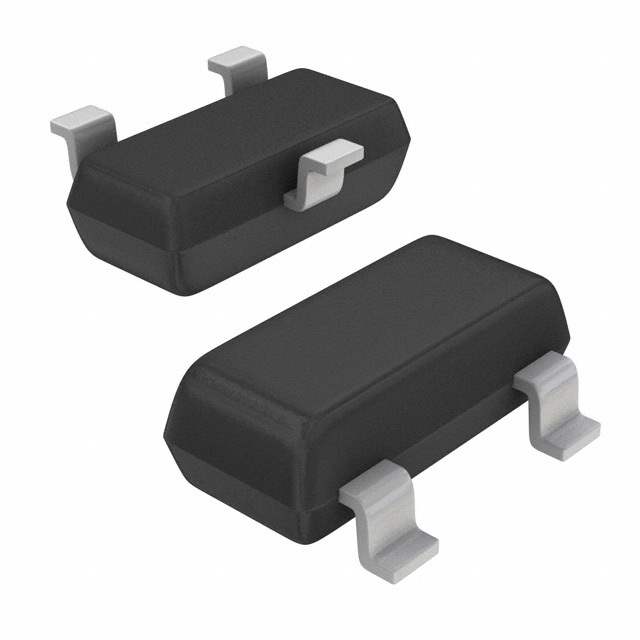
50V VCEO, 100mA collector ceiling, 150mW dissipation, EMT3 package, 10k base resistor
Quick Engineering Summary
| Field | Value |
|---|---|
| Manufacturer | Rohm Semiconductor |
| Category | Transistors (BJT) - Single, Pre - Biased |
| Package | EMT3 |
| Core function | TRANS PREBIAS NPN 50V 0. |
| Key electrical range | Collector Cut-off Current(Max): 500nA (ICBO); Frequency - Transition: 250MHz; Maximum Current Collector: 100mA; Maximum Power Dissipation: 150mW |
| Reported stock | 366000 pcs reported — confirm on RFQ |
Not for power switching; fine for compact logic-side loads
Wrong for power switching. Fine for compact logic-side loads.
The 100mA maximum collector current and 150mW maximum power dissipation are ceilings. Where it fits is small-signal switching with a built-in 10k base resistor in EMT3, and Active lifecycle plus EU RoHS removes a common new-design objection.
The verdict is straightforward
Design it in.
Board area and BOM count are the real reasons to use DTC114TETL, not current handling. The 50V VCEO figure settles the collector-emitter breakdown ceiling for low-voltage rails and moderate control nodes, but it says nothing about transient energy or inductive abuse. The 300mV max VCE(sat) at 1mA, 10mA is useful only at that stated corner. The 500nA ICBO max helps where high-impedance off states matter.
The real constraint is the built-in bias network
The constraint is the bias network.
The built-in resistor is both the appeal and the limit. You get only R1, listed as 10k, with no R2 present, so the device suits simple digital drive paths where dropping an external base resistor and keeping placement tight in EMT3 matter more than flexibility. It is a poor fit when the base network shapes analog behavior, when turn-off shaping matters, or when the upstream logic budget is already marginal and you need exact input current over voltage and temperature rather than a shorthand pre-biased transistor on the schematic.
Thermal headroom is the other hard boundary. A 150mW maximum power dissipation ceiling and 100mA maximum collector current can each look acceptable on their own, yet together they place this transistor on light loads, indicator paths, level shifting, and small enable or mute functions rather than anything that spends time near saturation with meaningful voltage across it. The listed hFE minimum of 100 at 1mA, 5V is too narrow a condition to stretch far beyond low-current operation, which is exactly the point. DTC114TETL is a convenience transistor for controlled conditions, not a general-purpose NPN.
Can you keep a running line on it?
Can you buy it without line-down risk? Yes.
The part is Active, supply and demand is marked sufficient, and stock is listed at 366000 with reel packaging. Keep DTC114TETL on the SMT line as a reel-fed standard part if this exact pre-biased topology is already in the design. The buying constraint is package commitment: EMT3 is small, and this page lists no alternate package path.
What the listing still doesn't answer
150mW is the decisive limit.
What is missing is the detail behind it. There is no pinout or package drawing here, even though EMT3 and SC-75, SOT-416 are named, so footprint confirmation still depends on the datasheet. There is no thermal resistance or derating curve, which leaves the 150mW ceiling without the ambient context needed for real board conditions.
Switching-time data, capacitance data, and input characteristic detail for the pre-bias network beyond the 10k R1 value are also absent. For DTC114TETL, those gaps matter more than another line of description because they set edge speed, drive burden, and the margin left once the board leaves the bench.
View the Win-Source product page for DTC114TETL.
Key Takeaways for Engineers & Buyers
- Keep DTC114TETL on low-power switch nodes; 150mW is the dissipation ceiling.
- Match the drive scheme to the built-in 10k R1 before committing the logic interface.
- Buy on reel for the running line while 366000 pieces are available.