
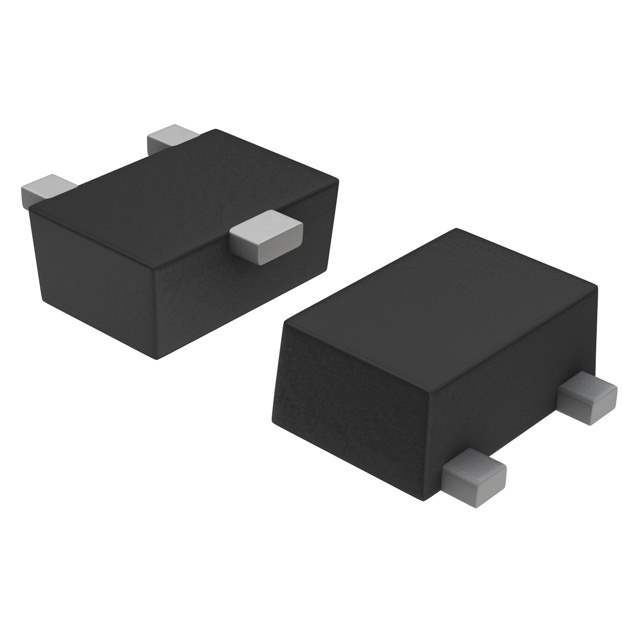
50V VCEO, 100mA collector ceiling, 260mW dissipation limit, SOT-723 package
Quick Engineering Summary
| Field | Value |
|---|---|
| Manufacturer | ON Semiconductor |
| Category | Transistors (BJT) - Single, Pre - Biased |
| Package | SOT-723 |
| Core function | TRANS PREBIAS NPN 50V SOT723 |
| Key electrical range | Collector Cut-off Current(Max): 500nA; Maximum Current Collector: 100mA; Maximum Power Dissipation: 260mW; Supply and Demand Status: Balance |
| Reported stock | 17700 pcs reported — confirm on RFQ |
50V is the reason to consider it
50V is the first number to clear. In a pre-biased NPN this small, the VCEO maximum collector-emitter breakdown voltage decides whether it can sit on the rail you have in mind; it says nothing about surge tolerance, switching speed, or safe transient headroom.
The next ceiling is 100mA maximum collector current. Treat it as a hard limit. Set that beside the 260mW maximum power dissipation and the use case sharpens: DTC114TM3T5G fits low-power biasing and small-signal switching where the integrated 10k base resistor saves parts, not loads that lean on current for long periods.
The package is tiny, and that cuts both ways
The weak point comes first: SOT-723 leaves very little thermal and handling margin. The upside is just as clear when board area is tight and the job is simple on/off drive from a logic source that benefits from a built-in resistor.
It fits dense control boards, sensor front ends, and housekeeping switches where an NPN - Pre-Biased device removes one external resistor and keeps placement compact. The listed 250mV @ 1mA, 10mA Max Vce (sat) is a ceiling, so it bounds conduction loss at that stated test condition, but it does not show how the drop moves across the rest of the current range. The 500nA collector cut-off current maximum is low enough to matter in high-impedance off-state nodes, yet it still does not settle temperature drift because no temperature sweep is shown.
Can you actually keep a line on it?
Can you buy it and keep building? Yes. Active status, Balance supply and demand, and 17700 in stock make DTC114TM3T5G a reasonable choice for current builds.
The catch is packaging: it is listed as Reel - TR, so plan around reel consumption and feeder compatibility.
What the listing still doesn't tell you
Wrong fit first: this is not enough to lock a footprint or sign off dynamic behavior. It is enough to place DTC114TM3T5G on a schematic as a pre-biased NPN, but the missing details are the ones that decide whether it behaves cleanly on the board and whether the tiny package stays comfortable once ambient rises.
The first gap is the resistor network detail. The listing gives only R1 at 10k and explicitly shows only R1, with no R2 value. For a digital transistor, that changes input bias behavior and turn-off assumptions immediately.
The second gap is package drawing and pinout. SOT-723 is named, but the mechanical drawing and lead assignment are not here, so layout cannot be closed from this page.
The third gap is thermal detail. You have a 260mW maximum power dissipation ceiling, but no thermal resistance or derating curve to connect that ceiling to ambient conditions. The fourth is switching behavior: no transition frequency, no capacitance, and no time-domain switching data are listed. If DTC114TM3T5G is only gating a slow control node, that may be fine. If edge shape or storage time matters, this page stops where the real decision starts.
View the Win-Source product page for DTC114TM3T5G.
Key Takeaways for Engineers & Buyers
- Keep collector stress below the 50V VCEO ceiling; that number closes rail compatibility, not transient behavior.
- Budget heat against the 260mW maximum and the 250mV @ 1mA, 10mA saturation limit before committing SOT-723.
- Buy on reel and align feeder setup now; DTC114TM3T5G is listed only as Reel - TR.