
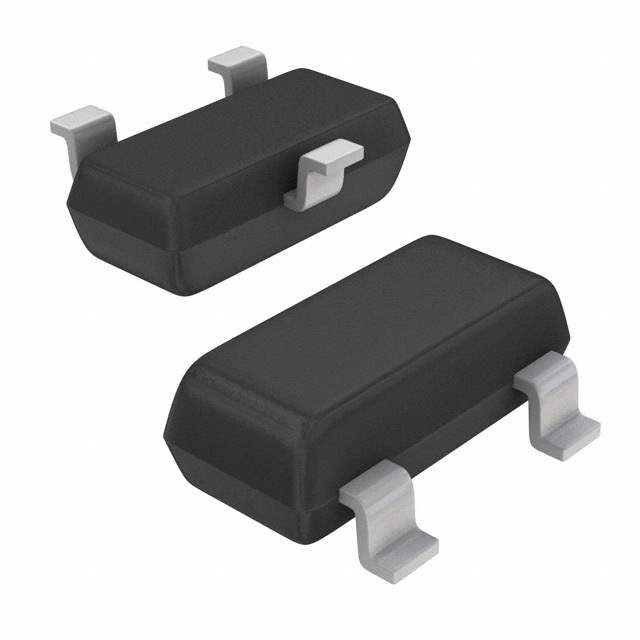
50V VCEO, 70mA collector, 150mW ceiling in EMT3 with built-in 10k and 47k bias resistors
Quick Engineering Summary
| Field | Value |
|---|---|
| Manufacturer | Rohm Semiconductor |
| Category | Transistors (BJT) - Single, Pre - Biased |
| Package | EMT3 |
| Core function | TRANS PREBIAS NPN 50V EMT3 |
| Key electrical range | Collector Cut-off Current(Max): 500nA; Frequency - Transition: 250MHz; Maximum Current Collector: 70mA; Maximum Power Dissipation: 150mW |
| Reported stock | 2220 pcs reported — confirm on RFQ |
The real limit is power, not the 50V headline
The constraint is thermal headroom. At 150mW, this part runs out of room before the 50V VCEO headline matters in many small-signal switch positions, especially when a pre-biased NPN in EMT3 is held on or asked to dissipate continuously.
The other hard ceiling is 70mA collector current. That rules out use as a general-purpose load switch and shuts the door on relay coils, lamps, and any load with startup current you have not bounded, while the listed 300mV max VCE(sat) at 250µA, 5mA only speaks to that specific light-load test point rather than saturation loss near the 70mA ceiling.
The bias network is fixed, and that's both the appeal and the trap
The weak point comes first: you don't get to choose the input resistor values. DTC114YETL has 10k for R1 and 47k for R2 built in, so the base-drive behavior is set before layout starts. If the control node, pull-up scheme, or leakage budget wants different values, this is the wrong shortcut.
That same fixed network is the appeal. The 500nA collector cut-off current max helps keep an off-state node quiet, and the minimum hFE of 68 at 5mA, 5V is a grounded spec, not an optimistic one. DTC114YETL fits level shifting, simple inverters, and MCU-driven enables where cutting external resistor count matters more than extracting every bit of drive current.
2220 on hand answers the immediate buy question
2220 pieces on hand makes the immediate supply call easy. Reel packaging, Active lifecycle, and EU RoHS keep DTC114YETL straightforward for a running line or a fresh build.
What the listing still doesn't tell you
What do you still need before committing it to a faster or warmer design? The missing items are the ones that decide edge speed, heat, and footprint confidence.
DTC114YETL is listed with 250MHz transition frequency, but there is no pinout, no package drawing, and no thermal resistance or derating curve to connect the 150mW ceiling to ambient reality. If this transistor will switch anything faster than a slow logic node, the omissions get more serious: there is no junction capacitance, no switching-time data, and no pulse-current or surge figure. Those gaps separate a safe resistor-saving switch from one that surprises you on the bench.
View the Win-Source product page for DTC114YETL.
Key Takeaways for Engineers & Buyers
- Keep DTC114YETL out of loads that can force more than 70mA collector current.
- Treat 150mW as the thermal ceiling; the listing gives no derating curve or thermal resistance.
- Use the built-in 10k R1 and 47k R2 only where that bias network matches the drive scheme.