
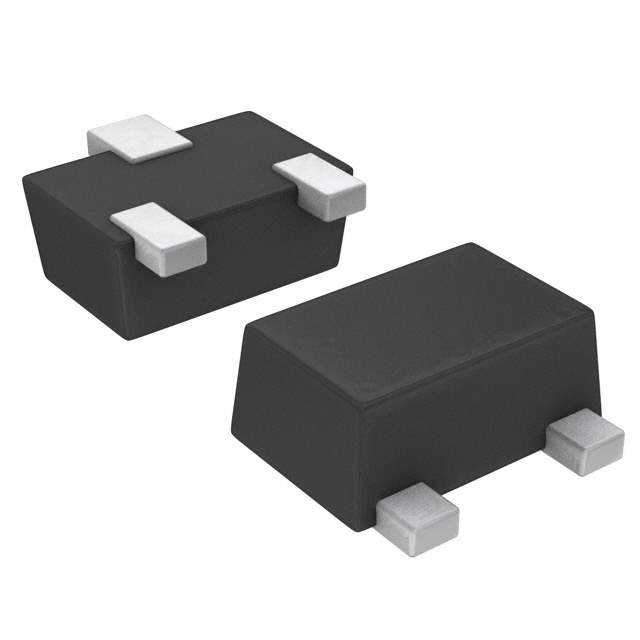
50V VCEO, 70mA collector ceiling, 150mW dissipation, VMT3 package, built-in 10k and 47k resistors
Quick Engineering Summary
| Field | Value |
|---|---|
| Manufacturer | Rohm Semiconductor |
| Category | Transistors (BJT) - Single, Pre - Biased |
| Package | VMT3 |
| Core function | TRANS PREBIAS NPN 50V VMT3 |
| Key electrical range | Collector Cut-off Current(Max): 500nA; Frequency - Transition: 250MHz; Maximum Current Collector: 70mA; Maximum Power Dissipation: 150mW |
| Reported stock | 480000 pcs reported — confirm on RFQ |
The weak point is power, not lifecycle
Power is the limit. Lifecycle is clean: Active, low risk, and EU RoHS compliant.
That keeps it viable for new design-in when a small-signal switching role and the built-in bias network are the point of using it.
150mW is the ceiling that really decides fit
The numbers create a thermal constraint first. A 70mA maximum collector current looks comfortable until it sits beside 150mW maximum power dissipation and 300mV max VCE(sat) at 250µA, 5mA, and then the part reads like what it is: a light-load switching and logic-interface device, not something the current rating alone can justify.
The 50V VCEO figure is a ceiling too, so it answers one rail question cleanly: whether the collector-emitter voltage can live there at all. It says nothing about transient tolerance, avalanche behavior, or how much ambient headroom VMT3 leaves you. The 500nA maximum collector cut-off current is also useful, especially on high-impedance nodes where off-state leakage matters more than raw current handling.
So the real attraction is the resistor network
And that is the real draw. The built-in 10k base resistor and 47k emitter-base resistor save two external parts when the default bias values already suit the circuit, which is exactly the case where a pre-biased NPN earns board space.
VMT3, SMD, and reel packaging all point the same way. This is a compact board-level transistor for dense digital or mixed-signal housekeeping, pull-down, level-interface, and simple load-switch roles. It is a poor fit when base-drive tailoring is part of the design, because R1 and R2 are fixed at 10k and 47k. The listed 250MHz transition frequency is real, but in most uses for a pre-biased transistor, the resistor network and the 150mW ceiling will settle the decision long before ft does.
Can you keep a running line on it?
Can production keep buying it? Yes, if you buy it the way it ships. DTC114YMT2L is listed on reel - TR with 480000 in stock quantity and balance in supply and demand, which fits continuous SMT consumption better than ad hoc bench builds.
If your line already takes VMT3 and reel input, the commercial risk looks low. If it does not, package handling matters more than lifecycle status, because nothing here points to a status problem.
What the listing still does not tell you
Some gaps remain.
The first one is practical: the listing gives VMT3 and maps it to SOT-723, but it does not show the pinout or package drawing here. For a pre-biased transistor, that matters immediately because the internal resistor topology has to land on the pads you expect, or the part is useless no matter how well the headline ratings fit.
The thermal picture is still incomplete too. You get 150mW maximum power dissipation, but not RθJC or a derating curve, so ambient headroom in a crowded layout is still unresolved. That missing detail matters more than the bare dissipation number once copper area, neighboring heat sources, and enclosure temperature start pushing the package.
Switching detail is also thin. There is no junction capacitance and no switching-time data, which matters more than the 250MHz transition figure when the node is edge-sensitive or timing-cleanup work is involved. ECAD models are not included either; they are only available by request, so symbol and land-pattern flow are not closed from this page alone.
View the Win-Source product page for DTC114YMT2L.
Key Takeaways for Engineers & Buyers
- Keep collector stress below the 50V VCEO ceiling; that number closes rail fit, not switching behavior.
- Treat 150mW as the thermal budget for DTC114YMT2L in VMT3 before using the full 70mA collector limit.
- Match the drive network to the built-in 10k R1 and 47k R2, or pick a different bias topology.