
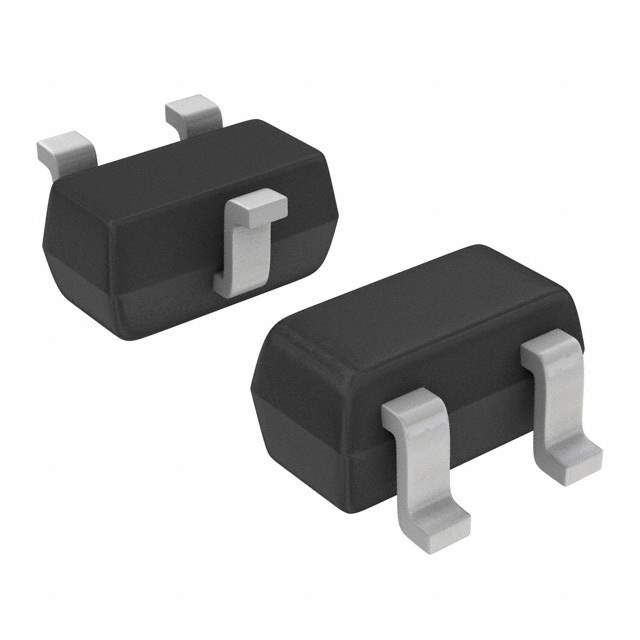
50V VCEO, 100mA collector ceiling, 200mW dissipation limit in SC-75/SOT-416 pre-biased NPN
Quick Engineering Summary
| Field | Value |
|---|---|
| Manufacturer | ON Semiconductor |
| Category | Transistors (BJT) - Single, Pre - Biased |
| Package | SC-75, SOT-416 |
| Core function | TRANS PREBIAS NPN 50V 0. |
| Key electrical range | Collector Cut-off Current(Max): 500nA; Maximum Current Collector: 100mA; Maximum Power Dissipation: 200mW; Supply and Demand Status: Limited |
| Reported stock | 41000 pcs reported — confirm on RFQ |
The weak point is power, not lifecycle
The 200mW limit is the catch. Still, DTC115EET1G is Active, low lifecycle risk, and EU RoHS compliant, so it remains a sound new design-in choice for a small pre-biased NPN in SC-75, SOT-416.
That power ceiling narrows the real use cases fast
And it also means the 100mA maximum collector current is not a license to use DTC115EET1G like a general small-signal switch with much thermal margin. The 100mA figure is a ceiling, and the 200mW figure is another ceiling; together they place the part in light-load biasing, level shifting, and simple on-off control where the integrated resistor network cuts parts count, not in jobs that lean on collector current for long stretches.
The 50V VCEO ceiling settles one question cleanly: rail voltage margin can be reasonable on higher-voltage logic or control nodes, but that alone does not settle dissipation or saturation behavior. The listed 250mV max VCE(sat) at 300μA, 10mA is useful only at that test point. It shows a neat pull-down in a modest-current condition, not behavior across the rest of the load range.
100k and 100k make the interface decision for you
100k on R1 and 100k on R2 set the terms. DTC115EET1G is not a blank NPN; it is an NPN - Pre-Biased device, and the built-in resistor pair is part of the function, not a footnote.
That matters more than the hFE line in many designs. The listed gain is 80 @ 5mA, 10V, a characterized point rather than a promise across every operating corner. If the circuit needs freedom to choose base resistance, trim turn-on current, or shape edge behavior with external parts, DTC115EET1G is the wrong starting point. If the goal is to collapse a resistor-transistor network into one SC-75, SOT-416 footprint, it's right in its lane.
50V is enough rail headroom, but the datasheet gaps are real
50V is the decisive ceiling for voltage fit, and it keeps DTC115EET1G in play on control rails that would rule out lower-voltage digital transistors.
Some review-critical items are still missing. There is no pinout here, no package drawing, and no thermal resistance figure. Those omissions are practical, not cosmetic: pin assignment decides whether the footprint drops in cleanly, the drawing sets courtyard and assembly detail, and thermal resistance is what turns the 200mW ceiling into an ambient decision. There is also no switching-time data, so this listing does not answer edge-speed or storage-behavior questions.
Can you keep a running line on DTC115EET1G?
Can you actually keep it flowing in production? Right now, 41000 in stock says you can probably cover real demand, and DTC115EET1G is stocked in Reel - TR, which fits automated assembly. Active status with no internal conflict also matters. This is not a sustaining-only buy.
The constraint is straightforward: supply and demand is marked Limited. That does not overturn the Active verdict, but it does change the buying posture, especially if the line depends on the integrated 100k/100k network and the SC-75, SOT-416 footprint rather than a more generic transistor option.
For a production BOM, buy against the reel demand you actually expect instead of assuming the next pull will be as easy as this one, because current availability and replenishment ease are not the same thing even when stock is healthy. For prototype and pilot runs, the appeal is simpler: fewer external parts, easier placement, and a package format that already suits automated assembly.
View the Win-Source product page for DTC115EET1G.
Key Takeaways for Engineers & Buyers
- Keep DTC115EET1G on low-power bias and switching nodes; 200mW is the dissipation ceiling.
- Match the drive scheme to the built-in 100k R1 and 100k R2 before freezing the logic interface.
- Place reel demand early if the line depends on DTC115EET1G; stock shows 41000 but supply is marked Limited.