
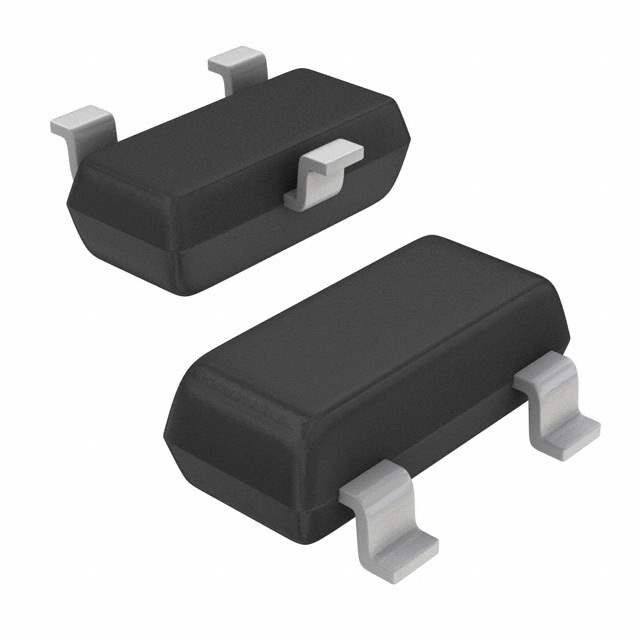
50V VCEO ceiling, 20mA collector limit, 150mW ceiling, EMT3 with 100k/100k bias resistors
Quick Engineering Summary
| Field | Value |
|---|---|
| Manufacturer | Rohm Semiconductor |
| Category | Transistors (BJT) - Single, Pre - Biased |
| Package | EMT3 |
| Core function | TRANS PREBIAS NPN 50V EMT3 |
| Key electrical range | Collector Cut-off Current(Max): 500nA; Frequency - Transition: 250MHz; Maximum Current Collector: 20mA; Maximum Power Dissipation: 150mW |
| Reported stock | 278300 pcs reported — confirm on RFQ |
Good for new builds, within a narrow load envelope
It fits.
DTC115EETL is Active and EU RoHS compliant, so there is no lifecycle issue blocking a new design. The appeal is straightforward: a pre-biased NPN in EMT3 with a fixed 100k/100k resistor network already inside.
That integration also sets the limits. It works for small-signal level shifting, logic gating, and simple on-off control when those resistor values already suit the node, but it stops being a clean fit when base drive needs tuning, collector current needs headroom beyond the 20mA ceiling, or dissipation margin is tight enough that the 150mW ceiling becomes the first constraint.
50V is the rail ceiling, not the design solved
50V is the first gate. It is the VCEO maximum collector-emitter breakdown voltage, so it sets the rail ceiling and nothing more.
The other hard limits are 20mA maximum collector current and 150mW maximum power dissipation. That puts this part firmly in control duty, not load driving. The listed 300mV max VCE(sat) at 250μA and 5mA is useful because it ties saturation to a stated test point, but it does not show what the drop looks like near the 20mA ceiling, where thermal margin can tighten before current does.
And the package keeps it in board-level control work
And that package choice keeps the use case narrow. EMT3 with SMD mounting suits dense board logic, not field wiring or anything that wants mechanical slack. Reel - TR packaging fits a running SMT line, and listed stock is 278300.
The fixed resistor pair is either the win or the trap
The weak point comes first: you don't get to choose the bias network.
That is also the advantage. DTC115EETL builds in 100k for R1 and 100k for R2, which cuts BOM count and placement work when those values already match the control node. If the input source, leakage budget, or switching threshold wants a different divider, the fit falls apart fast.
The gain figure needs the same kind of reading. The listing gives hFE minimum 82 at 5mA and 5V, plus collector cut-off current max 500nA. That supports low leakage and plausible small-signal switching, but it does not predict behavior across the full rail and current range because there are no curves here. This is a compact, predefined interface element, not a general-purpose BJT with room for bias optimization.
What the listing still doesn't answer
The constraint is missing thermal and dynamic detail.
For DTC115EETL, the absent items that would close the review are pinout, package drawing, thermal resistance, and any switching-time or capacitance data. Those are not minor omissions when the part is already bounded by a 50V VCEO ceiling, a 20mA collector-current ceiling, and a 150mW dissipation ceiling.
Pinout and package drawing decide whether the EMT3 footprint drops onto an existing board spin without rework. Thermal resistance decides how much ambient headroom remains before the 150mW ceiling turns from a paper limit into a field problem. Switching-time or capacitance data decides whether the 250MHz transition figure helps at all in an edge-rate budget, because frequency by itself does not describe how this pre-biased device behaves in a real switching node.
Those missing details matter most near the edges of the stated limits, where package heat flow, node capacitance, and actual switching behavior determine whether the part stays comfortably inside its envelope or just barely clears it.
View the Win-Source product page for DTC115EETL.
Key Takeaways for Engineers & Buyers
- Keep collector current below the 20mA ceiling; that limit closes off relay or lamp loads.
- Check the drive math against the built-in 100k R1 and 100k R2 before committing DTC115EETL.
- Buy on reel if the line is live; stock is 278300 and packaging is TR.