
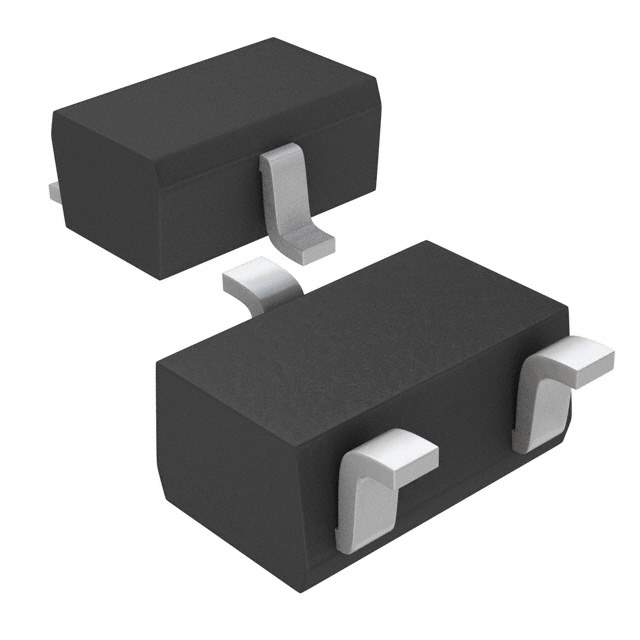
50 V, 100 mA, 200 mW in UMT3: a pre-biased NPN for light switching, not power stages
Quick Engineering Summary
| Field | Value |
|---|---|
| Manufacturer | Rohm Semiconductor |
| Category | RF Transistors (BJT) |
| Package | Tape & Reel |
| Core function | TRANS PREBIAS NPN 50V 0. |
| Key electrical range | Current - Collector (Ic) (Max): 100 mA; DC Current Gain (hFE) (Min) @ Ic, Vce: 82 @ 5mA, 5V; Frequency - Transition: 250 MHz; Power - Max: 200 mW |
| Reported stock | 54000 pcs reported — confirm on RFQ |
The weak point is power, not availability
Power is the limit here. DTC115EU3T106 is Active, stocked at 54000, and shipped in Tape & Reel with MSL 1 (Unlimited), so availability is the easy part.
Wrong for load drive, right for small-signal switching
Don’t use it in a power path. The 100 mA collector current and 200 mW power figures are ceilings, not a promise that DTC115EU3T106 can sit continuously in a hot corner without thermal consequences.
It fits the usual pre-biased BJT jobs instead: logic-level switching, pull-down or pull-up stages, and compact bias-controlled functions where the built-in 100 kOhms base resistor and 100 kOhms emitter-base resistor remove two externals. The 50 V collector-emitter breakdown ceiling leaves margin on higher-voltage control nodes, but thermal limits still decide the usable operating point. The listed 300mV at 250µA, 5mA is a saturation ceiling at that test point, useful for judging low-current switching loss and logic-low headroom, not for stretching assumptions up to the 100 mA current ceiling.
Buy it for a running line
Supply looks workable.
Packaging discipline matters more than lifecycle risk. DTC115EU3T106 comes in Tape & Reel with a standard package of 3,000, and the listed stock quantity is 54000, so it drops neatly into automated assembly and makes far less sense for a tiny bench build. Keep the reel format in mind when you release the BOM; the package choice already tells you this part is aimed at SMT production, not hand-loaded service stock.
What the listing still doesn't answer
And that leaves the real open items. The package is SC-70, SOT-323 / UMT3, but there is no pinout or drawing here, so footprint orientation still depends on the datasheet. Thermal resistance and any derating curve are also missing, and those are the details that determine how much of the 200 mW ceiling survives in actual ambient conditions.
Two more omissions matter when switching speed or edge shape drove the selection. The listing gives 250 MHz transition frequency, but no capacitance data and no switching-time data, so charge storage and node loading remain unresolved from this page alone. There is also no collector cutoff current figure, which leaves leakage-sensitive bias networks unanswered.
View the Win-Source product page for DTC115EU3T106.
Key Takeaways for Engineers & Buyers
- Keep DTC115EU3T106 on low-dissipation nodes; 200 mW is the package ceiling.
- Use the built-in 100 kOhms / 100 kOhms bias network only where that divider matches the drive scheme.
- Buy in reel multiples of 3,000 if DTC115EU3T106 is going onto a running SMT line.