
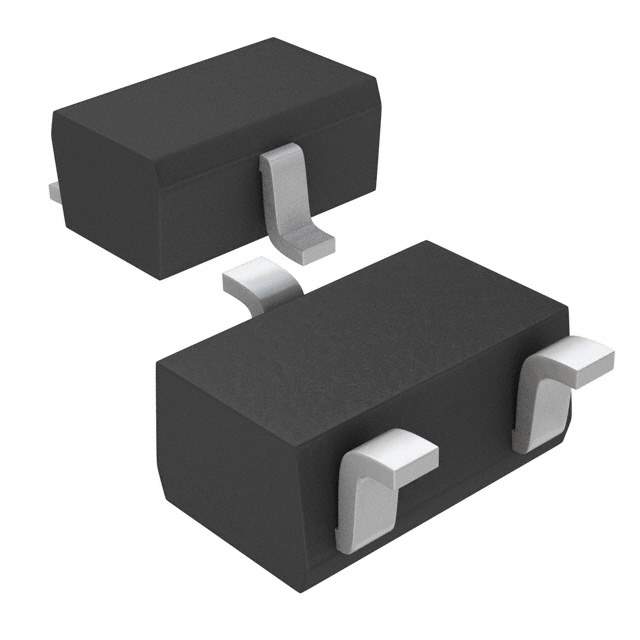
50 V, 100 mA, 200 mW in UMT3/SC-70; the lifecycle conflict matters more than the gain figure.
Quick Engineering Summary
| Field | Value |
|---|---|
| Manufacturer | Rohm Semiconductor |
| Category | RF Transistors (BJT) |
| Package | Tape & Reel |
| Core function | TRANS PREBIAS NPN 50V 0. |
| Key electrical range | Current - Collector (Ic) (Max): 100 mA; Current - Collector Cutoff (Max): 500nA (ICBO); DC Current Gain (hFE) (Min) @ Ic, Vce: 82 @ 5mA, 5V; Frequency - Transition: 250 MHz |
| Reported stock | 3300 pcs reported — confirm on RFQ |
The real limit is lifecycle, not silicon
The constraint is lifecycle, not silicon. DTC115GUAT106 carries a direct conflict: one field says Active, while another says not suitable for new design. That settles the design-in question even though the transistor itself remains a live product number.
Treat it as sustaining only. If DTC115GUAT106 is already on a board, it is a reasonable line item to keep buying while you manage the build. For a fresh schematic, don’t let the Active flag outweigh the explicit no-new-design signal. EU RoHS is fine, and MSL 1 (Unlimited) removes one handling concern, but neither changes the lifecycle ambiguity.
50 V and 200 mW set the safe envelope
50 V is the ceiling that frames the rest. It places DTC115GUAT106 on low-power control nodes where collector-emitter stress stays comfortably below breakdown, but it says nothing about switching behavior, surge tolerance, or how much ambient margin the package really leaves you.
The other hard stop is 200 mW. In a UMT3 / SC-70, SOT-323 body, that limit arrives fast. Add the 100 mA collector maximum and the message is clear: this part belongs in small-signal biasing and level control, not in jobs that ask the package to carry heat for long. Tiny transistor, tiny budget.
Can you keep a running line on DTC115GUAT106?
Can you buy it in a way that fits production? Yes, if reel flow is what you need. DTC115GUAT106 comes in Tape & Reel, the standard package is 3,000, and listed stock is 3300, so the commercial setup lines up better with a controlled build than with scattered bench or service demand.
The electrical picture points the same way. This is an NPN pre-biased transistor with only R2 listed, at 100 kOhms, so it is not a generic small-signal BJT drop-in where you choose the bias network yourself. The minimum hFE is 82 @ 5mA, 5V, and Vce saturation is 300mV @ 250µA, 5mA. Those figures are enough to place DTC115GUAT106 in light switching and interface duty around a few-milliamp operating point, but they do not answer behavior away from that test condition.
Leakage stays in check. The 500nA ICBO maximum is low enough that leakage will not dominate many logic-adjacent uses, and the 250 MHz transition frequency says the transistor itself is not unusually slow. Still, the listing does not make it an RF gain device just because the category says RF Transistors (BJT). In practice, DTC115GUAT106 fits compact control paths, pull-down or inverter stages, and housekeeping functions where the built-in bias element is intentional and the current stays modest.
What the listing still doesn’t answer
Wrong for a final release decision: the missing details are concrete. DTC115GUAT106 lacks the base resistor R1 value, pinout, package drawing, and thermal resistance, and those are the items that close footprint and thermal questions around the 200 mW ceiling.
View the Win-Source product page for DTC115GUAT106.
Key Takeaways for Engineers & Buyers
- Hold DTC115GUAT106 to rails that stay inside the 50 V collector-emitter breakdown ceiling.
- Keep collector load inside the 100 mA limit and the 200 mW package ceiling at the same time.
- Buy in reel-oriented quantities; stock is 3300 and the standard package is 3,000.