
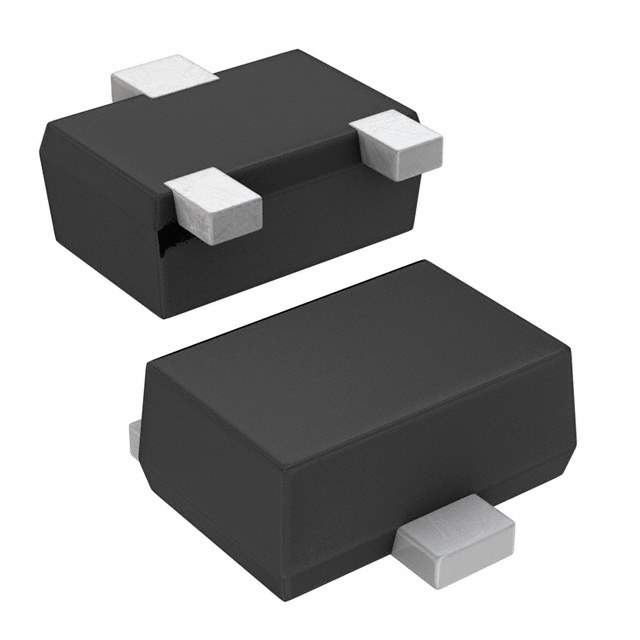
50 V, 100 mA, 150 mW in EMT3F (SOT-416FL); the built-in 2.2 kOhms and 2.2 kOhms decide the fit.
Quick Engineering Summary
| Field | Value |
|---|---|
| Manufacturer | Rohm Semiconductor |
| Category | RF Transistors (BJT) |
| Package | Tape & Reel |
| Core function | TRANS PREBIAS PNP 50V 0. |
| Key electrical range | Current - Collector (Ic) (Max): 100 mA; Current - Collector Cutoff (Max): 500nA; DC Current Gain (hFE) (Min) @ Ic, Vce: 20 @ 20mA, 5V; Frequency - Transition: 250 MHz |
| Reported stock | 1 pcs reported — confirm on RFQ |
The lifecycle call is the real constraint
The constraint is lifecycle, not voltage. Active appears twice, but Product Status says Not For New Designs, so the safe call is sustaining use only. EU RoHS is compliant, and that does not change the NRND read.
Those ceilings point to small-signal duty only
And the electrical limits support that call. The 50 V collector-emitter breakdown is a ceiling on rail exposure, not a casual operating point, and the 100 mA collector current is a ceiling too. With 150 mW maximum power in EMT3F (SOT-416FL), this is a small-signal transistor, not a load driver.
One number helps more than the rest for switching use: 300mV at 500µA and 10mA. That gives a defined low-current saturation point. Beyond that point, this listing stops short of answering the dissipation question.
Wrong for adjustable bias, right for fixed logic interfacing
Not for circuits that need resistor choice freedom. The built-in network is the whole proposition: R1 is 2.2 kOhms and R2 is 2.2 kOhms, so DTC123EEBTL fits where that ratio already matches the schematic and where removing two external resistors matters more than tuning base drive.
It suits compact SMT control and interface stages better than power-facing work. The EMT3F (SOT-416FL) body and SC-89, SOT-490 case point to dense board layouts, and the listed 20 minimum hFE at 20mA, 5V keeps it in low-current switching territory. Use it when the pre-biased topology is the reason, not when you just need any NPN.
Supply is thin, and the missing details still matter
The weak point is availability. Stock is 1, while standard package is 3,000 and the package format is Tape & Reel, so DTC123EEBTL does not belong in a live build unless line coverage is already in hand. If the part is qualified on an existing board, keep it there and avoid extending it to new assemblies.
The stronger point is that the listing still says enough to classify the role. It does not say enough to close a serious transistor review, though, because pinout is missing, the package drawing is missing, and no thermal resistance figure is given. That leaves board orientation and heat escape unresolved.
Reverse-recovery time is absent, junction capacitance is absent, and for a part filed under RF Transistors (BJT), that gap matters more than the 250 MHz transition frequency headline because switching edge behavior and node loading decide whether DTC123EEBTL behaves cleanly in the actual circuit.
View the Win-Source product page for DTC123EEBTL.
Key Takeaways for Engineers & Buyers
- Treat 50 V VCEO and 100 mA Ic as ceilings; keep DTC123EEBTL out of higher-stress rails.
- Check that the fixed 2.2 kOhms R1 and 2.2 kOhms R2 match the drive network before freezing the BOM.
- Cover the line risk now: stock shows 1 while DTC123EEBTL carries a Not For New Designs signal.