
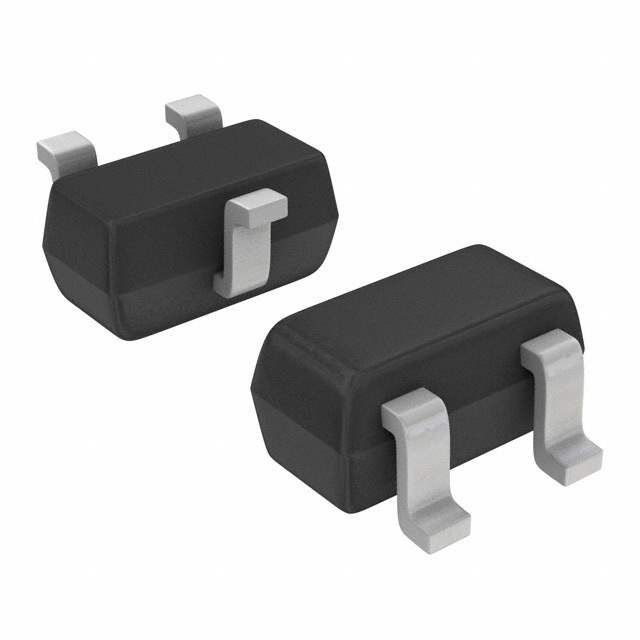
50V VCEO ceiling, 100mA collector ceiling, 200mW limit, SC-75/SOT-416, EOL status
Quick Engineering Summary
| Field | Value |
|---|---|
| Manufacturer | ON Semiconductor |
| Category | Transistors (BJT) - Single, Pre - Biased |
| Package | SC-75, SOT-416 |
| Core function | TRANS PREBIAS NPN 50V 0. |
| Key electrical range | Collector Cut-off Current(Max): 500nA; Maximum Current Collector: 100mA; Maximum Power Dissipation: 200mW; Supply and Demand Status: Balance |
| Reported stock | 15620 pcs reported — confirm on RFQ |
EOL is the real constraint here
The constraint is lifecycle, not silicon. DTC123EET1 is marked EOL and Obsolete(EOL), so the call for new work is already made: don't start a design with it, even with 15620 pieces listed and a practical SC-75, SOT-416 footprint still available.
For an existing production build, the picture changes. That listed quantity can cover a running line or a service build, but only when the internal resistor network already fits the logic-drive assumptions in the design. RoHS is still unsettled: one field says RoHS Compliant and another says RoHS Non-Compliant, so EU RoHS has to be resolved before any regulated shipment moves.
The electrical limits are small and very specific
This is a sustaining part.
The 50V VCEO is a ceiling on collector-emitter stress, not a suggested rail. It places DTC123EET1 in low-power switching and interface work where transients stay inside that limit, and it says nothing about switching speed or avalanche behavior because neither is listed.
The 100mA maximum collector current is another ceiling. The 200mW maximum power dissipation is likely to bite first in a tiny SC-75, SOT-416 body. With the listed 250mV max VCE(sat) at 5mA, 10mA, you get a snapshot of conduction loss at that test point, but not across the load range that actually determines thermal headroom on a board. The 500nA collector cut-off current helps in leakage-sensitive bias networks when an off-state node must stay quiet, but it does not change the current or thermal limits.
The built-in 2.2k and 2.2k resistors decide the fit
The weak point is flexibility. The strong point is integration: DTC123EET1 is an NPN pre-biased transistor with R1 at 2.2k and R2 at 2.2k, so it suits boards where saving external resistor placements matters more than tuning the base network.
It fits compact digital drive, level-shaping, and simple load switching when those resistor values are already acceptable and the gain floor of 8 at 5mA, 10V is enough for the intended collector current. It is the wrong device when the base resistor ratio is part of the design knob, when collector current has to run near the 100mA ceiling, or when thermal margin is tight enough that a 200mW limit in this package becomes the first failure mode instead of the last check.
What the listing still doesn’t answer
And those gaps matter more than the headline limits. DTC123EET1 is easy to place in concept, but the listing does not give a pinout, package drawing, or thermal resistance, so footprint confirmation and ambient headroom remain open.
It also leaves out switching behavior. There is no transition frequency value in the populated specs, no capacitance, and no time-domain switching data, so you cannot judge edge-rate impact, storage effects, or whether this pre-biased transistor will stay clean in a faster control path instead of a slow on-off node.
The ECAD line is only "Contact us to download," which is not the same as having the model in hand. For a sustaining buy, pull the manufacturer datasheet and package data before committing remaining stock to a board spin, because those missing details—not the 50V VCEO ceiling or the 100mA collector ceiling—decide whether DTC123EET1 drops in cleanly or creates rework.
View the Win-Source product page for DTC123EET1.
Key Takeaways for Engineers & Buyers
- Block new BOM releases on DTC123EET1; EOL status rules it out for fresh design-in.
- Check rail and load against the 50V VCEO and 100mA collector ceilings before using remaining stock.
- Confirm the RoHS record for DTC123EET1; compliance fields conflict even though stock shows 15620.