
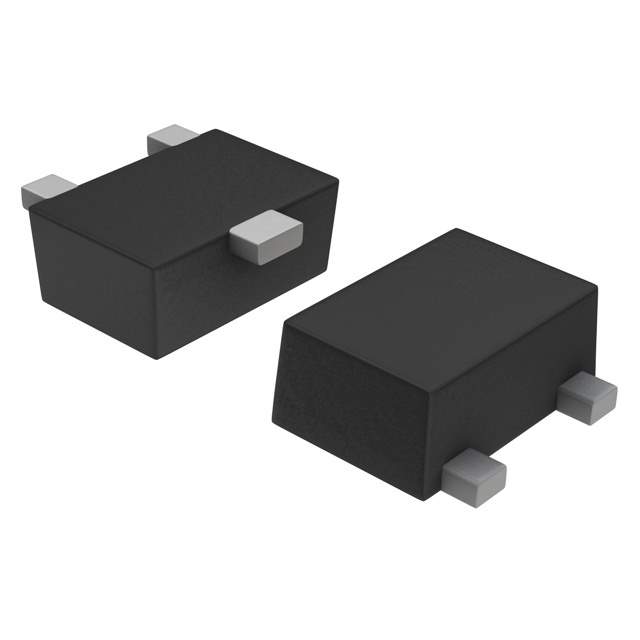
50 V, 100 mA, 260 mW in SOT-723; package and resistor network set where this pre-biased NPN fits.
Quick Engineering Summary
| Field | Value |
|---|---|
| Manufacturer | ON Semiconductor |
| Category | Transistors (BJT) - Single, Pre - Biased |
| Package | SOT-723 |
| Core function | TRANS PREBIAS NPN 50V SOT723 |
| Key electrical range | Supply and Demand Status: Limited |
| Reported stock | 3000 pcs reported — confirm on RFQ |
Tiny package first, then the case for using it
The weak point comes first: SOT-723 and a 260 mW maximum. That keeps DTC123EM3T5G in small-signal work, but the part is Active, surface mount, MSL 1 (Unlimited), and EU RoHS compliant, so there is no lifecycle or handling conflict blocking a new design.
The 100 mA rating does not make it a 100 mA workhorse
100 mA is the collector-current ceiling. By itself, that number says less than it seems to, because the same listing pairs it with 260 mW maximum power in a SOT-723 body, and together those limits frame DTC123EM3T5G as a constrained switch path rather than a casual load driver.
The 50 V collector-emitter breakdown ceiling is the next number that matters. It keeps the part in low-voltage control and interface jobs where rail excursions stay below that limit, but it does not answer switching speed, surge tolerance, or transient margin. Get that wrong and the failure mode is simple: breakdown.
The built-in resistor network is the real convenience feature. R1 is 2.2 kOhms and R2 is 2.2 kOhms, so DTC123EM3T5G fits places where a pre-biased NPN saves placement and fixes the bias network by part choice instead of two external resistors. It also rules the part out when the base network needs tuning, because those resistor values are already set.
Two smaller numbers still help. hFE is listed as 8 minimum at 5mA, 10V, and Vce saturation is 250mV maximum at 5mA, 10mA. Those conditions are narrow, but they at least point to modest current levels, not operation near the 100 mA ceiling.
260 mW is what keeps this in logic-side switching
260 mW is the decisive limit. It keeps DTC123EM3T5G in housekeeping roles such as pull-downs, level-interrupt style switching, and compact bias-controlled enables where the pre-biased NPN saves parts count and board area.
The boundaries are just as clear. If your design needs pinout, thermal resistance, or frequency or transition data before release, this listing does not provide enough to close that call. Those missing items decide footprint confidence, heat headroom, and whether the transistor behaves well enough at the edge rates your circuit uses.
Buy it like a reel-fed line item
Buy for planned builds.
Availability is the real constraint, not lifecycle. Stock is 3000, supply and demand is marked Limited, and the standard package is Reel - TR with 8000 per package. That makes DTC123EM3T5G a part to schedule into reel-fed assembly instead of leaving for late spot buys, especially with a 60 pct. fake threat in the open market in the background.
View the Win-Source product page for DTC123EM3T5G.
Key Takeaways for Engineers & Buyers
- Keep DTC123EM3T5G on reel builds; package is TR with 8000 per package.
- Start with the 260 mW ceiling; SOT-723 leaves little thermal slack.
- Lock supply early if DTC123EM3T5G is on a running line; stock is 3000 and demand is Limited.