
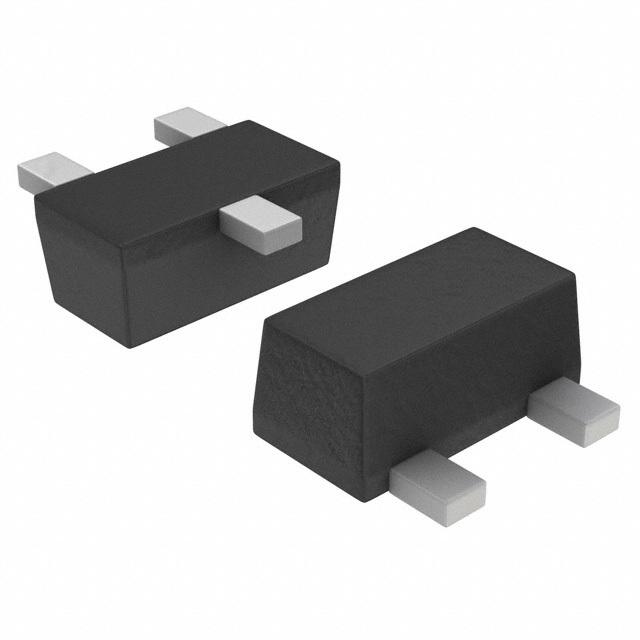
50V VCEO, 100mA collector ceiling, 150mW dissipation ceiling, EMT3F (SOT-416FL) package
Quick Engineering Summary
| Field | Value |
|---|---|
| Manufacturer | Rohm Semiconductor |
| Category | Transistors (BJT) - Single, Pre - Biased |
| Package | EMT3F (SOT-416FL) |
| Core function | TRANS PREBIAS NPN 50V 0. |
| Key electrical range | Collector Cut-off Current(Max): 500nA; Frequency - Transition: 250MHz; Maximum Current Collector: 100mA; Maximum Power Dissipation: 150mW |
| Reported stock | 21000 pcs reported — confirm on RFQ |
50V is enough for new design-in, with one catch
50V is the decisive number here. It gives a pre-biased NPN real rail headroom for small switching and interface work. The catch is fixed biasing: the built-in 2.2k and 47k resistors are not optional, so DTC123JEBTL fits only where that network already suits the drive scheme.
The current rating is not the first limit you hit
And the next limit is thermal, not current. The 100mA collector figure is a ceiling, while the 150mW maximum power dissipation is often the number that decides whether a tiny EMT3F switch stays uneventful or becomes a heat problem under real board conditions.
The listed 300mV @ 250μA, 5mA Vce(sat) is narrower than it first looks, because it only states the saturation ceiling at that test point rather than across the full load range. Don't size the job from the 100mA line alone.
The built-in resistor pair decides the fit
The constraint is fixed biasing. With R1 at 2.2k and R2 at 47k, DTC123JEBTL works where saving parts and board area matters in a simple digital drive path, level interface, or small load switch, and it does not belong in circuits that need external freedom to tune base current.
The minimum hFE of 80 @ 10mA, 5V is a floor for that intended region, not a blanket gain promise. The 500nA collector cut-off current maximum is low enough to keep leakage from taking over light-duty logic-side use, but it says nothing about switching speed in a real waveform. The 250MHz transition frequency shows the transistor itself is not inherently slow, yet without switching curves it still isn't a timing part.
Supply is the easy part; missing detail is harder
The weak point comes first: several details that would close the review quickly are missing. There is no pinout, no package drawing, no thermal resistance, and no switching waveform data such as turn-on or turn-off behavior. In a very small pre-biased transistor package, those gaps matter more than extra copy ever will.
Supply looks straightforward by comparison. Stock is listed at 21000, packaging is Reel - TR, and supply-demand status is Balance, so DTC123JEBTL looks workable for a running line as well as a fresh BOM. Put the datasheet beside the footprint before release, because the package naming here mixes EMT3F (SOT-416FL) with another package reference in the extended row data, and that kind of mismatch is exactly what stalls assembly.
View the Win-Source product page for DTC123JEBTL.
Key Takeaways for Engineers & Buyers
- Keep VCEO below the 50V ceiling; it sets rail margin, not a normal operating target.
- Budget heat against the 150mW dissipation ceiling before using the full 100mA collector rating.
- Match the drive network to the built-in 2.2k R1 and 47k R2; those resistors are the point of DTC123JEBTL.