
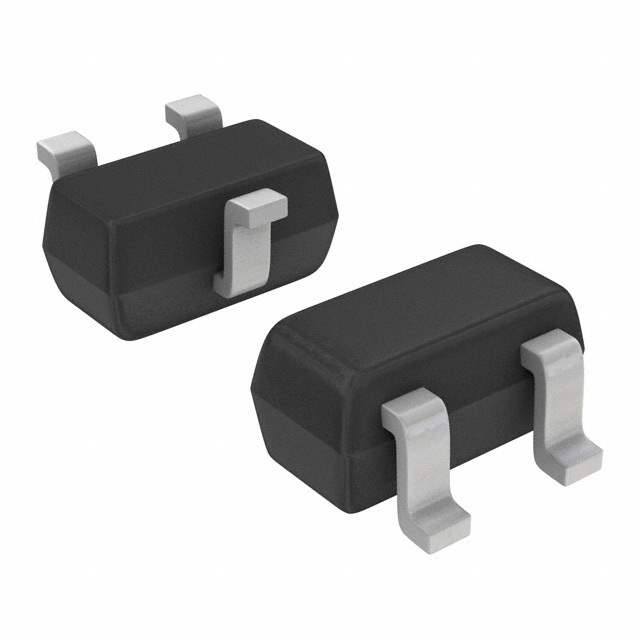
50V VCEO, 100mA collector ceiling, 200mW dissipation limit, SC-75 package with built-in 2.2k and 47k resistors
Quick Engineering Summary
| Field | Value |
|---|---|
| Manufacturer | ON Semiconductor |
| Category | Transistors (BJT) - Single, Pre - Biased |
| Package | SC-75 |
| Core function | TRANS PREBIAS NPN 50V 0. |
| Key electrical range | Collector Cut-off Current(Max): 500nA; Maximum Current Collector: 100mA; Maximum Power Dissipation: 200mW; Supply and Demand Status: Balance |
| Reported stock | 9611 pcs reported — confirm on RFQ |
Good for new builds, within a narrow power envelope
Use it.
What matters here is not the medium popularity tag but the fit: an Active pre-biased NPN that only earns board space when you want the transistor and bias network fixed in one SC-75 body. The 50V VCEO ceiling leaves headroom for small-signal switching, but it does not answer transient behavior or inductive stress. The 100mA collector rating and 200mW maximum power dissipation are hard ceilings, and together they keep DTC123JET1G in housekeeping switches, level interfaces, and compact logic-driven loads rather than anything that has to carry current for long stretches. EU RoHS is compliant.
The built-in resistors are the real design decision
And that is the real call here: the resistor values matter as much as the transistor. With 2.2k at R1 and 47k at R2, DTC123JET1G is not a generic NPN you bias later; it locks in one input-current path and one pull-down path from the start, which can trim parts count or upset a drive budget if the logic source was sized around a different network.
The listed 250mV VCE(sat) at 1mA, 10mA is useful, but only at that stated corner. It shows the device can pull low with a modest saturation drop there, yet it says nothing about behavior near the 100mA collector ceiling and does not stand in for a full saturation curve when logic-low margin or low-level loss is tight. The 500nA collector cut-off current ceiling helps when off-state leakage matters, especially in battery-fed or high-impedance nodes, but it remains an upper bound rather than a temperature-wide behavior picture because the temperature sweep is not here.
9611 pieces is enough to matter, not enough to relax
9611 pieces puts DTC123JET1G in credible running-line territory. Reel - TR packaging fits reel-fed SMT assembly, but if this is a sole-source line item, reserve it to the build schedule instead of assuming the balance will hold.
What the listing still doesn't answer
The weak point comes first: this listing is enough to screen the part in, not enough to close the board-level review.
No pinout is shown, and for a pre-biased transistor that is not a minor omission. The whole point is the internal resistor network tied to the transistor terminals, so the exact lead assignment decides whether the symbol, footprint, and test strategy are correct. No package drawing appears either, which leaves pad geometry and orientation unresolved even though the package is named as SC-75 and SOT-416.
The thermal picture is thin too. You get 200mW maximum power dissipation, but there is no thermal resistance and no derating curve, so ambient headroom stays open. The switching picture is thinner still, with no capacitance, no frequency figure, and no dynamic curves. For DTC123JET1G, those are the missing details that separate a tidy BOM reduction from a part that slows edges, misses timing, or runs hotter on the board than the simple current number suggests.
View the Win-Source product page for DTC123JET1G.
Key Takeaways for Engineers & Buyers
- Keep DTC123JET1G on low-power switch nodes; 200mW is the dissipation ceiling.
- Match the drive network to the built-in 2.2k R1 and 47k R2 before freezing the schematic.
- Book reel demand early if the line needs continuity; stock is listed at 9611.