
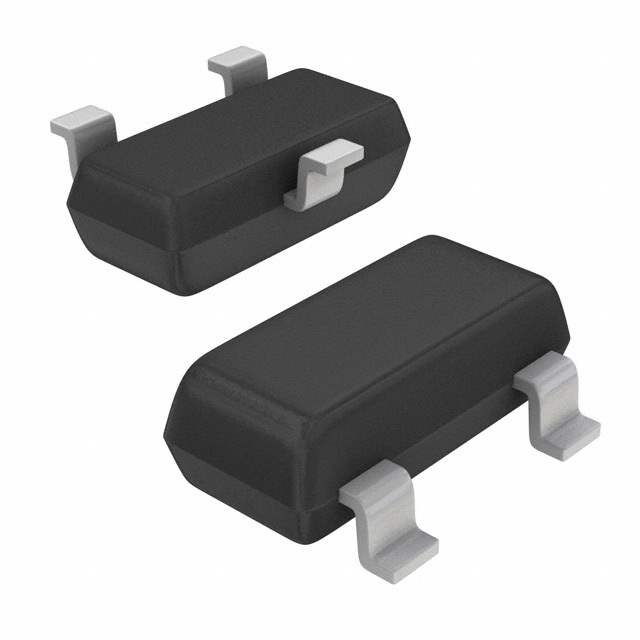
50V VCEO, 100mA collector ceiling, 150mW dissipation, EMT3 package with built-in 2.2k and 47k resistors
Quick Engineering Summary
| Field | Value |
|---|---|
| Manufacturer | Rohm Semiconductor |
| Category | Transistors (BJT) - Single, Pre - Biased |
| Package | EMT3 |
| Core function | TRANS PREBIAS NPN 50V 0. |
| Key electrical range | Collector Cut-off Current(Max): 500nA; Frequency - Transition: 250MHz; Maximum Current Collector: 100mA; Maximum Power Dissipation: 150mW |
| Reported stock | 90000 pcs reported — confirm on RFQ |
Can you start a new build on DTC123JETL?
Would you choose this for a new build? Yes, if you need a pre-biased NPN rather than a general-purpose small-signal transistor. It is listed Active, stock is 90000, packaging is Reel - TR, and the part is EU RoHS compliant, so nothing in the listing pushes it into sustaining-only use.
What matters more is the resistor network. Here that means 2.2k for R1 and 47k for R2 in an NPN device inside an EMT3 footprint. If those values fit your bias scheme, DTC123JETL can trim placement and BOM count. If they do not, Active status does not fix the mismatch.
The weak point is power, not voltage
Power is the constraint first. DTC123JETL is capped at 150mW maximum power dissipation, and on many real boards that ceiling arrives before the 50V breakdown limit does, because this is an EMT3 pre-biased transistor, not a part chosen for broad current-handling margin.
The 100mA maximum collector current is a ceiling too, not a comfortable operating point in every switching condition. The listing gives 300mV max VCE(sat) at 250μA, 5mA, which is useful but narrow: saturation is characterized at a very light collector current, so it does not answer what voltage drop looks like as DTC123JETL moves toward its 100mA limit, and that missing behavior matters more than the headline current number when heat is already tight.
Voltage is simpler. The 50V VCEO maximum sets the collector-emitter ceiling and rules out designs that need more headroom. The 500nA collector cut-off current max helps on leakage-sensitive bias nodes, but it says nothing about storage time, switching loss, or reverse-recovery behavior. The 250MHz transition frequency shows the transistor itself is not unusually slow, yet the built-in 2.2k and 47k resistors still shape how quickly the node moves in a pre-biased device.
It fits glue logic and level shifting, not load drive
Use it narrowly.
DTC123JETL fits compact SMT control paths where the built-in 2.2k and 47k resistors are exactly the point: logic inversion, simple level shifting, enable lines, or small-signal switching with fewer externals.
It is the wrong part for anything that treats 100mA as a comfortable working point or expects the package to absorb much heat. The category says single, pre-biased BJT. That points to bias-managed switching convenience, not open-ended transistor flexibility. EMT3 pushes it toward dense board work, not generous thermal margin.
What the listing still does not answer
Wrong for final signoff on switching speed or thermal headroom; right for a shortlist. The gaps are concrete: pinout, package drawing, thermal resistance, and saturation behavior beyond the single 300mV @ 250μA, 5mA point.
ECAD models are not directly available here either, only a contact path to download them. Pull the full datasheet and land pattern before layout if DTC123JETL is going into an active build, because the package is small and the listing does not include the mechanical detail.
View the Win-Source product page for DTC123JETL.
Key Takeaways for Engineers & Buyers
- Keep collector stress below the 50V VCEO ceiling; that number does not settle switching behavior.
- Budget heat from the 150mW package limit before using the full 100mA collector rating.
- Match the drive network to the built-in 2.2k R1 and 47k R2; those resistor values are the point of DTC123JETL.