
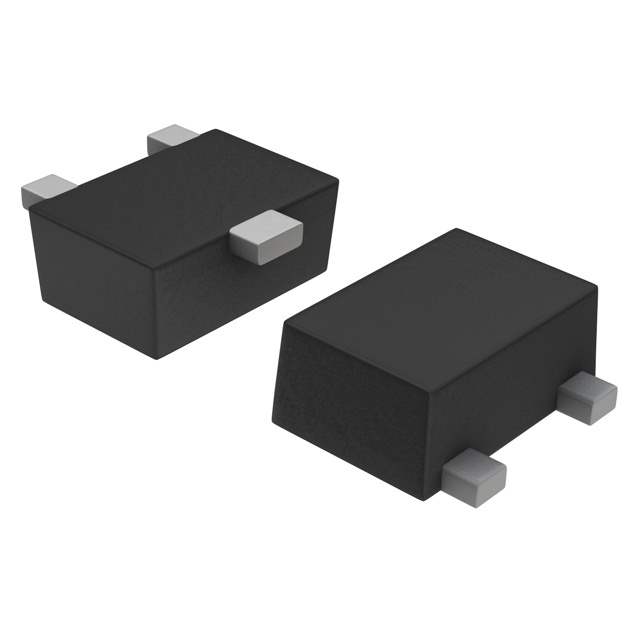
50V VCEO, 100mA collector, 260mW ceiling, SOT-723 pre-biased NPN with 2.2k and 47k resistors
Quick Engineering Summary
| Field | Value |
|---|---|
| Manufacturer | ON Semiconductor |
| Category | Transistors (BJT) - Single, Pre - Biased |
| Package | SOT-723 |
| Core function | TRANS PREBIAS NPN 50V SOT723 |
| Key electrical range | Collector Cut-off Current(Max): 500nA; Maximum Current Collector: 100mA; Maximum Power Dissipation: 260mW; Supply and Demand Status: Balance |
| Reported stock | 48390 pcs reported — confirm on RFQ |
So yes, this is a real new-design candidate
And that case is straightforward: DTC123JM3T5G is Active, stocked at 48390, and packaged on Reel - TR, so the commercial signals do not argue against putting it on a fresh BOM.
The electrical fit is narrower. This pre-biased NPN in SOT-723 has built-in 2.2k and 47k resistors, so it belongs where board area matters and where that fixed bias network is the feature rather than a compromise. EU RoHS is listed, removing one routine compliance objection. It works for new design-in when those resistor values and the small-package power ceiling already match the circuit you mean to build.
Not for power switching
Not for loads that push collector current or heat. It suits compact logic-level interfacing and small-signal switching, with 100mA collector current and 260mW as ceilings, not as a continuous operating target.
The 50V and 260mW numbers decide the fit
The weak point comes first: 260mW maximum power dissipation in SOT-723 leaves little room for loose thermal assumptions. The stronger number is 50V VCEO, which keeps DTC123JM3T5G in play on higher-voltage sense, pull-down, and interface nodes where many tiny transistors are ruled out immediately.
The 100mA maximum collector current matters too, but it does not answer the thermal question on its own. Read the 250mV max VCE(sat) at 1mA, 10mA next to the 260mW limit and the picture sharpens: this part is characterized for modest switched current, not presented as a hard-driven load transistor. The 500nA collector cut-off current max also helps on leakage-sensitive nodes, especially when off-state stray current would disturb a divider or a high-impedance input.
What is still missing before layout and release
What will stop the board spin first? The pinout.
SOT-723 is named, but the listing does not give the terminal assignment, and that is enough to block layout release. After that come the other concrete gaps that decide edge cases: thermal resistance, derating curve, and package drawing. There is also no switching figure such as transition frequency or a time-domain switching spec, so speed-sensitive paths cannot be judged from this page. The built-in resistor values are here, but without the package and thermal details, the page only gets you to fit and ceilings.
View the Win-Source product page for DTC123JM3T5G.
Key Takeaways for Engineers & Buyers
- Keep VCEO below the 50V ceiling; this listing does not make it a working rail target.
- Budget dissipation against the 260mW limit before using the 100mA collector rating.
- Confirm the SOT-723 pinout and land pattern before layout release.