
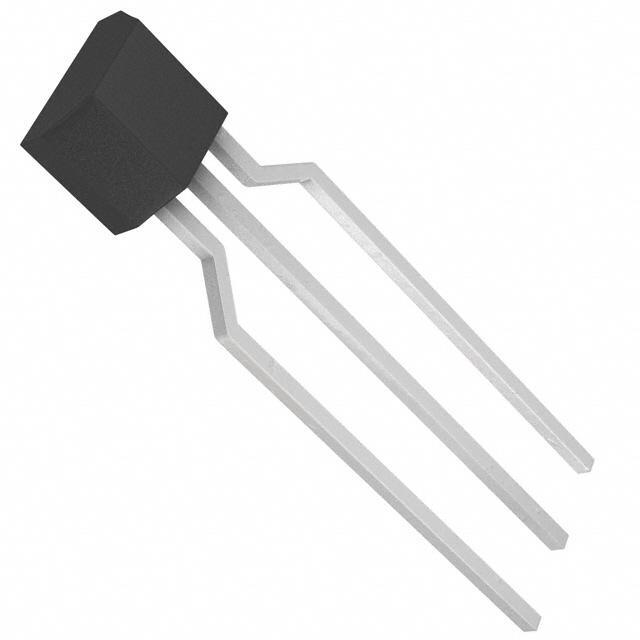
50V VCEO ceiling, 100mA collector ceiling, 300mW dissipation, through-hole SPT package
Quick Engineering Summary
| Field | Value |
|---|---|
| Manufacturer | Rohm Semiconductor |
| Category | Transistors (BJT) - Single, Pre - Biased |
| Package | SPT |
| Core function | TRANS PREBIAS NPN 50V 0. |
| Key electrical range | Collector Cut-off Current(Max): 500nA; Frequency - Transition: 250MHz; Maximum Current Collector: 100mA; Maximum Power Dissipation: 300mW |
| Reported stock | 5000 pcs reported — confirm on RFQ |
50V is useful, but EOL still closes new design-in
50V sets the collector-emitter breakdown ceiling. That puts DTC123JSATP on modest control rails, not in designs that may need more voltage headroom later from the active device choice.
The rest of the limits narrow the fit quickly. With a 100mA collector-current ceiling and 300mW maximum power dissipation, this is a small pre-biased NPN for light switching and biasing work, not a part to stretch into load-driving duty just because the package is through-hole. The listed 300mV max VCE(sat) at 250μA and 5mA is useful, but only at that test point, and it says little about behavior as current rises toward the 100mA ceiling.
The built-in resistor network is the real convenience. R1 is 2.2k and R2 is 47k, so the device can simplify a logic-to-transistor interface when those values already match the drive scheme. If the circuit needs a different ratio, though, the convenience disappears and the fit goes with it.
EOL decides the recommendation. DTC123JSATP is unsuitable for new design-in even though it is EU RoHS compliant. Keep it in existing production only, where the internal resistor values are already part of why the circuit works.
The dissipation ceiling is tighter than the voltage headline
The constraint is thermal and current headroom. The 300mW maximum power dissipation is a ceiling, not a target, and it is the number that keeps DTC123JSATP in low-power switching roles. The 100mA collector limit is also a ceiling, so it does not answer pulse behavior, startup stress, or fault survival on its own.
The 500nA collector cut-off current max is more useful in leakage-sensitive bias networks and simple level-detect stages, where off-state drift matters. And while 250MHz transition frequency shows the transistor core is not unusually slow, the integrated resistors still make this a convenience device first, not a general-purpose RF choice.
So buy only for a controlled bridge
And that leaves only one sensible buying posture. There are 5000 pieces listed, in AMMO PACKAGE, and that supports a sustaining buy for DTC123JSATP if your line already uses this exact pre-biased network. Don’t read more into it.
The missing details are the ones that close risk
Some gaps matter.
DTC123JSATP is identified as through-hole in SPT, and the text also points to SC-72 formed leads, but there is still no pinout or package drawing here. For a pre-biased transistor, that is not clerical detail; it determines whether the built-in R1 and R2 land where your footprint expects them.
The other missing items are the stress and thermal details that close out sustaining-use risk. There is no thermal resistance, no derating curve, no surge or pulse-current figure, and no switching-time data. Those omissions leave ambient headroom, overload tolerance, and edge-speed behavior unresolved, which is why DTC123JSATP belongs in known existing circuits rather than new work.
View the Win-Source product page for DTC123JSATP.
Key Takeaways for Engineers & Buyers
- Block DTC123JSATP on new BOMs; EOL status settles that.
- Check the rail against the 50V VCEO ceiling before any sustaining buy.
- Confirm the built-in bias network fits your drive: R1 is 2.2k and R2 is 47k.