
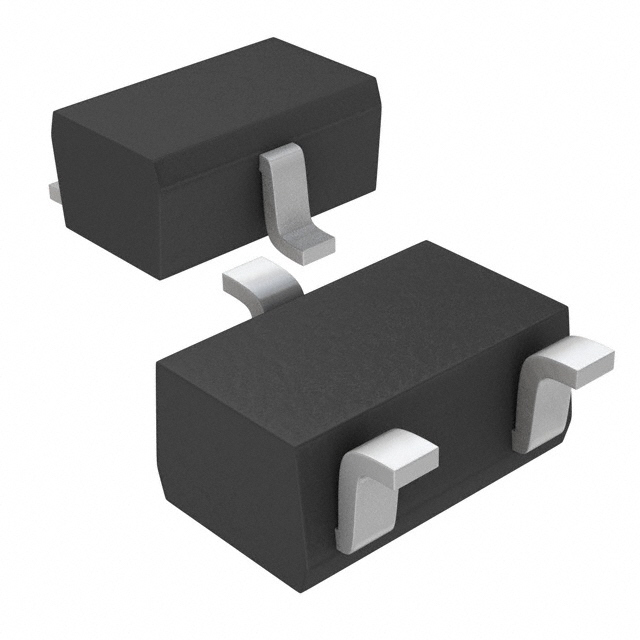
100 mA collector ceiling, 200 mW power ceiling, 2.2 kOhms/47 kOhms bias network, SC-70 SOT-323 UMT3
Quick Engineering Summary
| Field | Value |
|---|---|
| Manufacturer | Rohm Semiconductor |
| Category | Transistors (BJT) - Single, Pre - Biased |
| Package | Tape & Reel |
| Core function | TRANS PREBIAS NPN 0. |
| Key electrical range | Current - Collector (Ic) (Max): 100 mA; DC Current Gain (hFE) (Min) @ Ic, Vce: 80 @ 10mA, 5V; Frequency - Transition: 250 MHz; Power - Max: 200 mW |
| Reported stock | 9000 pcs reported — confirm on RFQ |
Not for heavy switching; fine for compact logic interfacing
Start somewhere else if the job begins with load current. The 100 mA collector-current maximum and 200 mW power maximum are hard ceilings, so this device belongs in small-signal switching and bias-cleanup work, not in outputs that run near either limit.
It fits dense board-level logic interfacing that benefits from the built-in resistor pair. DTC123JU3T106 is an NPN pre-biased transistor with 2.2 kOhms on R1 and 47 kOhms on R2 in a UMT3, SC-70, SOT-323 footprint, cutting external parts and routing where a discrete resistor-transistor network would otherwise take the space. Active lifecycle status supports new design-in.
Those resistor values decide the interface, not just the footprint
And that is the real reason to choose it. The 2.2 kOhms base resistor and 47 kOhms emitter-base resistor set how DTC123JU3T106 behaves at its input, so the decision is less about transistor substitution and more about whether that fixed bias network matches the logic source and the default-off behavior you need.
The gain figure helps, but only in context: hFE is listed as 80 minimum at 10mA and 5V. That does not close behavior at other collector currents or voltages, and it does not rescue a mismatched input drive scheme. The listed 300mV maximum Vce saturation at 250µA and 5mA is useful for low-current switching-loss expectations, but only at that test point. Read it as a ceiling at a stated condition, not as a blanket promise for every load case.
200 mW is the ceiling that keeps this in signal territory
200 mW is the number that stops wishful thinking. Combined with the 100 mA collector-current maximum, it keeps DTC123JU3T106 in compact pre-biased switch territory for modest loads, and thermal headroom disappears quickly if you treat the package like a general-purpose transistor with room to spare.
Package choice matters. UMT3 in SC-70, SOT-323 is exactly what you pick when board area is tight and assembly is fully surface mount, but the listing gives no thermal escape story beyond that 200 mW ceiling. There is no thermal resistance figure, no derating curve, and no drawing here to show pad assumptions, so those missing items will decide ambient headroom more than the 250 MHz transition frequency.
That 250 MHz figure still has value. It says the transistor itself is not inherently slow, yet the fixed resistor network remains what shapes the practical interface in most real circuits. DTC123JU3T106 fits pull-down, level-conditioning, and small-load switching on dense digital boards; it does not belong where startup surge, thermal pulse stress, or undefined drive impedance are central problems.
The buy constraint is packaging, not lifecycle
Packaging is the constraint. With 9000 listed in stock and MSL 1, DTC123JU3T106 is easy to feed into an SMT line, not hand-build convenience or mixed packaging needs.
What the listing still does not answer
What do you ask for first? Pinout. Then the package drawing, thermal resistance, and collector cutoff current. Those are the missing items that close placement, thermal, and leakage questions on DTC123JU3T106.
One more gap matters: there is no Vce breakdown figure in this listing. Without that ceiling, rail fit is still open even though the part is otherwise easy to place in a small-signal SMT design.
View the Win-Source product page for DTC123JU3T106.
Key Takeaways for Engineers & Buyers
- Keep collector load below the 100 mA ceiling; this is not the transistor for relay or lamp drive.
- Use the built-in 2.2 kOhms and 47 kOhms network as part of the logic-drive budget, not as a generic small-signal BJT.
- Reserve tape-and-reel stock early if DTC123JU3T106 is going onto a running SMT line; listed quantity is 9000.