
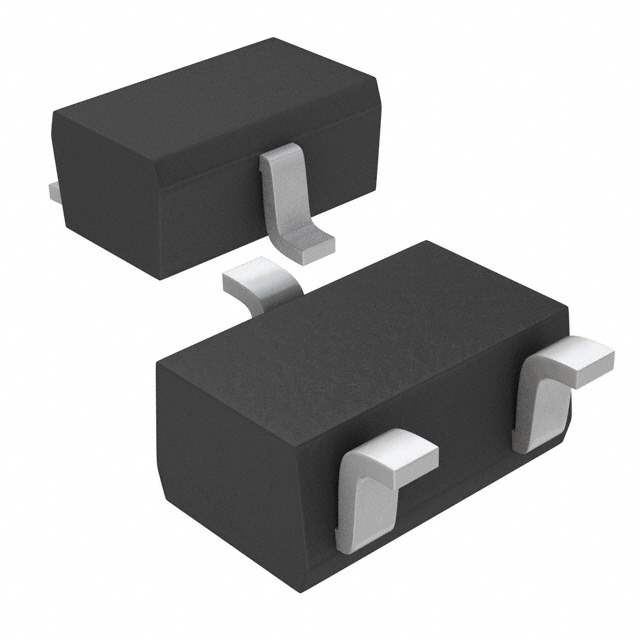
50V VCEO ceiling, 100mA collector ceiling, 200mW limit, UMT3 package with built-in 2.2k and 10k resistors
Quick Engineering Summary
| Field | Value |
|---|---|
| Manufacturer | Rohm Semiconductor |
| Category | Transistors (BJT) - Single, Pre - Biased |
| Package | UMT3 |
| Core function | TRANS PREBIAS NPN 50V 0. |
| Key electrical range | Collector Cut-off Current(Max): 500nA; Frequency - Transition: 250MHz; Maximum Current Collector: 100mA; Maximum Power Dissipation: 200mW |
| Reported stock | 60000 pcs reported — confirm on RFQ |
The weak point is lifecycle, not the transistor
The weak point comes first: DTC123YUAT106 carries an Active status, but another lifecycle field says not suitable for new design. That conflict is enough to keep it out of a clean-sheet program, even though the electrical listing itself is ordinary and usable.
For an existing production build, the picture is better. Stock is listed at 60000, packaging is Reel - TR, and the part is EU RoHS compliant, so a running line can keep moving if this exact pre-biased NPN is already qualified. It reads like a sustaining part, not one to introduce casually.
What decides the buy first: can you keep a line running?
Can you keep the line running? Yes, for now. The practical constraint is not package availability or tape format; it is the lifecycle contradiction sitting beside a stock quantity of 60000. If the device is already on your AVL, secure the reel build you need while that signal is still manageable.
The package and category show what kind of line item this is: a single pre-biased NPN in UMT3 for SMD assembly, with the base network fixed at 2.2k for R1 and 10k for R2. That resistor pair is both the convenience and the lock-in, because it removes external parts only when those values already fit the drive source and turn-off behavior you need.
Those headline numbers are all ceilings
And that is where the limits start to matter. The easy mistake with DTC123YUAT106 is to read the small-signal simplicity as design freedom. The 50V VCEO figure is a collector-emitter breakdown ceiling, so it answers whether the transistor can sit on rails up to 50V, but it says nothing about switching stress, inductive events, or safe operating margin beyond that ceiling.
The 100mA maximum collector current is also a ceiling, and the 200mW maximum power dissipation is the tighter companion limit that decides whether a compact UMT3 implementation stays comfortable or runs hot. The listed 300mV max VCE(sat) at 500µA, 10mA is useful only at that stated test point; it shows the device can pull low with modest drop there, but it does not provide a full saturation picture across the current range. Leakage is controlled on paper at 500nA collector cut-off current max, which helps when the off-state matters more than speed.
Fit is narrow by design, and the missing data keeps it narrow
Fit is narrow.
Use it where the resistor network is the point. DTC123YUAT106 belongs in compact level-shift, pull-down, and simple logic-drive jobs where an NPN with built-in bias resistors removes two external parts and where 50V, 100mA, and 200mW are plainly enough. It does not belong in a design that needs resistor-value freedom, heavier collector current, or a thermal model with any confidence behind it.
The gain listing reinforces that narrow fit. hFE is given as 33 min at 10mA, 5V, so you get one anchored condition for low-current behavior, not a broad transfer picture, and while frequency transition at 250MHz says the transistor itself is not especially slow, for a pre-biased device that number does not replace the switching data you would actually want for edge control in a real interface.
Several concrete items are still absent. There is no pinout here, no package drawing, no thermal resistance, and no switching waveform data. ECAD is listed only as contact to download. Those gaps still decide whether DTC123YUAT106 drops cleanly into a new layout or remains a sustaining-only line item.
View the Win-Source product page for DTC123YUAT106.
Key Takeaways for Engineers & Buyers
- Treat the 100mA collector rating as a ceiling; check load current against the 200mW package limit.
- Match the drive network to the built-in 2.2k R1 and 10k R2 before dropping in DTC123YUAT106.
- If this is for a new BOM, stop at the lifecycle conflict and clear it before release.