
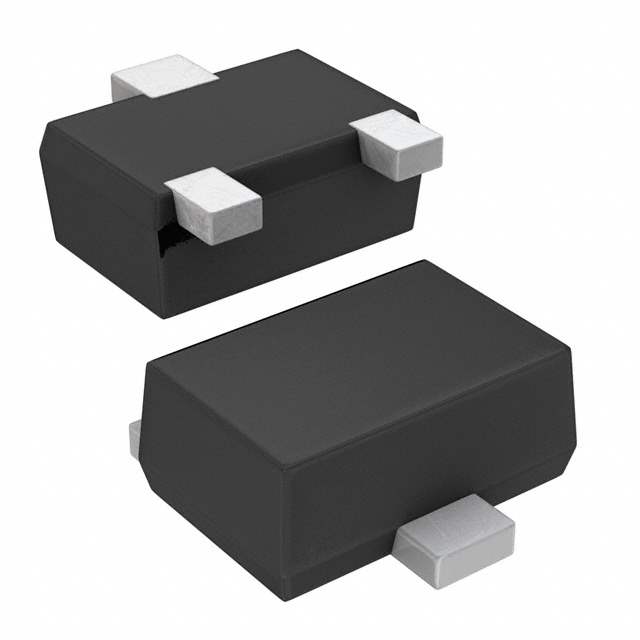
50V VCEO, 30mA collector ceiling, 150mW dissipation limit, EMT3F (SOT-416FL) package
Quick Engineering Summary
| Field | Value |
|---|---|
| Manufacturer | Rohm Semiconductor |
| Category | Transistors (BJT) - Single, Pre - Biased |
| Package | EMT3F (SOT-416FL) |
| Core function | TRANS PREBIAS NPN 50V EMT3F |
| Key electrical range | Collector Cut-off Current(Max): 500nA; Frequency - Transition: 250MHz; Maximum Current Collector: 30mA; Maximum Power Dissipation: 150mW |
| Reported stock | 15000 pcs reported — confirm on RFQ |
Still a valid new design-in, with one obvious boundary
And that boundary is current. Active status and EU RoHS remove the lifecycle objection, but the 30mA collector ceiling and 150mW dissipation limit keep DTC124EEBTL in housekeeping switch duty, not real load drive.
50V closes the rail question, not the load question
50V is the collector-emitter breakdown ceiling, so it answers the first question quickly: whether DTC124EEBTL can sit on higher-voltage control rails without immediate overstress. It does not answer the harder one, because the separate ceilings are 30mA for collector current and 150mW for power dissipation.
The other useful limit is 300mV @ 500μA, 10mA for VCE(sat). That gives a bounded saturation drop at the stated test point, enough to judge whether a low-current on/off node will pull low cleanly. It doesn't support a broad claim at 30mA, and the listing gives no saturation curve across current.
Wrong for adjustable bias, right for dense logic interfacing
Not for circuits that need resistor choice freedom. DTC124EEBTL fixes R1 at 22k and R2 at 22k, so the upside is less board area and a cleaner BOM, while the tradeoff is obvious before layout even starts: your input-bias behavior is largely predetermined.
That fixed network is exactly why the part fits dense SMT control sections where a discrete NPN plus two resistors would burn placement time and area. Level detection, simple inverter stages, pull-down control, and low-current low-side switching all line up with the part's built-in biasing and tiny EMT3F (SOT-416FL) package. In that role, integration does the work. In anything that needs bias tuning, more thermal slack, or meaningful load current, it doesn't.
The gain figure belongs in that same narrow frame. hFE is listed as 56 @ 5mA, 5V, which supports modest-current switching around the stated test region and nothing more. It does not settle behavior at other operating points, and it certainly does not rescue a design already leaning on the 30mA collector ceiling or the 150mW dissipation limit. This is a tiny board-level transistor for dense digital or mixed-signal housekeeping, not a forgiving general-purpose BJT that can absorb abuse or carry actuator current for long.
150mW is the real design stop sign
150mW is the decisive number. In an EMT3F body, dissipation headroom disappears fast once the transistor stays on for long periods or has to drop meaningful voltage, so DTC124EEBTL needs to be treated as a small-signal switch with a narrow thermal budget.
Reel packaging reinforces the intended use. Packaging is Reel - TR, stock is 15000, and supply-demand is marked Balance, which lines up with scheduled SMT production better than ad hoc bench quantities. The listing also calls out dry storage cabinet and humidity protection package; useful handling information, but not an MSL callout.
The missing items are the ones that finish the review
A few gaps matter.
Pinout, package drawing, RθJC, and derating data are not listed here, and those are the details that finish the land-pattern and thermal picture around the 150mW ceiling.
Switching data is missing too. A 250MHz transition frequency is not a substitute for rise, fall, or storage-time numbers when the transistor is used as a switch.
View the Win-Source product page for DTC124EEBTL.
Key Takeaways for Engineers & Buyers
- Keep collector current below the 30mA ceiling; this part is for small-signal switching, not load drive.
- Budget heat against the 150mW maximum before using DTC124EEBTL as a sustained low-side switch.
- Lock the 22k/22k bias network into the logic-drive assumption; you can't retune R1 or R2 externally.