
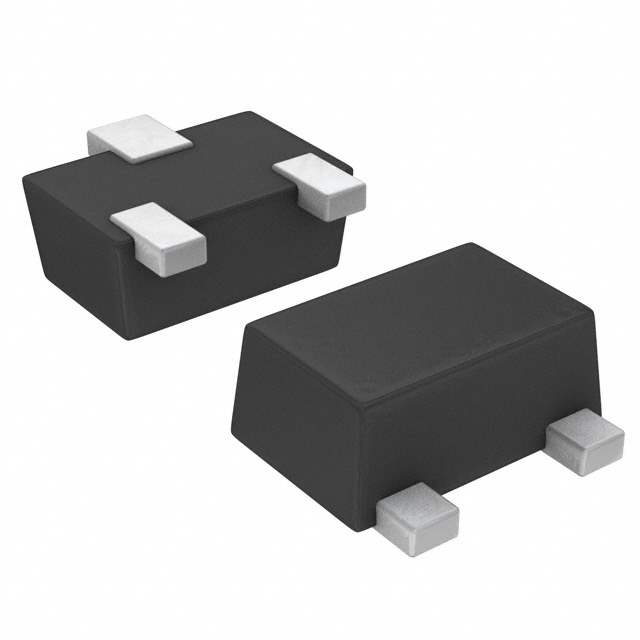
50V VCEO, 30mA collector, 150mW dissipation, VMT3 package, NPN pre-biased transistor
Quick Engineering Summary
| Field | Value |
|---|---|
| Manufacturer | Rohm Semiconductor |
| Category | Transistors (BJT) - Single, Pre - Biased |
| Package | VMT3 |
| Core function | TRANS PREBIAS NPN 50V VMT3 |
| Key electrical range | Collector Cut-off Current(Max): 500nA; Frequency - Transition: 250MHz; Maximum Current Collector: 30mA; Maximum Power Dissipation: 150mW |
| Reported stock | 8960 pcs reported — confirm on RFQ |
The weak point is current; the strong point is integration
Current is the weak point first. The 30mA collector rating is a hard ceiling, and it keeps DTC124EMT2L out of jobs where the transistor is expected to carry a real load.
The strength is integration. The built-in 22k R1 and 22k R2 network in a VMT3 body removes two external resistors, which gives this part a clean place in dense SMT control paths for logic-to-transistor interfacing, level shifting, and simple pull-down or switch functions when those resistor values already match the drive source. Active lifecycle and EU RoHS status also support new design-in.
The voltage and power numbers are ceilings, not comfort
They are hard limits.
The 50V VCEO rating is a collector-emitter breakdown ceiling, so it answers whether DTC124EMT2L can sit on higher-voltage signal rails, but it says nothing about switching behavior, transient survival, or thermal margin in that use. The 150mW maximum power dissipation is the other stop, and in a VMT3 device it is the number that keeps saturation loss and ambient from drifting into wishful thinking.
The listed 300mV max VCE(sat) at 500µA and 10mA helps because the saturation claim is tied to a stated test point rather than the full 30mA ceiling.
500nA leakage is a good sign, but the review still has holes
500nA max collector cut-off current is a good sign for off-state control in high-impedance bias networks. The missing items are concrete: pinout, package drawing, and thermal resistance.
Can you keep a running line on DTC124EMT2L?
Can you actually keep this part moving on a line? Today, 8960 units says yes, and reel - TR packaging matters more than any abstract demand flag because tiny pre-biased transistors like DTC124EMT2L tend to disappear quickly once they are qualified into an assembly and released across repeat builds.
The commercial and technical signals line up cleanly here: Active lifecycle, balance in supply and demand, reel - TR packaging, and stock on hand. That combination supports both a fresh build and an existing production line without pushing a package change or creating a hand-load exception at the last minute.
Availability is not the real constraint. Fit is. DTC124EMT2L only earns its place when the fixed 22k and 22k resistor pair is the network you already want, because that integration is the whole reason to choose this part over a plain small-signal BJT. Lock that into the schematic before release, then reserve stock against the build if the line is near-term.
View the Win-Source product page for DTC124EMT2L.
Key Takeaways for Engineers & Buyers
- Keep collector current below the 30mA ceiling; this part is for signal switching, not load drive.
- Use the built-in 22k/22k bias network only where that input impedance matches the drive source.
- Place DTC124EMT2L on reel-fed SMT builds if you need immediate line coverage from 8960 units.