
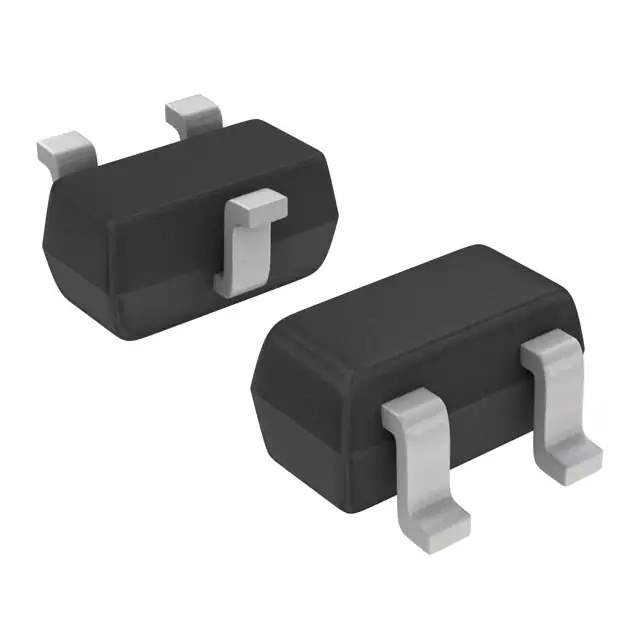
50 V, 100 mA, 200 mW in SC-75/SOT-416; usable only where the built-in 22 kOhms and 47 kOhms fit
Quick Engineering Summary
| Field | Value |
|---|---|
| Manufacturer | ON Semiconductor |
| Category | Transistors (BJT) - Single, Pre - Biased |
| Package | Tape & Reel |
| Core function | TRANS PREBIAS NPN 50V 0. |
| Key electrical range | Current - Collector (Ic) (Max): 100 mA; Current - Collector Cutoff (Max): 500nA; DC Current Gain (hFE) (Min) @ Ic, Vce: 80 @ 5mA, 10V; Power - Max: 200 mW |
| Reported stock | 1 pcs reported — confirm on RFQ |
Sustaining only, not a fresh design choice
Don't start here. DTC124XET1 is discontinued, with lifecycle fields split between EOL and Discontinued but none pointing to an active status.
For existing production, this is a short-run sustainment part. EU RoHS status is conflicted too, so compliance is not settled from this listing.
Wrong for power switching, fine for small biased logic stages
Power switching is the wrong job for this part. The 100 mA collector current and 200 mW power figure are ceilings, not places to operate comfortably, and in an SC-75, SOT-416 body there is not much room when load, ambient, or saturation loss starts moving the wrong way.
It fits better in small interface, pull-down, or level-conditioning stages where the built-in bias network is the point. The fixed 22 kOhms base resistor and 47 kOhms emitter-base resistor decide the fit early; if the circuit wants different values, this is the wrong transistor before voltage or current even become the main issue.
50 V is the rail ceiling that decides reuse
50 V is the number that matters most. It is the collector-emitter breakdown maximum, so it sets the highest rail the device may be asked to withstand.
The rest of the electrical picture is narrower than it first looks. Vce saturation is listed as 250mV at 1mA, 10mA, which is useful only as a bounded low-current switching clue, not a promise across the full 100 mA ceiling. The minimum hFE of 80 at 5mA, 10V is also tied to that stated condition. Use DTC124XET1 for modest signal switching, not where current headroom is carrying the design.
Can you actually buy enough to keep a line moving?
Can you get enough parts at all? From this listing, no. Stock is shown as 1, while the standard package is 3,000 pcs on tape and reel, so the real constraint is availability. MSL 1 (Unlimited) doesn't help if supply is effectively gone.
Treat DTC124XET1 like a last-time-buy problem. For any assembly that still depends on it, isolate remaining demand, compare it with the single-unit stock signal, and move the line toward an approved internal alternate path instead of assuming normal replenishment.
The missing details are exactly the ones that close risk
And that's the bigger problem. The listing gives the headline ceilings and the internal resistor values, but it leaves out the details that actually close risk in a release decision: pinout confirmation, package drawing, thermal resistance, and any derating curve.
Without those items, the 200 mW maximum stays a headline instead of becoming an ambient decision, and even basic layout confidence is weaker than it should be because orientation and land-pattern checks are still open. If this device is switching anything dynamic, the omissions get more serious. There is no switching-time data and no capacitance figure, so edge behavior and node loading remain unknown, which matters more here than another static limit because a pre-biased transistor is usually chosen to simplify small control paths, and those are exactly the paths where an unspoken timing or loading detail can turn into a slow edge, a missed threshold, or a nuisance failure that takes too long to trace.
View the Win-Source product page for DTC124XET1.
Key Takeaways for Engineers & Buyers
- Block new BOM releases for DTC124XET1; lifecycle is Discontinued.
- Check the rail against the 50 V collector-emitter ceiling before reuse.
- Confirm the built-in 22 kOhms and 47 kOhms match the drive network you expect.