
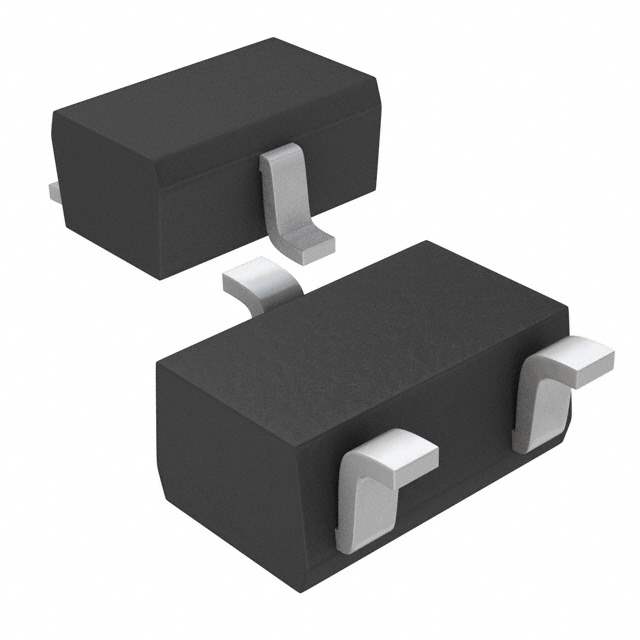
50V VCEO, 50mA collector ceiling, 200mW dissipation limit, UMT3 package
Quick Engineering Summary
| Field | Value |
|---|---|
| Manufacturer | Rohm Semiconductor |
| Category | Transistors (BJT) - Single, Pre - Biased |
| Package | UMT3 |
| Core function | TRANS PREBIAS NPN 50V UMT3 |
| Key electrical range | Collector Cut-off Current(Max): 500nA; Frequency - Transition: 250MHz; Maximum Current Collector: 50mA; Maximum Power Dissipation: 200mW |
| Reported stock | 30600 pcs reported — confirm on RFQ |
The lifecycle signal is the weak point
The weak point comes first: DTC124XUAT106 carries a direct not-for-new-design signal even though another field says Active. That conflict is enough to keep it out of a clean-sheet program. Use it for existing production, not for a platform you expect to keep extending.
The stronger case is operational. In UMT3, DTC124XUAT106 is a pre-biased NPN with R1 at 22k and R2 at 47k, so it fits places where that fixed input network is the point: small logic-level switching, level translation, and tight board space. EU RoHS is compliant.
Those ceilings are tighter than they look
And the electrical limits matter more anyway. The 50mA maximum collector current and 200mW maximum power dissipation are hard ceilings. DTC124XUAT106 can switch small loads, but it is not where you leave current and heat unattended.
The fixed resistor network decides the fit
The real constraint is the built-in bias network. With R1 at 22k and R2 at 47k, DTC124XUAT106 works when you want repeatable turn-on behavior without adding two external resistors and when that exact divider suits the driving node. If the input source needs a different base current budget or a different off-state pull path, the part starts dictating the schematic instead of simplifying it.
The other number that shapes the fit is the 300mV max VCE(sat) at 500µA, 10mA. That listed condition does not promise the same result across the load range, but it does place the device squarely in low-current saturated switching rather than linear use. Pair that with the 50V VCEO ceiling and the 500nA collector cut-off current max, and it lands in compact control paths, interface glue, and simple pull-down stages on higher-voltage rails where leakage needs to stay quiet. It does not belong in power switching, and it does not solve a design that really needs resistor values other than 22k and 47k.
Wrong for open-ended redesigns, fine for a running line
Wrong for open-ended redesigns. DTC124XUAT106 is a poor choice when the review still depends on package drawing detail, transient current tolerance, or thermal modeling. The listing gives UMT3 and the translated package note SC-70, SOT-323, but it does not include the pinout or a mechanical drawing here, so footprint confirmation still sits outside this page. It also omits pulse-current behavior, leaving no IFSM-style surge number to use when the load is not well behaved.
Where it does fit is narrower and more practical. For an existing board already built around a pre-biased NPN with this resistor pair, the buy side is straightforward: reel packaging, sufficient supply status, and 30600 pieces listed. Secure the sustaining quantity you need while that stock is present, because the lifecycle conflict is the real constraint, not day-to-day availability.
The remaining gaps are concrete. DTC124XUAT106 still needs pinout, package drawing, and thermal resistance data before you can sign off land pattern confidence or ambient headroom. The transition frequency is listed at 250MHz, but without fuller curves that number does not replace switching-waveform data.
View the Win-Source product page for DTC124XUAT106.
Key Takeaways for Engineers & Buyers
- Hold DTC124XUAT106 to rails that stay inside the 50V VCEO ceiling.
- Check load current against the 50mA collector maximum before reusing this bias network.
- Keep buys on reel while 30600 pieces are available for existing production.