
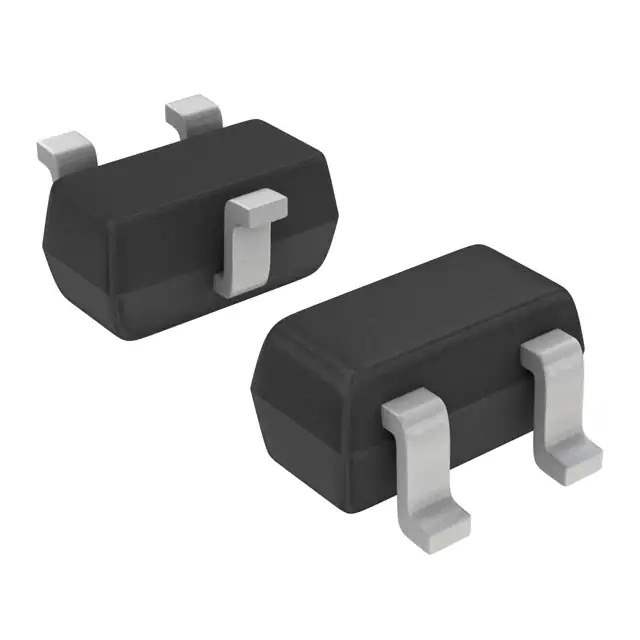
50 V, 100 mA, 200 mW in SC-75/SOT-416; suited to small pre-biased switching, not new builds
Quick Engineering Summary
| Field | Value |
|---|---|
| Manufacturer | ON Semiconductor |
| Category | Transistors (BJT) - Single, Pre - Biased |
| Package | Tape & Reel |
| Core function | TRANS PREBIAS NPN 50V 0. |
| Key electrical range | Current - Collector (Ic) (Max): 100 mA; Current - Collector Cutoff (Max): 500nA; DC Current Gain (hFE) (Min) @ Ic, Vce: 15 @ 5mA, 10V; Power - Max: 200 mW |
| Reported stock | 320000 pcs reported — confirm on RFQ |
Wrong for fresh designs, still usable on a running line
Not for a new schematic. DTC143EET1 is discontinued, with lifecycle signals split between EOL and Discontinued, and neither supports a new design-in.
It still has a place on an existing line that already depends on a pre-biased NPN in SC-75, SOT-416 and can use taped parts. The limits are clear: 50 V collector-emitter breakdown, 100 mA collector current, and 200 mW maximum power. Those are ceilings, not operating targets. EU RoHS is compliant, and MSL 1 (Unlimited) removes one handling concern while you keep production moving.
And the package is part of the limit
And that 200 mW maximum matters as much as the 100 mA collector ceiling, because the SC-75, SOT-416 body leaves little thermal margin. This belongs in low-power switching, where the built-in 4.7 kOhms base resistor and 4.7 kOhms emitter-base resistor save parts count.
The fixed resistor pair decides the fit
The real constraint is lack of flexibility. With R1 at 4.7 kOhms and R2 at 4.7 kOhms, the integrated network suits logic-driven on/off stages only when that divider is exactly what the circuit needs. If the bias network needs tuning, the fit is already wrong before voltage or current become the issue.
The listed Vce saturation is 250mV @ 1mA, 10mA. Treat that as a bounded test condition, not a blanket promise across the load range. It shows small-load pull-down behavior with modest loss at that point, but says nothing about behavior near the 100 mA ceiling, where surprises tend to show up first.
320000 pieces help only if your build is finite
320000 pieces is the number that matters. Stock exists, the standard package is 3,000 pcs, and the format is Tape & Reel, so a planned sustaining run can be covered without repacking friction.
Still, that is not continuity. Tie purchases to a dated production need, because a discontinued small-signal transistor with a fixed internal resistor network can stall a line long before the raw quantity looks scarce. DTC143EET1 works as a controlled bridge strategy; it is the wrong anchor for an open-ended program.
What the listing still doesn't tell you
What does a buyer need to know first? Whether the missing details are minor, or the kind that can stop a build.
Here they are not minor. There is no pinout, and for a pre-biased transistor in SC-75, SOT-416 that is not clerical detail; it determines whether the board footprint and symbol mapping are even correct. There is also no package drawing, so land pattern and orientation still depend on the full datasheet.
The thermal picture is also incomplete. You get a 200 mW maximum, but no thermal resistance or derating curve, so ambient headroom remains unresolved once the part is on a real board with real copper and real airflow. The switching picture is thin as well: no capacitance data and no time-domain behavior are listed, leaving edge speed and node loading unanswered when the circuit is sensitive to either.
So yes, DTC143EET1 can still cover a sustaining build. But without pinout, package drawing, and thermal detail, signoff stays incomplete even when the headline ratings look straightforward.
View the Win-Source product page for DTC143EET1.
Key Takeaways for Engineers & Buyers
- Block new BOM releases on DTC143EET1; lifecycle is Discontinued.
- Keep collector current below the 100 mA ceiling and power within the 200 mW ceiling.
- Confirm the fixed 4.7 kOhms / 4.7 kOhms bias network matches the drive logic before any last-time build.