
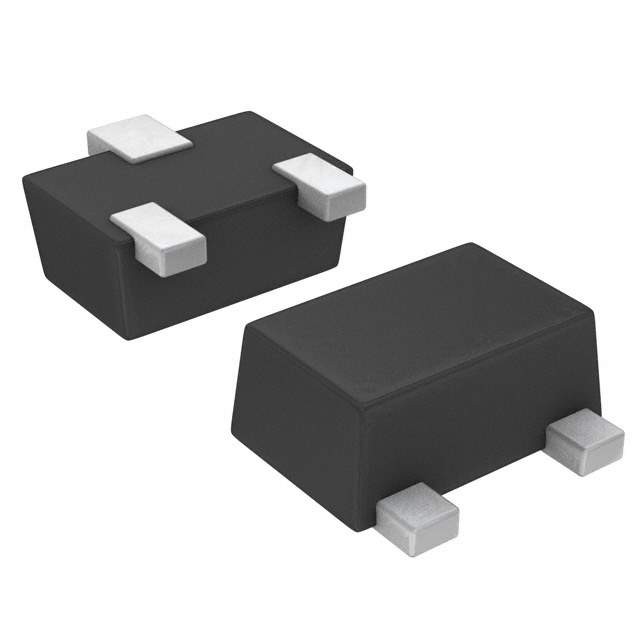
50V VCEO ceiling, 100mA collector ceiling, 150mW limit, SOT-723 package with built-in 4.7k/4.7k bias resistors
Quick Engineering Summary
| Field | Value |
|---|---|
| Manufacturer | Rohm Semiconductor |
| Category | Transistors (BJT) - Single, Pre - Biased |
| Package | VMT3 |
| Core function | TRANS PREBIAS NPN 50V 0. |
| Key electrical range | Current - Collector (Ic) (Maximum): 100mA; Current - Collector Cutoff (Maximum): 500nA; DC Current Gain (hFE) (Minimum) @ Ic, Vce: 30 @ 10mA, 5V; Frequency - Transition: 250MHz |
| Reported stock | 64000 pcs reported — confirm on RFQ |
The real constraint is power density, not the 50V headline
The hard limit is 150mW. In a SOT-723 body, that ceiling decides whether DTC143EMT2L stays a tidy logic-interface transistor or runs out of thermal room quickly, and it does not justify treating the 100mA collector rating as a normal operating point.
The rest of the numbers support that reading. The collector-emitter breakdown is 50V, a rail ceiling and nothing more; it places the device on higher-voltage sense or pull-down nodes than many tiny digital transistors, but it does not answer switching loss, transient survival, or ambient headroom. The collector current is 100mA maximum, also a ceiling. Set that beside 300mV maximum VCE(sat) at 500µA and 10mA, and the practical takeaway is modest-current switching where saturation loss stays controlled at the stated test point. Push much beyond that, and the missing thermal data becomes the real blocker rather than the headline voltage.
That leaves the part in a usable but qualified spot. DTC143EMT2L makes sense for new design-in when you want an NPN pre-biased transistor with fixed 4.7k and 4.7k resistors, a small footprint, and reel packaging, but the 2025 Estimated EOL Date needs a direct answer before you commit to a long production horizon. EU RoHS is compliant.
Use it for small-signal switching, not load driving
Use it for small signals.
DTC143EMT2L fits where the built-in resistor network removes two externals and where 30 minimum hFE at 10mA, 5V is enough to keep the stage predictable. It is not the main load path.
64000 on hand helps, but lifecycle is the buying question
64000 pieces on hand helps only so much. Reel - TR packaging makes DTC143EMT2L workable for a running line, but the supply-and-demand flag says Limited, so that stock is not a reason to relax.
The real buy-side issue is the mismatch between Active status and the Estimated EOL Date of 2025. Lock that down first. If the program is short or already in production, the present quantity is useful. If it is meant to run well past 2025, that single field matters more than the medium popularity tag or the EAR99 export classification.
What the listing still doesn't answer
And that still leaves the fit unresolved. 50V is enough to start the discussion, not finish it. The missing items are concrete: pinout, package drawing, and thermal resistance data. Without them, board placement and heat path are still assumptions.
The switching picture is thin too. No turn-on or turn-off timing, no capacitance, and no derating curve are listed here. For DTC143EMT2L, those gaps decide whether the 250MHz transition frequency is useful in your circuit or just a family-level hint.
View the Win-Source product page for DTC143EMT2L.
Key Takeaways for Engineers & Buyers
- Clear the 2025 Estimated EOL Date before locking DTC143EMT2L into a long-life BOM.
- Keep collector current below the 100mA ceiling and power inside the 150mW limit.
- Confirm the internal 4.7k R1 and 4.7k R2 match the drive logic before layout.