
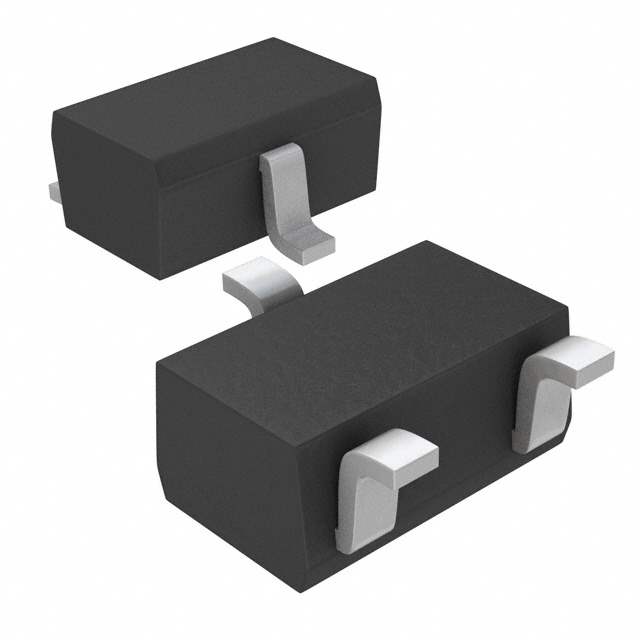
50V VCEO ceiling, 100mA collector limit, 200mW dissipation cap, UMT3 with built-in 4.7k/4.7k resistors
Quick Engineering Summary
| Field | Value |
|---|---|
| Manufacturer | Rohm Semiconductor |
| Category | Transistors (BJT) - Single, Pre - Biased |
| Package | UMT3 |
| Core function | TRANS PREBIAS NPN 50V 0. |
| Key electrical range | Collector Cut-off Current(Max): 500nA; Frequency - Transition: 250MHz; Maximum Current Collector: 100mA; Maximum Power Dissipation: 200mW |
| Reported stock | 231030 pcs reported — confirm on RFQ |
Active on paper, but not a clean new design choice
The weak point comes first: DTC143EUAT106 carries a lifecycle conflict. One field says Active, another says not suitable for new design, and that is enough to keep it out of a fresh platform unless you already need this exact pre-biased NPN behavior.
For existing production, the picture is better. The part is common-used, popularity is high, stock is listed at 231030, and packaging is Reel - TR, so it looks supportable for a running line. EU RoHS is straightforward. Still, the conflicting lifecycle note matters more than the Active label, so sustaining use is the safer read.
50V is the rail ceiling; 200mW is the real squeeze
50V is a ceiling, not a target. That settles one fit question quickly: DTC143EUAT106 belongs on low-to-moderate voltage nodes where collector-emitter stress stays comfortably below breakdown, and it does not justify assuming the transistor is comfortable switching a 50V line under every load condition.
The tighter limit is often thermal. Collector current tops out at 100mA, while maximum power dissipation is 200mW, and those two ceilings have to be read together in a UMT3 body because the current number alone overstates what the package can really support in use. The listed 300mV @ 500µA, 10mA for Vce(sat) is useful at that stated condition, but it does not support carrying the same expectation up near the 100mA ceiling.
That points it at logic interfacing, not load driving
So this is where it fits. The built-in 4.7k base resistor and 4.7k emitter-base resistor suit compact board-level switching and inversion, while the 100mA and 200mW ceilings keep it in small-signal work rather than load-driving duty.
The built-in resistor pair is the feature to buy on purpose
4.7k/4.7k is the deciding figure. DTC143EUAT106 is not just an NPN in UMT3; it is a pre-biased device with fixed input behavior, and that either simplifies the schematic or works against it.
When the circuit wants that exact resistor network at the transistor input, the part can remove two external resistors and tighten placement in SC-70, SOT-323 class space. When the bias network needs a different ratio or a different absolute value, DTC143EUAT106 stops making sense before current or voltage even enter the discussion. Choose it because that resistor pair is exactly right for the logic stage, not because any small NPN would do.
The missing datasheet items are the ones that close the review
Some gaps matter.
What is missing here is concrete: thermal resistance, derating curve, pinout drawing, and package drawing. Those omissions are the ones that stop a clean decision, because the 200mW limit cannot be translated into ambient headroom without the thermal path, and the package name alone is not enough when land pattern and orientation have to be fixed for layout.
There is also no switching waveform detail beyond the 250MHz transition frequency, so edge behavior in an actual interface remains open. That leaves the part easy to place in a broad category but harder to close out for implementation, especially when the same page already asks for a conservative lifecycle reading. For a running build, the stock position and reel format support continued use. For a new platform, the status conflict and these missing details make the part a poor place to spend design effort.
View the Win-Source product page for DTC143EUAT106.
Key Takeaways for Engineers & Buyers
- Treat 50V VCEO as a ceiling; keep DTC143EUAT106 out of rails that live near that limit.
- Budget around the 200mW dissipation limit before using the full 100mA collector rating.
- Lock reel demand early if DTC143EUAT106 is on a running line; the lifecycle signal is mixed even with 231030 in stock.