
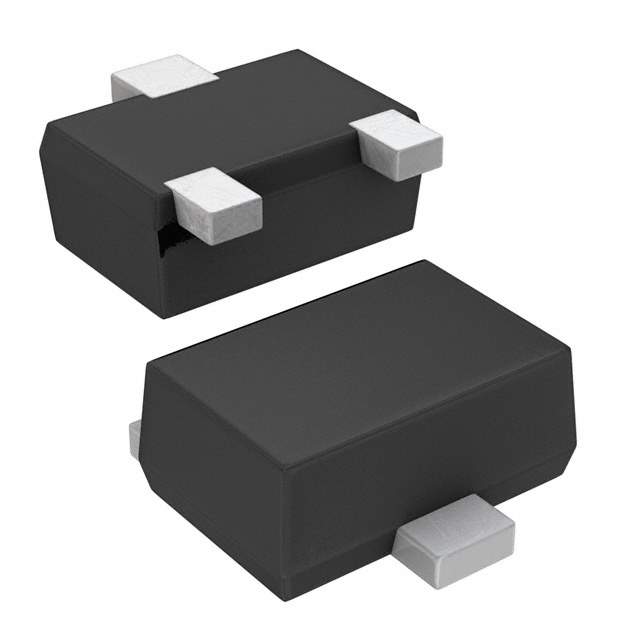
50V VCEO ceiling, 100mA collector ceiling, 200mW limit, SC-85/UMT3F pre-biased NPN
Quick Engineering Summary
| Field | Value |
|---|---|
| Manufacturer | Rohm Semiconductor |
| Category | Transistors (BJT) - Single, Pre - Biased |
| Package | UMT3F |
| Core function | TRANS PREBIAS NPN 50V UMT3F |
| Key electrical range | Current - Collector (Ic) (Maximum): 100mA; Current - Collector Cutoff (Maximum): 500nA; DC Current Gain (hFE) (Minimum) @ Ic, Vce: 30 @ 10mA, 5V; Frequency - Transition: 250MHz |
| Reported stock | 21000 pcs reported — confirm on RFQ |
50V is the reason to consider DTC143EUBTL
50V sets the collector-emitter breakdown ceiling. That number is the main reason to look at DTC143EUBTL for higher-voltage logic-side switching where a small pre-biased NPN has to survive the rail, even though it says nothing by itself about current handling or heat.
The design-in case is clear. Lifecycle is Active with low risk and no stated conflict, and EU RoHS compliance is called out directly. The only practical caution is supply marked Limited, so availability belongs in the plan rather than in last-minute purchasing.
Wrong for heavy load switching, right for compact bias networks
Heavy load switching is the wrong job for this part. The 100mA collector current is a ceiling, and the 200mW power figure is a separate ceiling that can stop you sooner once voltage remains across the device.
It fits compact board-level switching and interface work that benefits from the built-in 4.7k base resistor and 4.7k emitter-base resistor. Those values point to a device meant to cut external parts and placement area in a small SMD footprint, not a free-form transistor stage. The listed 300mV VCE(sat) at 500µA and 10mA gives one bounded low-current switching point, but it does not describe saturation behavior at higher collector current.
Can you actually keep a line running on it?
Can you buy it in a production rhythm? Mostly yes. DTC143EUBTL shows 21000 in stock and reel package, which is the packaging signal you want for automated assembly rather than bench builds or hand-fed replenishment.
The catch is the same one buyers will notice first: supply and demand is marked Limited. That matters more than the popularity field. If this transistor is going onto a running line, lock the reel format into the BOM and place coverage earlier than usual. It's not waving a lifecycle red flag, but it is telling you not to count on casual replenishment.
The real design limit is what the listing does not show
The constraint is missing stress and switching detail around the headline ratings. The numbers are enough to place the device in the right class, but they do not close out edge-case review.
No thermal resistance or derating curve is listed. The 200mW maximum is only a ceiling until you know how it shifts with ambient and board conditions, and in SC-85 / UMT3F that detail can decide whether a cramped layout is comfortable or marginal.
No pinout or package drawing is shown. With a pre-biased transistor, category match is not enough; the internal resistor network only helps when the pins land where the schematic expects.
Switching detail is thin as well. A 250MHz transition frequency is listed, but that is not a substitute for turn-on or turn-off behavior in a logic path. There is also no pulse-current or surge figure, so startup or fault spikes should not be assumed acceptable just because the DC collector ceiling is 100mA.
View the Win-Source product page for DTC143EUBTL.
Key Takeaways for Engineers & Buyers
- Keep DTC143EUBTL off rails that can force more than 50V across collector-emitter.
- Treat 100mA collector current and 200mW power as separate ceilings in the load budget.
- Buy DTC143EUBTL in reel-package flow; 21000 pieces are listed, but supply is marked Limited.