
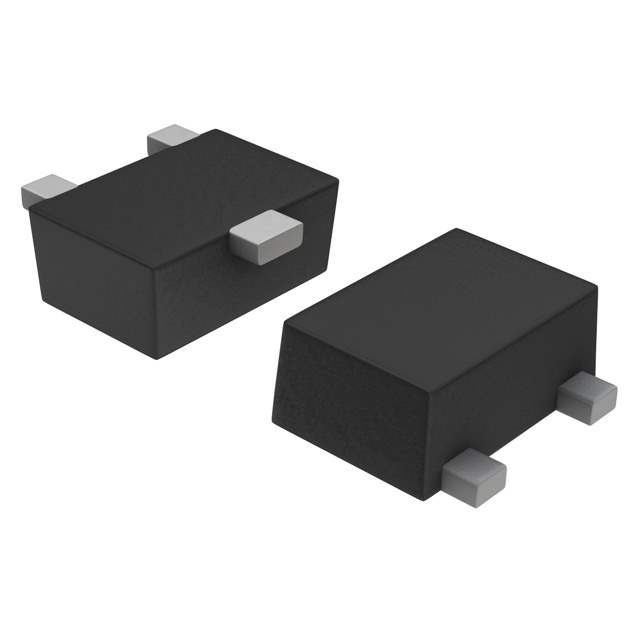
50V VCEO, 100mA collector ceiling, 260mW limit, SOT-723 pre-biased NPN with 4.7k base resistor
Quick Engineering Summary
| Field | Value |
|---|---|
| Manufacturer | ON Semiconductor |
| Category | Transistors (BJT) - Single, Pre - Biased |
| Package | SOT-723 |
| Core function | TRANS PREBIAS NPN 50V SOT723 |
| Key electrical range | Collector Cut-off Current(Max): 500nA; Maximum Current Collector: 100mA; Maximum Power Dissipation: 260mW; Supply and Demand Status: Sufficient |
| Reported stock | 14170 pcs reported — confirm on RFQ |
Use it for new builds, with small-signal discipline
Good fit.
Active status and aligned lifecycle signals make this a reasonable new design-in choice, and EU RoHS compliance removes a common procurement snag. The real limit is scale: a pre-biased NPN in SOT-723 with a 260mW maximum power dissipation belongs in compact logic-level switching and bias networks, not in spots that need thermal slack or generous current margin.
Not for load driving; fine for compact bias-and-switch nodes
Heavy load driving is the wrong job. The 100mA maximum collector current and 260mW power ceiling shut that down fast.
It fits dense board work where the built-in 4.7k base resistor saves parts and routing, and where SOT-723 is the package the layout needs.
Those headline numbers are ceilings, not comfort zones
And that carries straight into the electrical limits. The 50V VCEO only sets the off-state voltage ceiling; it does not tell you the part has much room once collector current and dissipation start stacking up.
The 100mA collector current figure is a ceiling too, not a target. If the load path wants that much current continuously, the 260mW maximum power dissipation becomes the tighter limit very quickly, especially in SOT-723. The listed 250mV @ 1mA, 10mA for VCE(sat) is still useful, but only in a narrow way: it shows low-voltage switching at that stated test point, not a broad saturation picture across the current range. The 500nA collector cut-off current matters in high-impedance nodes or battery paths, where off-state leakage can become the surprise.
14170 pieces help, but the datasheet still has holes
14170 pieces in stock makes this a practical line item today, and Reel - TR packaging lines up with automated assembly rather than hand-load exceptions.
What still blocks release is missing technical detail. This listing gives R1 at 4.7k and explicitly shows no R2, so the bias network shape is clear, but not enough is here to finish the job. Pinout is absent. A package drawing is absent. Thermal resistance is absent, and that number decides how much ambient room the 260mW ceiling really leaves on your board. There is also no switching spec such as transition frequency, and no saturation curve beyond the single 250mV @ 1mA, 10mA point.
The buy call is straightforward: if DTC143TM3T5G fits the function, reserve reel quantity for the build plan, then pull the full datasheet before locking footprint and thermal assumptions.
View the Win-Source product page for DTC143TM3T5G.
Key Takeaways for Engineers & Buyers
- Keep DTC143TM3T5G on reel builds only; packaging is Reel - TR.
- Treat 100mA collector current and 260mW as separate ceilings when sizing load and ambient headroom.
- Pull the full datasheet for pinout and thermal data before releasing the DTC143TM3T5G footprint.