
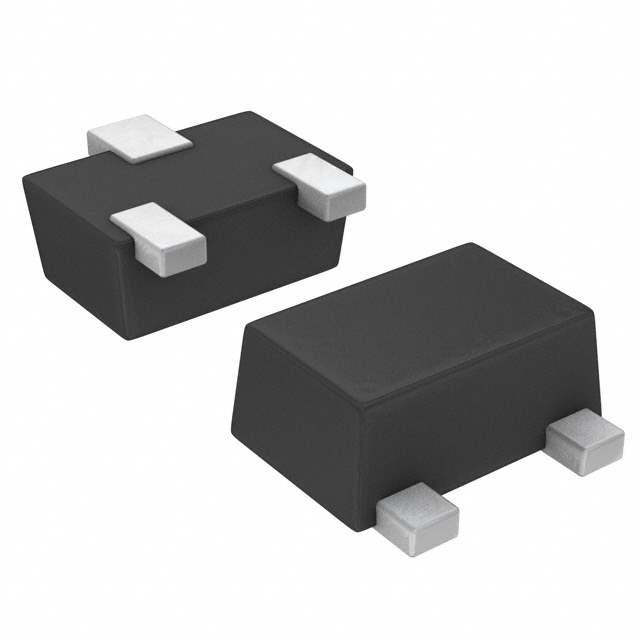
50V VCEO ceiling, 100mA collector ceiling, 150mW dissipation ceiling, VMT3 package
Quick Engineering Summary
| Field | Value |
|---|---|
| Manufacturer | Rohm Semiconductor |
| Category | Transistors (BJT) - Single, Pre - Biased |
| Package | VMT3 |
| Core function | TRANS PREBIAS NPN 50V 0. |
| Key electrical range | Collector Cut-off Current(Max): 500nA (ICBO); Frequency - Transition: 250MHz; Maximum Current Collector: 100mA; Maximum Power Dissipation: 150mW |
| Reported stock | 3540 pcs reported — confirm on RFQ |
The constraint is power, not breakdown voltage
Power dissipation is the real constraint here. The 150mW maximum sets the boundary first, and by itself it does not tell you safe ambient or copper area. It does tell you DTC143TMT2L belongs in small-signal switching and interface work, not in jobs where the transistor is expected to sit hot or carry load current for long stretches.
The 50V VCEO maximum gives useful rail margin, but it does not rescue a thermally tight use case. Set beside the 100mA maximum collector current, the picture is straightforward: moderate voltage is available, modest current is allowed, and the package-level dissipation ceiling shuts the door on heavier switching roles before breakdown voltage does. Active lifecycle and EU RoHS support new design-in.
50V is a ceiling, not permission to switch anything
50V is the collector-emitter breakdown ceiling. It tells you whether DTC143TMT2L belongs on a higher-voltage logic or control node, but not whether that node stays inside the 150mW dissipation limit once current starts flowing.
A second number matters just as much: 300mV max VCE(sat) at 250μCA and 5mA. That is a small-signal condition, so it supports low-current saturated switching behavior rather than any broad promise of low drop at the 100mA collector ceiling. The 500nA ICBO maximum is also useful in standby paths or pull-down functions because it puts a hard ceiling on off-state collector leakage.
Wrong for load driving, right for compact bias-and-switch jobs
Wrong for load driving.
DTC143TMT2L is a pre-biased NPN with only R1 listed at 4.7k, in VMT3, and that combination points to compact board-level switching where saving external bias parts matters more than extracting maximum drive current from the stage.
It fits logic interfacing, signal gating, and simple transistor stages where the built-in base resistor is the point. The 250MHz transition frequency shows it is not a sluggish device, but that still falls short of an RF transistor recommendation. Use DTC143TMT2L where the integrated bias network simplifies placement and assembly, and skip it where resistor choice freedom, higher collector current, or more thermal headroom matters more.
Buy it for running lines, but close the package gaps first
Buyable now.
Availability is not the issue. DTC143TMT2L is listed Active, packaged on Reel - TR, with 3540 in stock quantity and supply marked sufficient, so it works as a credible line item for ongoing builds and for a fresh design that already expects tape-and-reel SMT flow.
The real hold-up is package definition. The listing names VMT3, and the text maps that to SOT-723, but it does not include the pinout, land pattern, or mechanical drawing that determine whether DTC143TMT2L drops into your footprint without a board spin. ECAD is not included here, so pull the package drawing before committing copper.
The electrical omissions are just as concrete. No thermal resistance is listed, so the 150mW ceiling cannot be converted into ambient headroom from this page alone. No pulse or surge current figure is listed either, which leaves the 100mA collector number as a steady-use ceiling rather than evidence of transient tolerance.
View the Win-Source product page for DTC143TMT2L.
Key Takeaways for Engineers & Buyers
- Keep collector current below the 100mA ceiling; this listing does not give pulse headroom.
- Budget dissipation against the 150mW ceiling before using DTC143TMT2L as a loaded switch.
- Confirm the VMT3 pinout and drawing before layout; ECAD is not included here.