
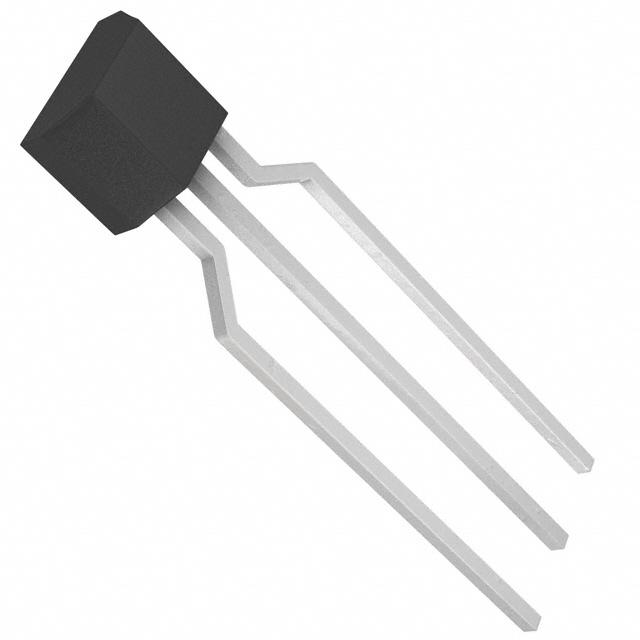
50V VCEO, 100mA collector ceiling, 300mW dissipation limit, through-hole SPT package
Quick Engineering Summary
| Field | Value |
|---|---|
| Manufacturer | Rohm Semiconductor |
| Category | Transistors (BJT) - Single, Pre - Biased |
| Package | SPT |
| Core function | TRANS PREBIAS NPN 50V 0. |
| Key electrical range | Collector Cut-off Current(Max): 500nA (ICBO); Frequency - Transition: 250MHz; Maximum Current Collector: 100mA; Maximum Power Dissipation: 300mW |
| Reported stock | 1 pcs reported — confirm on RFQ |
50V is useful, but it doesn't rescue an EOL line
50V sets the collector-emitter breakdown ceiling. That keeps DTC143TSATP relevant for higher-voltage small-signal switching than many low-voltage digital transistors, but it does not change the bigger problem.
The listing marks the part EOL, and the status fields line up without conflict. No new design-in. If an existing build already depends on its pre-biased NPN behavior and 4.7k base resistor, it can serve only as a stopgap. EU RoHS compliance is present, but that is not the gating issue.
The current and power numbers are both ceilings
And the limits tighten from there. The 100mA maximum collector current is a ceiling, not a working point, which keeps this device in light switching and bias-network duty rather than any use where load current can creep upward through production spread or fault conditions.
The 300mW maximum power dissipation is the other hard stop. In a through-hole SPT package, that points to a modest thermal budget before you even get to the missing context around ambient or lead temperature assumptions. The listed 300mV VCE(sat) at 250μA and 5mA is only meaningful at that test point; it suggests low voltage drop in very light conduction, but says nothing about saturation loss near the 100mA ceiling.
DTC143TSATP fits simple bias-and-switch jobs, not much beyond that
Use it narrowly.
The built-in 4.7k base resistor is the reason to keep DTC143TSATP in the conversation at all. It suits logic-driven discrete switching, pull-down stages, and compact bias networks where folding the resistor into the transistor saves an external part and preserves an established circuit approach. The minimum hFE of 100 at 1mA and 5V supports that reading. This is a small-signal, pre-biased NPN, not a general-purpose load switch.
The package and mounting details push in the same direction. Through-hole and SPT make more sense in established board designs, serviceable assemblies, or older layouts that already expect formed leads than in fresh density-driven layouts. And while the 250MHz transition frequency sounds generous, it should not be read as permission to treat the device like an RF transistor, because without capacitance data, switching behavior, or a fuller curve set, that figure only says the transistor itself is not especially slow under the stated characterization.
Leakage is at least bounded. The 500nA collector cut-off current is a ceiling, so off-state error current stays small in absolute terms, but only within the conditions behind ICBO, which are not expanded here. If your circuit depends on off leakage for accuracy, the missing details still matter.
Can you actually buy enough to keep a line moving?
Can you get enough parts to matter? Not really. Listed stock is 1, and for an EOL transistor that makes DTC143TSATP a repair-only option, not a production planning option.
Treat the single unit as scarcity, then quarantine it for debug, FA, or a last-board save. The AMMO PACKAGE detail describes packing, not recoverable supply.
What the listing still doesn't answer
The constraint is missing detail. Pinout, package drawing, and thermal resistance are absent here. Switching waveforms are absent too, along with any reverse-recovery-style timing data that would matter in a fast clamp or digital-switch role.
View the Win-Source product page for DTC143TSATP.
Key Takeaways for Engineers & Buyers
- Block DTC143TSATP from new BOM releases; lifecycle is EOL.
- Reserve the single listed unit only for failure analysis or line-down repair.
- Check the 300mW and 100mA ceilings against your actual load before using remaining stock.