
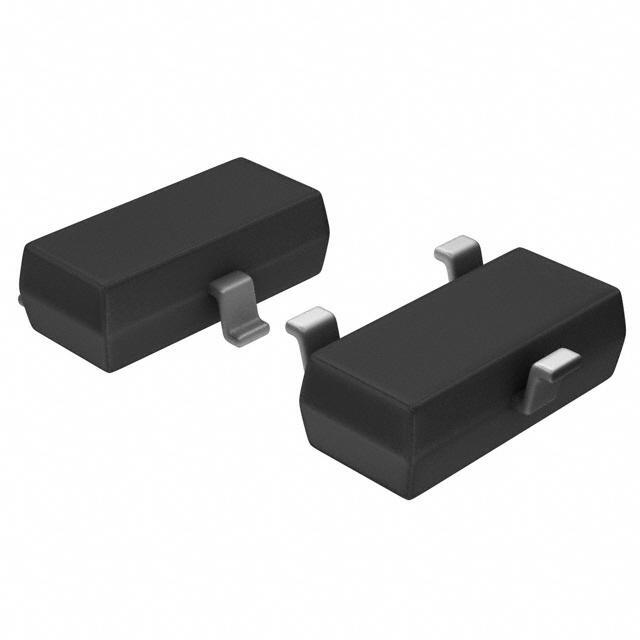
50V VCEO, 100mA collector ceiling, 200mW dissipation ceiling, SMT3 pre-biased NPN with 4.7k/10k resistors
Quick Engineering Summary
| Field | Value |
|---|---|
| Manufacturer | Rohm Semiconductor |
| Category | Transistors (BJT) - Single, Pre - Biased |
| Package | SMT3 |
| Core function | TRANS PREBIAS NPN 50V 0. |
| Key electrical range | Collector Cut-off Current(Max): 500nA; Frequency - Transition: 250MHz; Maximum Current Collector: 100mA; Maximum Power Dissipation: 200mW |
| Reported stock | 2379000 pcs reported — confirm on RFQ |
Good for new design-in
Yes, it fits.
Active lifecycle with no conflict makes the case for new design-in. Stock is listed at 2379000, EU RoHS is listed, and Reel - TR packaging points to line-ready assembly. This is also a very specific device, not a generic small-signal transistor: an NPN pre-biased transistor with built-in 4.7k and 10k resistors, chosen when that bias network is exactly what the circuit needs rather than when base-drive tuning is still open.
Not for arbitrary bias networks
If you need to choose your own base resistor values, this is the wrong transistor.
It fits when the built-in 4.7k base resistor and 10k emitter-base resistor already match the logic interface and turn-off behavior you want. The 50V VCEO figure is a collector-emitter ceiling, not a rail recommendation, and the 100mA maximum collector current is a ceiling as well. That alone rules out loads that treat it like a power switch.
Then the 200mW maximum power dissipation narrows the window further, because voltage drop and package heat can end the conversation before current ever reaches 100mA. In practice, the voltage, current, and dissipation limits all point the same way: signal-level switching, not arbitrary bias networks or power-duty use.
And the saturation number needs context
And that same caution applies to the switching numbers.
One useful point is listed: 300mV max VCE(sat) at 500μA and 10mA. That's not a blanket promise across load current; it is one stated condition, and it shows the part can pull low with a modest drop in a light-load control path.
The gain line works the same way. Minimum hFE is 30 at 10mA and 5V, enough to place DTC143XKAT146 in low-current interface work but not enough to predict behavior across the full 100mA ceiling. Collector cut-off current at 500nA helps on leakage-sensitive nodes when the transistor is off. Frequency transition at 250MHz says the transistor itself is not especially slow, yet without switching curves it still leaves edge-rate and storage-time questions open.
What would stop a release today?
Can you keep buying it?
On the numbers here, yes. Active status, Balance supply-demand, and 2379000 in stock remove the immediate continuity argument against DTC143XKAT146, while Reel - TR is exactly what a placement line wants.
What stops a release today is not availability but definition. The listing names SMT3 and the broader TO-236-3, SC-59, SOT-23-3 family style in the row detail, but it does not include the package drawing or pinout that layout needs, and the thermal picture is still thin. For a pre-biased transistor, that is not a minor omission, because the part is often selected to save parts and board area, so footprint certainty is part of the value. Get the full datasheet in hand before layout release; the buy signal is strong, but the mechanical definition still has to catch up.
The missing data is the real limit
The weak point is clear.
The listing omits the pinout, package drawing, thermal resistance, switching curves, and a derating curve.
View the Win-Source product page for DTC143XKAT146.
Key Takeaways for Engineers & Buyers
- Keep DTC143XKAT146 out of paths that can approach the 100mA collector ceiling.
- Use the built-in 4.7k R1 and 10k R2 as fixed bias assumptions, not tunable values.
- Pull the package drawing and pinout before layout; this listing stops at SMT3.