
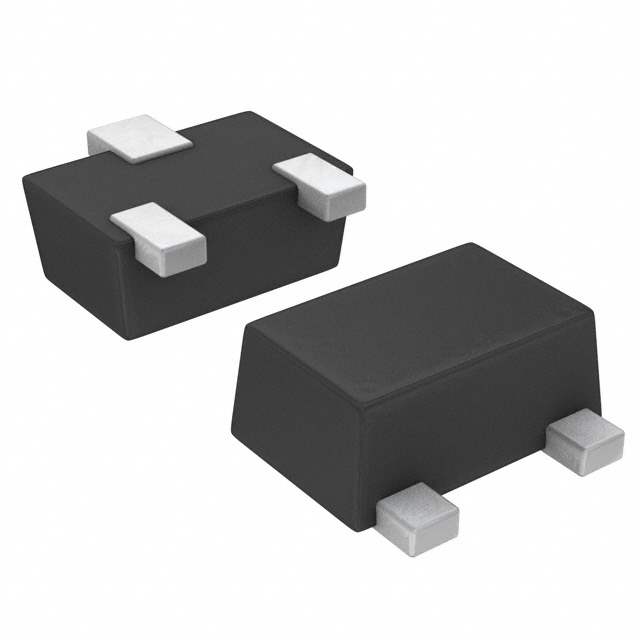
50V VCEO ceiling, 100mA collector limit, 150mW dissipation ceiling in a VMT3 pre-biased NPN
Quick Engineering Summary
| Field | Value |
|---|---|
| Manufacturer | Rohm Semiconductor |
| Category | Transistors (BJT) - Single, Pre - Biased |
| Package | VMT3 |
| Core function | TRANS PREBIAS NPN 50V 0. |
| Key electrical range | Collector Cut-off Current(Max): 500nA; Frequency - Transition: 250MHz; Maximum Current Collector: 100mA; Maximum Power Dissipation: 150mW |
| Reported stock | 66360 pcs reported — confirm on RFQ |
Can you design DTC143XMT2L into a new build?
Can you buy and place it now? Yes. DTC143XMT2L is listed Active, stock shows 66360, and the package is reel - TR, so it reads like a part for a current SMT line rather than a sustaining-only cleanup buy.
What matters more is fit. This is an NPN pre-biased transistor with R1 at 4.7k and R2 at 10k, so it belongs in circuits that want that fixed internal network, not ones that need external base-drive values tuned around the stage. EU RoHS is compliant.
The ceiling is thermal before it is current
The constraint is power. At 150mW maximum power dissipation, the first mistake is assuming the 100mA maximum collector current can be used freely across any voltage drop, even though the listing gives no derating curve or thermal resistance to show ambient headroom.
That makes the 100mA collector rating a ceiling, not a target. The listed 300mV max VCE(sat) at 500µA and 10mA is useful for judging low-current switching loss, but it does not answer heavier conduction because that saturation point is only given at 10mA. DTC143XMT2L suits small-signal switching and level translation, not loads that press collector current and package heat at the same time.
50V is what widens the fit
50V is the decisive number. It gives DTC143XMT2L room beyond the usual low-voltage digital domain, so a pre-biased NPN can survive modest high-side referenced or pull-down jobs without being boxed into logic-only rails.
That still leaves real boundaries. No pulse or avalanche data is listed, so VCEO settles the rail question but not energy handling, surge behavior, or inductive stress. For switching fit, the resistor pair matters just as much: R1 is 4.7k and R2 is 10k, which makes the part strongest where BOM reduction and repeatable biasing matter more than the freedom to choose base and bleed resistors independently for edge speed, noise immunity, or unusual source impedance.
Leakage helps its case. Collector cut-off current is listed at 500nA max, a useful limit when an off-state path can disturb a high-impedance node, though the temperature behavior is still not shown in curves. The 250MHz transition frequency is also listed, but without switching waveforms or capacitance data it does not support a claim of fast edge performance in a real interface. DTC143XMT2L fits compact board-level switching; timing-critical analog cleanup still needs more data.
Buy it, but close the missing package data
Buy it.
Use the available 66360 for current builds, but do not release DTC143XMT2L into layout freeze until the datasheet closes pinout, package drawing, thermal resistance, and derating information.
View the Win-Source product page for DTC143XMT2L.
Key Takeaways for Engineers & Buyers
- Keep DTC143XMT2L on rails that stay inside the 50V VCEO ceiling.
- Budget heat from the 150mW maximum power dissipation before using the full 100mA collector limit.
- Lock the input drive around the built-in 4.7k R1 and 10k R2 network; this transistor isn't a blank BJT.