
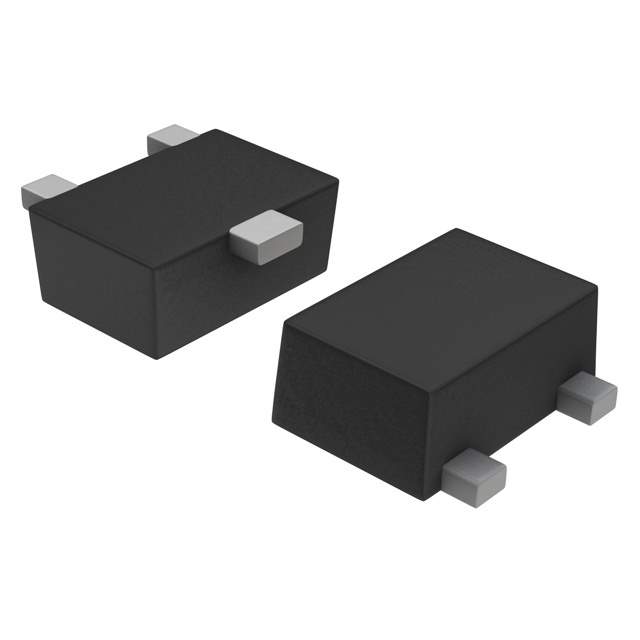
50V, 100mA, 260mW in SOT-723, with built-in 4.7k and 47k resistors deciding where it fits
Quick Engineering Summary
| Field | Value |
|---|---|
| Manufacturer | ON Semiconductor |
| Category | Transistors (BJT) - Single, Pre - Biased |
| Package | SOT-723 |
| Core function | TRANS PREBIAS NPN 50V SOT723 |
| Key electrical range | Current - Collector (Ic) (Maximum): 100mA; Current - Collector Cutoff (Maximum): 500nA; DC Current Gain (hFE) (Minimum) @ Ic, Vce: 80 @ 5mA, 10V; Power - Max: 260mW |
| Reported stock | 1 pcs reported — confirm on RFQ |
Can you start a new design with DTC143ZM3T5G?
Can you use it in a new design? Yes, if the internal resistor network is the reason you want it rather than a nice extra. This Active pre-biased NPN in SOT-723 fits when you want to collapse a small bias network into one placement and keep the board fully SMD.
Supply is the real caution. Listed stock is 1, packaging is Reel - TR, and the part also carries an Estimated EOL Date of 2026 even though lifecycle is shown as Active. That is not a formal conflict, but it is enough to keep this from being a carefree line item for a long production horizon. Use it only when the 4.7k and 47k values are exactly what the circuit needs, and get direct lifecycle confirmation before the BOM is frozen. EU RoHS is straightforward.
50V is the rail ceiling; 260mW is the real constraint
260mW is the decisive number. In a SOT-723 body, that power figure is a ceiling, not a place to operate casually, and it keeps DTC143ZM3T5G from being treated like a general small-signal switch just because the collector-emitter breakdown is 50V.
That 50V collector-emitter breakdown does matter. It lets the transistor sit on higher-voltage control rails than many logic-biased BJTs, but it says nothing about comfort with dissipation. If the job is voltage standoff with modest collector current, the 50V ceiling is useful. If the circuit spends meaningful time in saturation or linear transition, the 260mW limit becomes the first hard boundary.
The 100mA collector current is also a ceiling. It supports light load switching, not routine operation at the top of the range in this package. The listed 250mV Vce(sat) at 1mA and 10mA is the only saturation point given, so it supports low-current switching expectations but leaves the voltage drop near the top of the current rating unanswered. The minimum hFE of 80 at 5mA and 10V is just as narrow: useful for small-signal bias levels, not a full picture across the current range.
The built-in resistors are the whole point. R1 is 4.7k and R2 is 47k, and those values set input current, turn-on bias, and how hard the driving node has to work. Get that match wrong and the transistor either never turns on hard enough or turns on more softly than the load path expects.
Best in tiny bias-and-switch jobs
This is a narrow-fit part.
Dense SMD control sections are where it belongs: the pre-biased NPN saves two external resistors, and the load current stays comfortably below the 100mA ceiling. It suits logic-driven enables, pull-down functions, and small interface switching.
What the listing still doesn't tell you
And those fit limits are only part of it. There is no pinout here, no package drawing, and no thermal resistance figure, so board fit and ambient headroom remain open. There is also no switching data such as storage time or transition behavior, and that is what decides whether DTC143ZM3T5G is merely convenient or actually clean in a fast control path.
Surge behavior is also missing: no IFSM-style equivalent pulse current information is listed for the collector path, and no derating curve appears with the 260mW ceiling. Those omissions do not disqualify the part, but they do keep a serious release review open.
View the Win-Source product page for DTC143ZM3T5G.
Key Takeaways for Engineers & Buyers
- Check the logic-drive math against the built-in 4.7k and 47k network before releasing DTC143ZM3T5G.
- Keep DTC143ZM3T5G out of loads that lean on the full 100mA ceiling in SOT-723.
- Place a small buy only; listed stock is 1 while lifecycle remains Active.