
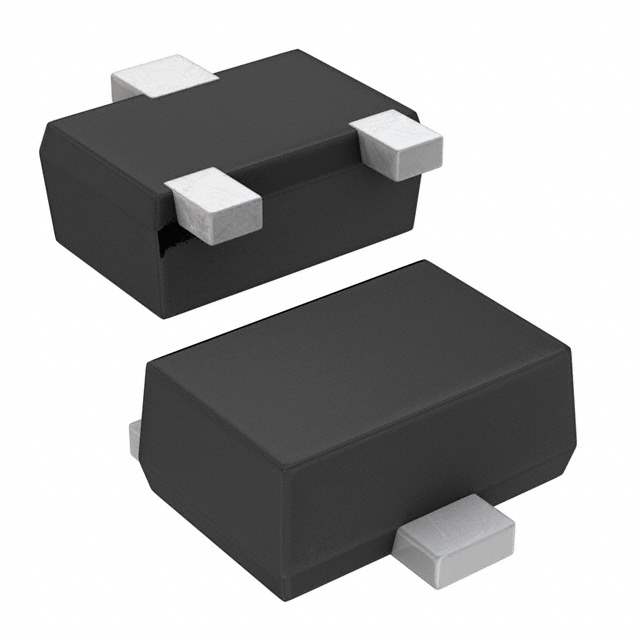
50V VCEO, 30mA collector ceiling, 150mW dissipation, EMT3F (SOT-416FL) package
Quick Engineering Summary
| Field | Value |
|---|---|
| Manufacturer | Rohm Semiconductor |
| Category | Transistors (BJT) - Single, Pre - Biased |
| Package | EMT3F (SOT-416FL) |
| Core function | TRANS PREBIAS NPN 50V EMT3F |
| Key electrical range | Collector Cut-off Current(Max): 500nA; Frequency - Transition: 250MHz; Maximum Current Collector: 30mA; Maximum Power Dissipation: 150mW |
| Reported stock | 42000 pcs reported — confirm on RFQ |
Not for power switching; fine for small-signal bias cleanup
Wrong for power switching. The 30mA maximum collector current is a ceiling, not a working point, and the 150mW maximum power dissipation is the other hard stop that keeps this device in low-power switching and interface duty.
It fits better where a single pre-biased NPN can replace two external resistors. The built-in 47k base resistor and 47k emitter-base resistor make DTC144EEBTL useful when board area and BOM count matter more than bias flexibility. Active lifecycle and EU RoHS support new design-in, but the listed supply-and-demand status is Limited, so it should not be treated as a casual late-stage add.
Can you actually buy it for a running line?
Can you get it onto a line without drama? Yes, with one caution. The stock quantity is 42000 and packaging is Reel - TR, so DTC144EEBTL is set up for assembly flow rather than bench handling.
The constraint is the word Limited in supply and demand. That does not overturn the Active lifecycle call, but it does change the move: place demand against the reel plan early instead of assuming spot availability stays comfortable.
The 50V headline matters less than the 30mA and 150mW ceilings
And that is where the first pass often goes sideways. The 50V VCEO maximum collector-emitter breakdown voltage tells you DTC144EEBTL can sit on higher-voltage small-signal nodes than many logic-side transistors, but it does not answer whether the device can carry the load once it turns on, especially when current and heat margins are already narrow.
That call is set by the 30mA maximum collector current and the 150mW maximum power dissipation. Both are ceilings. If the use case needs more collector current, or if the on-state loss budget is already tight, this package class stops looking comfortable quickly, even before ambient headroom enters the picture.
The listed 300mV maximum VCE(sat) at 500µA and 10mA helps, but only at that stated corner. It shows the part is characterized for low-current saturation behavior, not that it will track the same way near the 30mA ceiling. The 500nA collector cut-off current maximum is the quiet-state number that matters on leakage-sensitive nodes, especially when a pull-up or pull-down has to stay honest in standby.
Then there is the built-in network: 47k for R1 and 47k for R2. That is the real fit question for DTC144EEBTL. You are not choosing a bare NPN and adding your own bias values later; you are taking this resistor pair as-is, so input drive strength and turn-off behavior need to suit that fixed network.
What the listing still doesn’t answer
The constraint is missing detail. No pinout, package drawing, thermal resistance, or derating curve is listed here. For DTC144EEBTL, those gaps decide land pattern confidence and how much of the 150mW ceiling is usable on the board.
View the Win-Source product page for DTC144EEBTL.
Key Takeaways for Engineers & Buyers
- Check that the control node can live with the built-in 47k R1 and 47k R2 network before freezing the bias scheme.
- Keep collector load inside the 30mA ceiling and the 150mW dissipation ceiling; those two limits close the fit fast.
- Book reel demand early if DTC144EEBTL is for production, because packaging is Reel - TR and supply is listed Limited.