
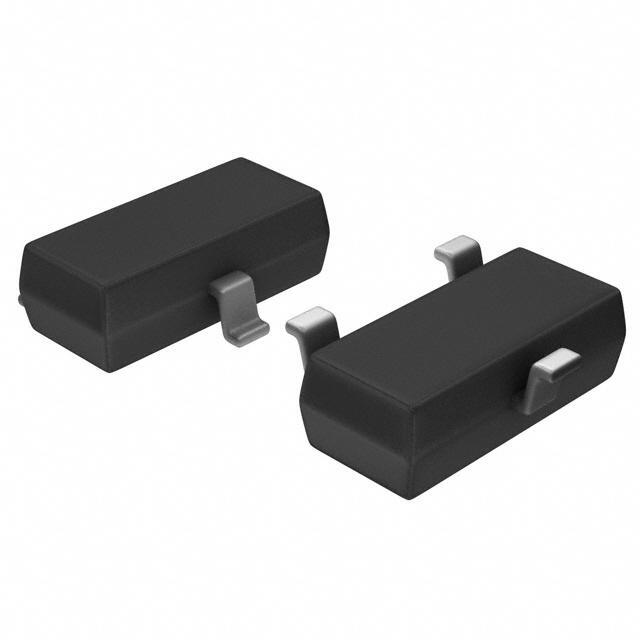
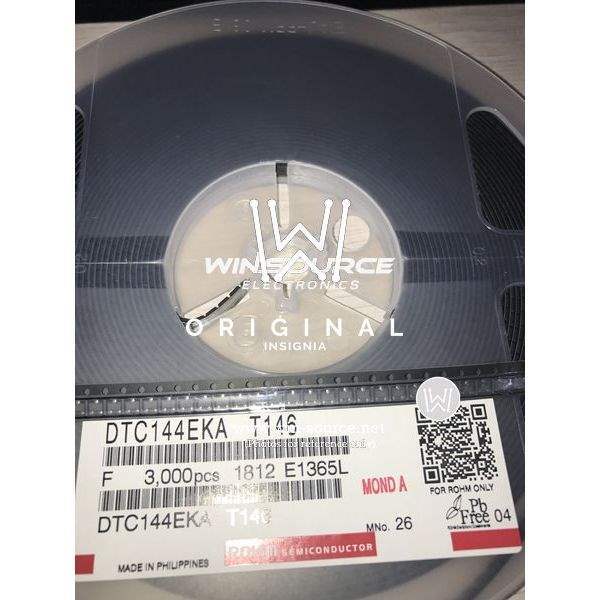
50V VCEO ceiling, 100mA collector limit, 200mW cap, SMT3 pre-biased NPN with 47k/47k resistors
Quick Engineering Summary
| Field | Value |
|---|---|
| Manufacturer | Rohm Semiconductor |
| Category | Transistors (BJT) - Single, Pre - Biased |
| Package | SMT3 |
| Core function | TRANS PREBIAS NPN 50V 0. |
| Key electrical range | Collector Cut-off Current(Max): 500nA; Frequency - Transition: 250MHz; Maximum Current Collector: 100mA; Maximum Power Dissipation: 200mW |
| Reported stock | 86530 pcs reported — confirm on RFQ |
Not for load drive; good for compact logic-level switching
Wrong part for load drive. The listed ceilings are 100mA collector current and 200mW power dissipation, which leave little room for output current headroom or thermal slack. A relay coil, lamp, or other heavier load will hit those limits long before the 50V VCEO ceiling becomes the main issue.
Where it fits is the job the category suggests: a single pre-biased NPN that folds a few external parts into one SMT3 device. The built-in 47k base resistor and 47k emitter-base resistor suit designs that want board density and repeatable biasing more than transistor flexibility. Active lifecycle and EU RoHS strengthen the case for new work.
Can you actually buy it for a line build?
Can you get it in production quantities? Yes. Stock is listed at 86530, packaging is Reel - TR, and supply-and-demand status is Sufficient, so this looks like a practical line-build part rather than a bench-only buy.
The real constraint is program length. An Estimated EOL Date of 2028 sits alongside the Active lifecycle, so DTC144EKAT146 works for current design-in but should already be on the watch list for long-lived BOMs.
Then the built-in resistor pair decides the interface
And that is the real interface decision. DTC144EKAT146 fixes R1 at 47k and R2 at 47k, so this is not a generic NPN you can bias however you like later; it is a transistor plus a fixed input network that either matches the driving node or works against it.
The gain figure only speaks at its stated corner: hFE minimum 68 at 5mA, 5V. The saturation listing is just as specific, with 300mV max at 500µA, 10mA. Treat that as a ceiling at that condition, not a blanket promise of low drop elsewhere.
The hard limit is dissipation, not the headline voltage
A small thermal and current budget defines this part. The 50V VCEO ceiling gives decent collector-emitter breakdown margin for signal-level rails and pull-up networks, but it does not make the device comfortable at meaningful power because the same listing also sets a 100mA collector-current ceiling and a 200mW maximum power-dissipation cap.
That combination is the real boundary. It separates a useful digital helper transistor from a poor power-stage choice, and it matters more than the headline voltage because a design can look safe on breakdown margin while still running straight into current or heat limits.
The 300mV VCE(sat) max at 500µA, 10mA is still useful, since it points to modest on-state loss at that exact test condition, but it does not settle behavior outside it. DTC144EKAT146 belongs around control nodes, level shifting, and compact switching where the built-in bias network cuts parts count; it does not belong where current or heat drives the design.
Frequency transition at 250MHz says the transistor itself is not especially slow, yet the switching detail needed for edge-sensitive use is still missing here. For a timing-critical path, trr, RθJC, and pinout matter more than the headline MHz figure.
The datasheet gaps are the real review blockers
Proceed carefully. Missing items for DTC144EKAT146 include pinout, package drawing, RθJC, and switching curves. Those close footprint work, ambient headroom, and edge behavior, and this listing does not include them.
View the Win-Source product page for DTC144EKAT146.
Key Takeaways for Engineers & Buyers
- Keep collector current below the 100mA ceiling; DTC144EKAT146 is a small-signal switch, not a load driver.
- Check the bias math against the built-in 47k R1 and 47k R2 before freezing the logic interface.
- Buy on reel for the running line while 86530 pieces are available.