
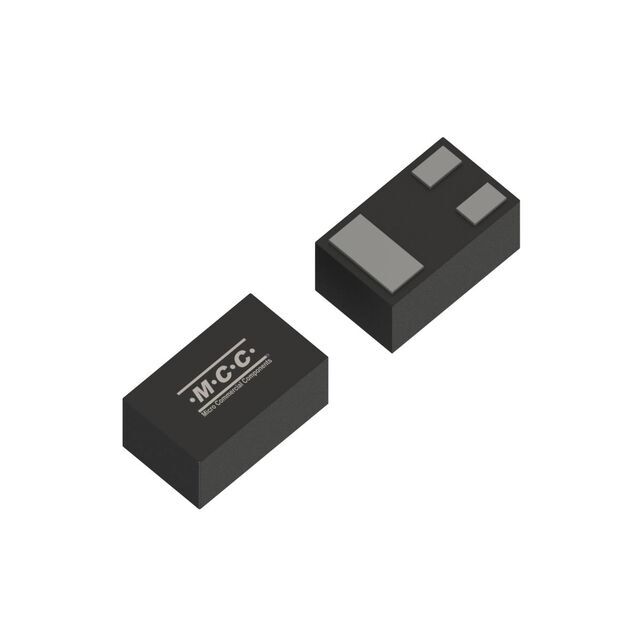
50 V, 100 mA, 150 mW in DFN1006-3; stock count, not lifecycle, is the immediate constraint
Quick Engineering Summary
| Field | Value |
|---|---|
| Manufacturer | Micro Commercial Co |
| Category | Transistors (BJT) - Single, Pre - Biased |
| Package | SC-101, SOT-883 |
| Core function | PRE-BIASED TRANSISTOR |
| Key electrical range | Current - Collector (Ic) (Max): 100 mA; Current - Collector Cutoff (Max): 500nA; DC Current Gain (hFE) (Min) @ Ic, Vce: 68 @ 5mA, 5V; Frequency - Transition: 200 MHz |
| Reported stock | 1 pcs reported — confirm on RFQ |
Active status helps, but the line item is still fragile
And that is the real split on DTC144EL3-TP: lifecycle is not the problem. It is listed Active with low lifecycle risk, so it works for new design-in and existing production. EU RoHS is compliant, and REACH is unaffected, removing the usual compliance objection.
The weak point is supply. Listed quantity is 1, with Reel - TR packaging, so this is not a part to release casually into a build that expects immediate volume. Put DTC144EL3-TP on the BOM only after reel supply is lined up.
Not for arbitrary biasing; right for resistor-defined switching
This is the wrong part when you want a plain small-signal NPN and plan to choose the base network yourself. DTC144EL3-TP is a pre-biased NPN with 47 kOhms on R1 and 47 kOhms on R2, so those internal values already shape circuit behavior.
It fits compact, resistor-defined switching instead. The DFN1006-3 supplier package and SC-101, SOT-883 case suit dense surface-mount work, and the 300mV maximum Vce saturation at 500µA and 10mA gives one characterized low-current switched point. That does not tell you how DTC144EL3-TP behaves across the full 100 mA ceiling.
Can you actually buy DTC144EL3-TP for a build?
Right now, not comfortably. The stock figure is 1, and the package format is Reel - TR, so do not release DTC144EL3-TP into a production schedule until reel availability is in hand.
That matters more than the Active lifecycle flag today. A healthy lifecycle does not help if the line stops on a one-piece listing.
The 50 V rating is useful, but power closes the design first
150 mW is the number that sets the boundary first. DTC144EL3-TP also carries a 100 mA maximum collector current and a 50 V maximum collector-emitter breakdown rating, but both are ceilings, not normal operating points, and they do not grant simultaneous use at the edge.
The 50 V figure answers only whether the collector-emitter path has enough voltage headroom for the rail in question, while the 100 mA limit answers whether the load current belongs in range at all; neither one, on its own, tells you what dissipation, switching loss, or thermal margin looks like in a DFN1006-3 body when the design starts pushing toward the edges.
One characterized conduction point is given: 300mV maximum Vce saturation at 500µA and 10mA. That is useful because it anchors low-current switching behavior with a stated base-drive condition. The 68 minimum hFE at 5mA and 5V helps in that same narrow window, not as a blanket gain promise across every collector current you may want to use.
Leakage matters too. The 500nA maximum collector cutoff current is an off-state ceiling, so it matters at high-impedance nodes and in low-leakage sensing paths. The 200 MHz transition frequency does not turn DTC144EL3-TP into a precision analog device.
The missing curves are the real review blockers
Two gaps matter. Thermal resistance and pinout detail.
Without a thermal path number, the 150 mW limit stays a package ceiling with no ambient story attached. The listing also omits switching curves and fuller saturation behavior beyond 300mV at 500µA and 10mA.
View the Win-Source product page for DTC144EL3-TP.
Key Takeaways for Engineers & Buyers
- Treat 100 mA collector current as a ceiling; check your load line against the 150 mW limit.
- Use the built-in 47 kOhms and 47 kOhms network on purpose, not as a generic small-signal NPN.
- Secure reel supply before release; listed stock is 1.