
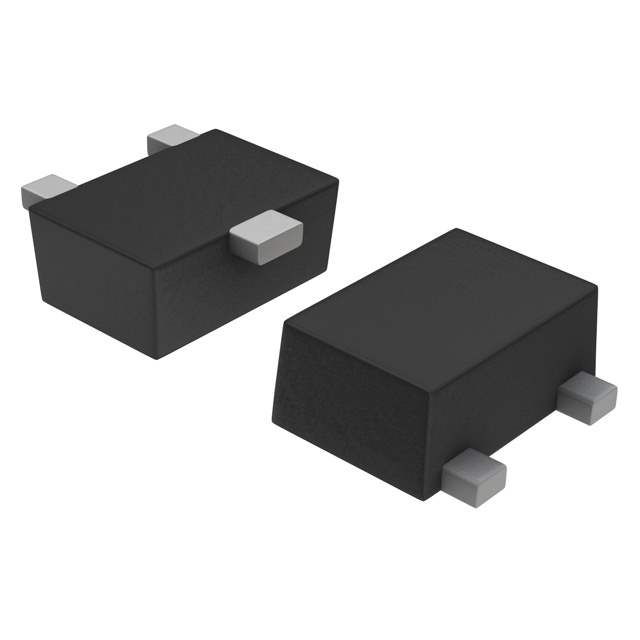
50V VCEO ceiling, 100mA collector limit, 260mW dissipation ceiling, in SOT-723 with built-in 47k/47k bias resistors
Quick Engineering Summary
| Field | Value |
|---|---|
| Manufacturer | ON Semiconductor |
| Category | Transistors (BJT) - Single, Pre - Biased |
| Package | SOT-723 |
| Core function | TRANS PREBIAS NPN 50V SOT723 |
| Key electrical range | Collector Cut-off Current(Max): 500nA; Maximum Current Collector: 100mA; Maximum Power Dissipation: 260mW; Supply and Demand Status: Balance |
| Reported stock | 13300 pcs reported — confirm on RFQ |
The tiny package is the catch, but it is a real design-in part
The weak point comes first: SOT-723 leaves very little board area and very little copper for heat spreading. That matters because DTC144EM3T5G also has a 260mW maximum power dissipation ceiling.
Past that, the design-in case is plain enough. The part is Active, available quantity is 13300, it ships in reel form, and the pre-biased NPN structure is defined with 47k on R1 and 47k on R2. That makes it a sensible fit when the goal is to remove two external resistors and keep the switch function compact. EU RoHS is compliant. What remains open is dynamic behavior and thermal headroom at ambient, since those curves are not listed.
The ceilings are clear, and they narrow the use case fast
This part is tightly bounded.
The 50V VCEO figure is a breakdown ceiling. It answers one question quickly: DTC144EM3T5G fits low-voltage and moderate-voltage collector nodes, but not rails that sit near that limit or see poorly controlled spikes. Get that wrong and the failure mode will be direct.
The 100mA maximum collector current is also a ceiling. So is the 260mW maximum power dissipation. Taken together, those numbers force the real design question into the open: how much voltage must the transistor drop while carrying current, and how much heat can the package shed before you run out of margin? In a package this small, that tradeoff arrives fast, and the current rating by itself does not tell the story.
One listed operating point helps, but only a little. The 250mV max VCE(sat) at the 300µA, 10mA point says saturation loss can stay low at light switched current when your drive conditions match that test condition. It says nothing about the rest of the operating range, where voltage drop and dissipation can move against you at the same time.
Leakage and gain are clearer. The 500nA collector cut-off current maximum is low enough to matter in pull-up or sense paths where off-state drift can show up as false biasing, though it remains only an off-state ceiling. The 80 minimum hFE at 5mA, 10V shows usable gain at that stated condition. It does not carry a design that assumes the same behavior elsewhere.
Can you keep a line on DTC144EM3T5G?
Can you buy it in a form the line actually wants?
Yes, and that is the practical point. DTC144EM3T5G is listed in Reel - TR, and the available quantity is 13300, so it fits a normal SMT flow without special handling or repack friction.
Lifecycle is not the real concern here; Active already settles that. The real check is whether your assembly handles SOT-723 consistently, because a clean electrical fit will not overcome a package your line dislikes. If your process already places very small discretes, this is the kind of transistor you secure in reel form and keep moving.
DTC144EM3T5G fits control nodes, not power switching
47k is the decisive figure here.
With 47k on R1 and 47k on R2, this is a pre-biased small-signal NPN where the resistor pair is part of the function. That points DTC144EM3T5G toward board-level logic interfacing, simple level shifting, and small load switching when those resistor values already suit the driving source.
It is the wrong tool when you need freedom to tune base resistance, push switching speed, or run collector current hard against the package dissipation ceiling. The 250mV max VCE(sat) point at 300µA, 10mA supports low-current switching use; it does not make this a general-purpose power transistor.
What the listing still doesn't answer
This part is wrong for a layout or timing decision without a few missing basics.
You still need pinout, package drawing, thermal resistance, and switching-speed data.
View the Win-Source product page for DTC144EM3T5G.
Key Takeaways for Engineers & Buyers
- Keep VCE below the 50V breakdown ceiling; that number does not buy transient margin by itself.
- Budget heat against the 260mW dissipation ceiling before using the full 100mA collector rating.
- Match the drive network to the built-in 47k R1 and 47k R2, or pick a different bias scheme.