
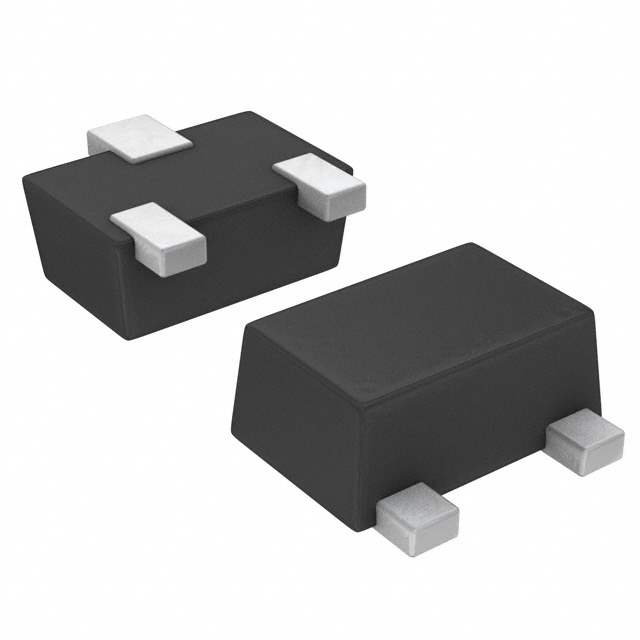
50V VCEO, 30mA collector ceiling, 150mW dissipation limit, VMT3 package, 47k/47k built-in bias network
Quick Engineering Summary
| Field | Value |
|---|---|
| Manufacturer | Rohm Semiconductor |
| Category | Transistors (BJT) - Single, Pre - Biased |
| Package | VMT3 |
| Core function | TRANS PREBIAS NPN 50V VMT3 |
| Key electrical range | Collector Cut-off Current(Max): 500nA; Frequency - Transition: 250MHz; Maximum Current Collector: 30mA; Maximum Power Dissipation: 150mW |
| Reported stock | 322000 pcs reported — confirm on RFQ |
Good for new builds
Yes, for new builds. Active status, EU RoHS compliance, and 322000 in stock make DTC144EMT2L a credible design-in choice when a VMT3 pre-biased NPN fits the job.
The built-in resistors save parts, but the ceilings stay small
And that trade is the whole story. The 47k R1 and 47k R2 network removes two external resistors, but it also locks in the bias scheme, so you are selecting a transistor-plus-network rather than a bare NPN you can tune later.
The 50V VCEO figure is a collector-emitter breakdown ceiling. It answers whether the device can sit on higher-voltage small-signal rails, but it says nothing about current margin once the transistor is on. That limit is set by the 30mA maximum collector current and the 150mW maximum power dissipation, both hard ceilings that keep DTC144EMT2L in signal-level switching, pull-downs, and interface glue instead of relay drive or any use that carries meaningful load current in a tiny package for long.
The saturation listing is useful, but only in bounds: 300mV @ 500μA, 10mA shows the device can pull low at that stated condition. It does not turn 30mA into a comfortable operating point, because the dissipation ceiling remains 150mW and no thermal resistance or derating curve is listed to show how quickly ambient temperature cuts into that budget. Voltage headroom is decent here. Current and heat are not.
The package and gain point it at logic-side switching
The constraint is fixed bias. VMT3 with SMD mounting points to dense boards where saving two resistors matters, and the minimum hFE of 68 @ 5mA, 5V supports the same read: the gain is characterized in a small-signal region, not at the 30mA ceiling.
That makes DTC144EMT2L a sensible fit for MCU or logic-controlled enables, level interfaces, and simple low-current switching where the fixed 47k/47k network matches the source impedance and default state you want. It is a poor fit when startup state, base current, or turn-off behavior needs tuning, because those resistor values are already chosen. If your circuit depends on squeezing switching speed or collector current, the 250MHz transition frequency alone does not close that call.
The buy call is easy; the datasheet gaps are not
The weak point is detail. Reel-TR packaging and a Balance supply-demand status are fine for production intake, and the listed stock supports a running line today.
What still blocks a clean electrical signoff is the missing pinout or package drawing, thermal resistance or derating curve, and switching data beyond transition frequency. On a pre-biased transistor, those omissions matter more than they would on a generic small-signal BJT, because the fixed resistor network makes turn-on and turn-off behavior part of the selection. DTC144EMT2L may still be the right answer, but the datasheet needs to supply the land-pattern-level and thermal details before you freeze it.
View the Win-Source product page for DTC144EMT2L.
Key Takeaways for Engineers & Buyers
- Keep collector current below the 30mA ceiling; that limit, not the 50V rating, is the first hard stop in small-signal switching.
- Check the 47k R1 and 47k R2 network against your drive source before release; the built-in bias is the whole point of DTC144EMT2L.
- Buy on reel for line use and hold dry storage controls; stock is 322000 today, so secure the running lot if this lands on a common BOM.