
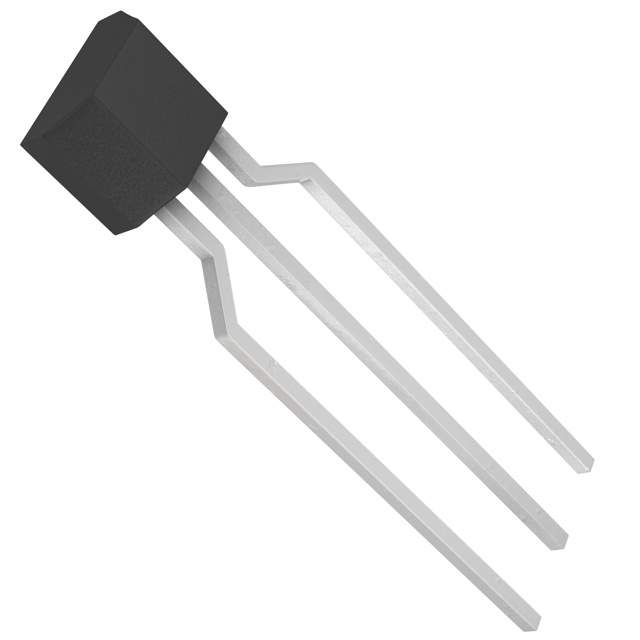
50V VCEO ceiling, 30mA collector ceiling, 300mW dissipation ceiling, SPT through-hole pre-biased NPN
Quick Engineering Summary
| Field | Value |
|---|---|
| Manufacturer | Rohm Semiconductor |
| Category | Transistors (BJT) - Single, Pre - Biased |
| Package | SPT |
| Core function | TRANS PREBIAS NPN 50V 0. |
| Key electrical range | Collector Cut-off Current(Max): 500nA; Frequency - Transition: 250MHz; Maximum Current Collector: 30mA; Maximum Power Dissipation: 300mW |
| Reported stock | 15000 pcs reported — confirm on RFQ |
Wrong for any new platform, still usable in a running line
Wrong for any new platform. DTC144ESATP is EOL, and that outweighs the otherwise workable 50V VCEO ceiling and 30mA collector ceiling because lifecycle risk will last longer than any schematic convenience.
In a running line, the part still fits where the circuit already expects a pre-biased NPN with 47k on R1 and 47k on R2 in a through-hole SPT body. That resistor pair is the real fit question, since it fixes input loading and turn-off bias behavior and leaves no room to tune base drive externally, so the part stays suited to simple level-shift, pull-down, or small-signal switching jobs built around an integrated bias network.
EU RoHS compliance is fine. It does not change the EOL call.
Use DTC144ESATP only on sustaining builds, and only where those embedded resistor values are already part of the design intent.
50V is the useful ceiling, not the whole answer
50V is the decisive number here.
It is the collector-emitter breakdown ceiling. The other ceilings are 30mA collector current and 300mW dissipation, while 300mV at 500μA, 10mA is a saturation limit at that test point.
Can you still buy enough to cover a line?
Can you still cover the line? Yes, for a bridge plan. Listed stock is 15000 and packaging is Reel - TR, so DTC144ESATP can support a controlled last-time buy for existing production if your usage is already qualified.
Buy like an EOL owner: tie the order to real build demand and service exposure, then freeze new consumption.
The built-in resistors help fit, but they also lock the use case
The weak point is flexibility. The upside is that DTC144ESATP includes 47k base bias and 47k emitter-base bias, saving two external resistors and giving you a defined input network without extra placement.
That works in low-current housekeeping paths where the 30mA collector ceiling and 300mW dissipation ceiling sit comfortably above the actual load, and where through-hole SPT packaging is acceptable. It does not fit designs that need adjustable base resistor values, higher collector current, or a thermal budget that depends on detailed derating data. The listed hFE minimum of 68 at 5mA, 5V is useful only at that test condition.
The missing details are the ones that close the review
300mW sets the scale. It tells you DTC144ESATP is a small-signal part, but key details are still missing.
No pinout, package drawing, or thermal resistance figure is listed, so board fit and ambient headroom stay open. Switching-time data is also absent, and that matters more than the 250MHz transition frequency when the transistor is used as a logic-controlled switch rather than a gain stage.
View the Win-Source product page for DTC144ESATP.
Key Takeaways for Engineers & Buyers
- Block DTC144ESATP from new BOMs; EOL status settles that.
- Check the control node against the built-in 47k/47k network before reusing DTC144ESATP.
- Reserve listed stock of 15000 only for existing production and service demand.