
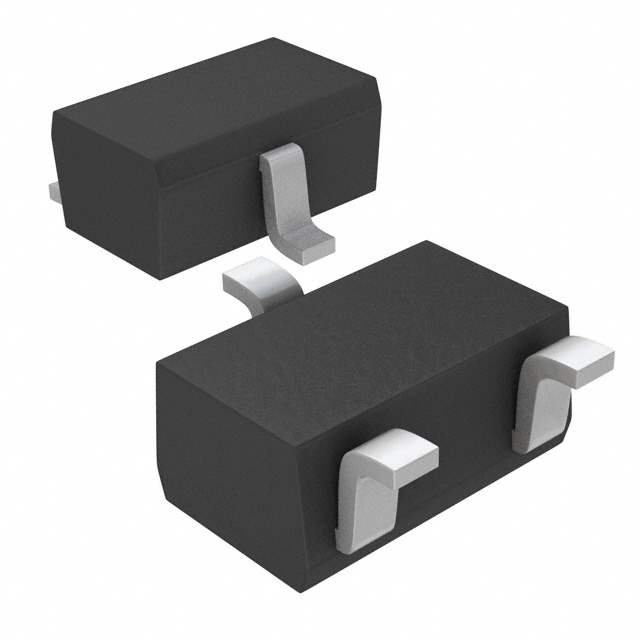
50V VCEO ceiling, 100mA collector ceiling, 200mW dissipation ceiling, UMT3 package, 47k base resistor
Quick Engineering Summary
| Field | Value |
|---|---|
| Manufacturer | Rohm Semiconductor |
| Category | Transistors (BJT) - Single, Pre - Biased |
| Package | UMT3 |
| Core function | TRANS PREBIAS NPN 50V 0. |
| Key electrical range | Collector Cut-off Current(Max): 500nA; Frequency - Transition: 250MHz; Maximum Current Collector: 100mA; Maximum Power Dissipation: 200mW |
| Reported stock | 3000 pcs reported — confirm on RFQ |
The weak point is fixed bias, but it is a real design-in part
The built-in 47k base resistor is the catch before anything else. It simplifies a digital drive stage only when that value already suits the source; if you need freedom to tune base current externally, DTC144GUAT106 gives that up from the start.
After that, the design-in case is plain enough. Active lifecycle, low stated risk, reel packaging, and 3000 in stock make it a credible fit for sustaining builds and new SMT work that want a pre-biased NPN instead of a bare transistor plus resistor. EU RoHS is compliant. What is still missing here is the pinout and package drawing, so board fit remains open until the full datasheet is in hand.
50V is the rail ceiling that decides where it can sit
50V VCEO is the decisive limit. It sets the rail boundary for DTC144GUAT106 and leaves real headroom on low-voltage control and interface rails, but it does not make the device a line-side or inductive-stress answer on its own because no avalanche or surge figure is listed.
The 100mA maximum collector current is also a ceiling, not a normal operating point, and the 200mW maximum power dissipation narrows the usable space further because UMT3 thermal limits can stop you before current does. The listed 300mV at 500µA, 10mA says one useful thing: saturation loss is modest at light collector current. It says little about behavior near the 100mA ceiling.
This one fits logic-driven switching, not analog bias work
The constraint is fixed base drive. That points the device toward simple on-off stages where a logic node needs to pull or switch a modest load without spending board area on a separate resistor.
Single NPN, pre-biased, SMT, UMT3: the category and polarity all line up with that use. The listed hFE minimum of 68 at 5mA, 5V gives some confidence under small-signal switching conditions, and the 500nA collector cut-off current ceiling helps when off-state leakage matters. Use it for compact digital interfacing and small load switching. Skip it for analog bias accuracy, custom base networks, or designs led by higher dissipation.
Can you keep a line on it?
Can you actually buy it in a way that fits production? Yes—if reel flow suits the build. Stock is 3000 and packaging is Reel - TR, so DTC144GUAT106 lines up better with scheduled SMT consumption than with hand-build convenience.
The missing datasheet items are exactly the ones that close risk
And that is where the remaining risk sits. DTC144GUAT106 is easy to place conceptually, but the absent details are the ones that decide whether it survives edge cases or simply matches the footprint you expected.
No pinout appears in this listing, and for a pre-biased transistor that is not a minor omission. With only R1 called out, exact terminal assignment still has to be nailed down before layout work or rework instructions are safe. There is also no package drawing here, even though the text ties the device to SC-70, SOT-323, and supplier package UMT3; without that drawing, land pattern and height checks stay unresolved.
The electrical gaps matter just as much. No thermal resistance is listed, so the 200mW ceiling cannot be tied to ambient headroom from this page alone. No switching-time data appears either, despite the 250MHz transition frequency, and those are not interchangeable. If turn-on or turn-off behavior matters, the datasheet still needs to provide it.
View the Win-Source product page for DTC144GUAT106.
Key Takeaways for Engineers & Buyers
- Keep collector voltage below the 50V VCEO ceiling; that number does not settle transient behavior.
- Budget heat from the 200mW dissipation ceiling before using the full 100mA collector rating.
- Match the drive network to the built-in 47k R1; this device is not a bare small-signal NPN.