
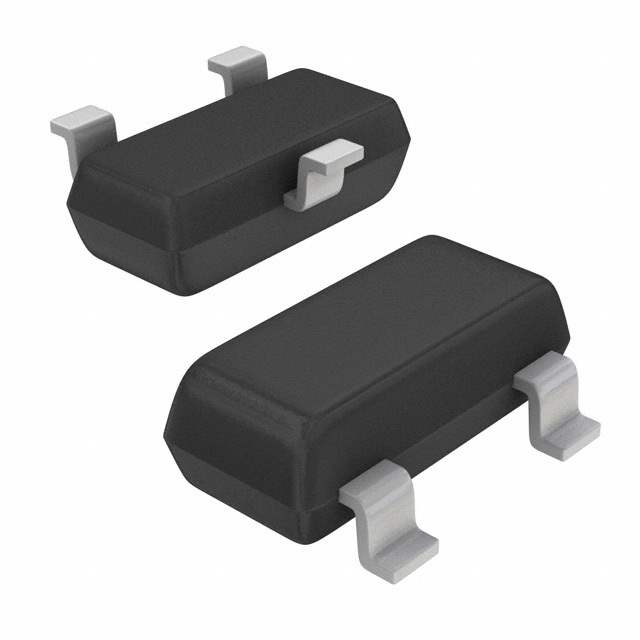
50V VCEO, 100mA collector ceiling, 150mW dissipation, EMT3 package: useful limits, but not for new designs
Quick Engineering Summary
| Field | Value |
|---|---|
| Manufacturer | Rohm Semiconductor |
| Category | Transistors (BJT) - Single, Pre - Biased |
| Package | EMT3 |
| Core function | TRANS PREBIAS NPN 50V 0. |
| Key electrical range | Collector Cut-off Current(Max): 500nA (ICBO); Frequency - Transition: 250MHz; Maximum Current Collector: 100mA; Maximum Power Dissipation: 150mW |
| Reported stock | 123000 pcs reported — confirm on RFQ |
50V is the gate, but lifecycle is the real stop sign
50V is the listed VCEO maximum, and that ceiling decides whether DTC144TETL belongs on your rail at all. It clears low-voltage switching and level-shift jobs, but by itself it says nothing about thermal margin, saturation loss, or pulse stress.
The real stop sign is lifecycle. One field says Active, another says Not For New Designs, and that conflict is enough to keep DTC144TETL in sustaining duty rather than a fresh platform. It still fits when you need the same pre-biased NPN in EMT3 to keep an existing board running, with EU RoHS compliance already listed. For a new design, the electrical limits are workable, but the lifecycle signal isn't clean enough to back a new commitment.
Wrong for power switching, fine for small-signal board work
Wrong for power switching. The 100mA maximum collector current is a ceiling, and the 150mW maximum power dissipation closes the door on relay coils, lamp loads, or any switch path that spends real time dropping voltage.
DTC144TETL fits better in compact board-level logic interfacing and simple drive stages that benefit from the built-in 47k base resistor and the pre-biased NPN structure. The listed 300mV max VCE(sat) at 500µA, 5mA gives one useful anchor: at that test point it can pull low without much drop, but only under that small-current condition. Don't stretch that number into a heavier-load promise.
47k and 300mV tell you how much freedom you really have
47k is the built-in base resistor. That one value shapes how casually DTC144TETL drops into a logic path.
It trims the BOM and keeps the part attractive for dense SMT control boards, but the input drive network is already partly chosen for you. If edge rate, source impedance, or bias current needs are touchy, the internal resistor becomes a constraint instead of a convenience.
The gain listing helps, but only a little. hFE is given as 100 @ 1mA, 5V, and the transition frequency is 250MHz; those numbers say the device is not unusually sluggish for a small transistor, yet neither replaces switching-waveform data. Here, the package and built-in resistor matter more than the headline frequency.
The missing datasheet items are the real review blockers
Weak point first: the listing leaves out the items that close the last engineering questions.
There is no pinout or package drawing here, no thermal resistance, no derating curve, and no pulse or surge current figure.
Can you keep a line running on DTC144TETL?
Can you keep a line running on DTC144TETL? For the near term, 123000 on hand says yes, and reel packaging says the part is set up for normal SMT flow rather than hand-to-mouth handling.
That is the practical case for Rohm Semiconductor DTC144TETL in an existing product: if it is already on a released board, the visible stock position supports a planned build instead of a scramble. Inventory alone doesn't settle the decision, though, because the lifecycle story still splits in two directions. One status line says Active, another says Not For New Designs, so the sensible move is to buy for current assemblies and stop there.
That also frames the next step. Lock reel demand to the builds you already know you need, then use the next spin to decide whether you want to stay with this exact pre-biased topology. The listing gives ECAD access only as contact-based, and it does not include the package drawing or pinout inline, so the mechanical handoff is not self-contained here. For a running line with a known footprint, that's manageable. For a new board, it is friction you don't need.
View the Win-Source product page for DTC144TETL.
Key Takeaways for Engineers & Buyers
- Hold DTC144TETL to rails that stay comfortably below the 50V VCEO ceiling.
- Budget collector load against both the 100mA limit and the 150mW package ceiling.
- Buy reel quantity now for running builds; the lifecycle flags conflict even with 123000 on hand.