
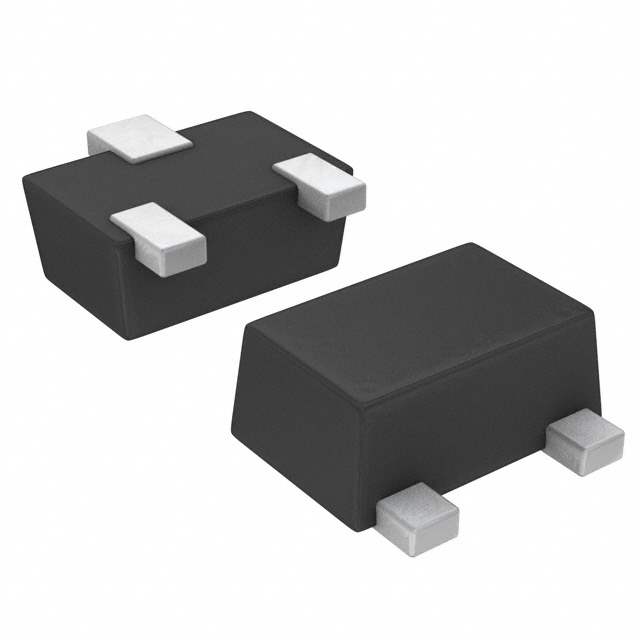
50V VCEO, 100mA collector ceiling, 150mW dissipation, VMT3 package, built-in 47k base resistor
Quick Engineering Summary
| Field | Value |
|---|---|
| Manufacturer | Rohm Semiconductor |
| Category | Transistors (BJT) - Single, Pre - Biased |
| Package | VMT3 |
| Core function | TRANS PREBIAS NPN 50V 0. |
| Key electrical range | Collector Cut-off Current(Max): 500nA; Frequency - Transition: 250MHz; Maximum Current Collector: 100mA; Maximum Power Dissipation: 150mW |
| Reported stock | 89161 pcs reported — confirm on RFQ |
The weak point is fixed bias, and that is also the appeal
The limitation comes first: this is a pre-biased NPN with a fixed 47k base resistor, so the input network is largely decided up front. There isn't much room to tune it later.
That same fixed resistor is the reason to use it. If the logic drive and pull conditions already want 47k, DTC144TMT2L removes one external resistor and keeps the switching stage compact in VMT3.
The rest of the listing supports new design-in, not just sustaining use. Lifecycle is Active with no conflict, stock is 89161, packaging is Reel - TR, and EU RoHS is called out. It fits boards that want a small SMT transistor stage with built-in bias and modest current, not ones where the base network is still up for debate.
Wrong for power switching, right for light control nodes
Power switching is the wrong job for it. The 100mA collector current maximum and 150mW power dissipation maximum are ceilings, not places to operate casually, so they rule out using DTC144TMT2L as a general low-side switch for loads that can sit near either limit.
The better fit is light control work on higher-voltage rails. A 50V VCEO ceiling is generous for a pre-biased transistor in this size, while the listed 300mV max VCE(sat) at 500µA and 5mA shows saturation loss only at a very light test point. Useful, but narrow, because it does not answer the voltage-drop question as collector current moves upward. That keeps DTC144TMT2L in indicator, enable, mute, and level-shift style roles rather than anything pretending to be a power stage.
Can you keep a running line on it?
Can we keep buying it? Yes, and the listing is fairly direct about that.
DTC144TMT2L is marked Active, supply and demand is listed as Balance, and stock quantity is 89161. The practical constraint is packaging: it comes as Reel - TR, so the buy should line up with SMT placement flow instead of loose handling.
One more supply note matters. Open-market fake threat is listed at 42 pct., high enough to matter if anyone tries to backfill outside the authorized channel. Keep this device on the approved AVL path and avoid spot buys once the line is qualified around this exact pre-biased transistor.
The missing curves are what still block a confident thermal call
Use it carefully.
The listing gives enough to place DTC144TMT2L in the right class, but not enough to close the harder edge cases that usually decide whether a small transistor stays boring in production or turns into a margin problem after ambient, pulse loading, and board heat all start stacking up.
The 150mW maximum power dissipation is only a ceiling. Without a derating curve or thermal resistance, you cannot tell how quickly ambient temperature consumes that budget on a real board. The 300mV max VCE(sat) point is also limited to 500µA and 5mA, so it does not show what conduction loss looks like as collector current rises toward the 100mA ceiling.
Two concrete gaps still matter. There is no pinout or package drawing in this listing, even though VMT3 and SOT-723 are named, so footprint confirmation still depends on the datasheet. There is also no transient current figure such as IFSM-equivalent surge handling for the transistor, which leaves pulse abuse unanswered. DTC144TMT2L may still be the right fit, but those missing details are the ones that decide whether the part stays comfortable on the board.
View the Win-Source product page for DTC144TMT2L.
Key Takeaways for Engineers & Buyers
- Keep DTC144TMT2L on rails that stay comfortably below the 50V VCEO ceiling.
- Budget heat from the 100mA collector limit against the 150mW package ceiling before committing VMT3.
- Place DTC144TMT2L only where a fixed 47k base resistor matches the drive network.