
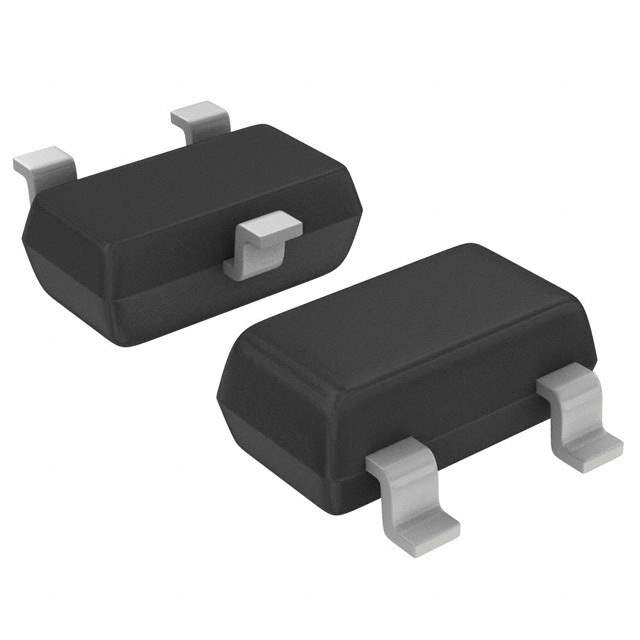
50 V, 100 mA, 230 mW in SC-59 for sustaining builds, not new design-in
Quick Engineering Summary
| Field | Value |
|---|---|
| Manufacturer | ON Semiconductor |
| Category | Transistors (BJT) - Single, Pre - Biased |
| Package | SC-59 |
| Core function | TRANS PREBIAS NPN 50V 0. |
| Key electrical range | Supply and Demand Status: Balance |
| Reported stock | 3990 pcs reported — confirm on RFQ |
50 V is the headline, but EOL decides the part
50 V is the decisive number. It is the collector-emitter breakdown ceiling, so DTC144TT1 can sit on modest control rails without being ruled out on voltage alone. That still does not make it a live option for fresh work: lifecycle is EOL, and part status is Obsolete.
The other hard limits are 100 mA collector current maximum and 230 mW maximum power. Both are ceilings, not operating targets, and in a pre-biased NPN this small they set the real boundary faster than the voltage rating does. Push current or heat too far and the outcome is familiar: the device stops behaving like a clean logic-side switch.
One detail in the listing matters more than it first appears. Only R1 is named, at 47 kOhms, and no R2 value is shown. That narrows how you should think about the part, because DTC144TT1 is not a generic small-signal BJT you can bias any way you like; part of its input behavior is already fixed by that resistor choice, which helps with repeatable drive from a weak logic source but gives you less freedom if your base-drive assumptions came from a discrete transistor stage.
New design-in: no
No for new design-in. EU RoHS and MSL 1 help with handling and compliance, but they do not outweigh EOL status.
Wrong for power switching, right for compact bias-fixed control
Wrong for power switching. The 100 mA collector ceiling and 230 mW power ceiling shut that down quickly, especially in SC-59 where board area and thermal escape are limited.
It still fits a compact surface-mount control path that benefits from a built-in 47 kOhms base resistor and does not need a second external bias resistor. The listing gives hFE minimum as 160 at 5mA, 10V and Vce saturation maximum as 250mV at 1mA, 10mA. Those are test-point anchors, not broad operating promises, and they point to light switching and interface duty rather than meaningful load current with much margin. If your circuit depends on custom base-network tuning, this is the wrong transistor shape.
Can you keep a line running with 3990 on hand?
Can you keep a line running with 3990 on hand? That is the first buying question. Listed stock is 3990, package is Reel - TR, and quantity per package is 3000.
For an existing build, that supports a controlled last-time allocation or a short sustaining window, not open-ended supply. If line demand is steady, reserve what you need against actual builds now instead of assuming a later refill.
The missing datasheet items are the real review blockers
The weak point is the missing detail. The basic limits are clear enough, but the listing still needs a pinout and package drawing to close footprint confidence, and it needs thermal resistance or a derating curve to say anything useful about ambient headroom from the 230 mW ceiling.
It also leaves out switching frequency data, gives no fuller input-network detail beyond R1 at 47 kOhms, and shows no R2 value. For a pre-biased transistor, those omissions matter more than one more headline limit.
View the Win-Source product page for DTC144TT1.
Key Takeaways for Engineers & Buyers
- Freeze new BOM adds for DTC144TT1; lifecycle is EOL and part status is Obsolete.
- Check your load against the 100 mA collector ceiling and 230 mW power ceiling before allocating remaining stock.
- Plan around reel quantities: package is TR with 3000 per package, while listed stock is 3990.