
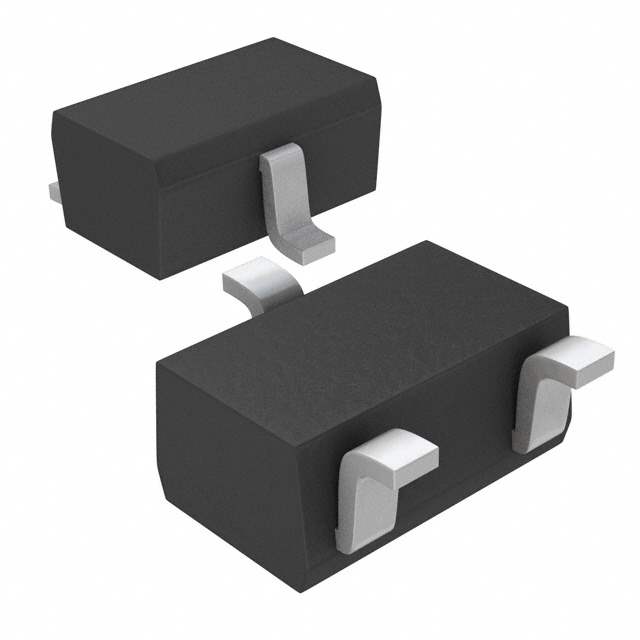
50V VCEO, 100mA collector ceiling, 200mW dissipation, and UMT3 define the design window
Quick Engineering Summary
| Field | Value |
|---|---|
| Manufacturer | Rohm Semiconductor |
| Category | Transistors (BJT) - Single, Pre - Biased |
| Package | UMT3 |
| Core function | TRANS PREBIAS NPN 50V 0. |
| Key electrical range | Collector Cut-off Current(Max): 500nA (ICBO); Frequency - Transition: 250MHz; Maximum Current Collector: 100mA; Maximum Power Dissipation: 200mW |
| Reported stock | 12000 pcs reported — confirm on RFQ |
The weak point is power, not availability
Power is the limit. DTC144TUAT106 is Active, stocked at 12000, and offered on reel, so availability is not the argument against a new design-in.
Use it where the integrated bias resistor saves parts and the load is modest. The 100mA collector figure is a ceiling, and it still has to fit inside the 200mW package budget.
The numbers force this into small-signal territory
The constraint is dissipation first, current second. A 100mA maximum collector current and 200mW maximum power dissipation put this device in light switching and interface work, not in spots where a transistor has to absorb much fault energy or sit hot for long periods.
The 50V VCEO ceiling gives useful rail margin for higher-voltage logic-side switching, but it does not answer thermal behavior or transient survival. The listed 300mV max VCE(sat) at 500µA, 5mA describes one operating corner, so it shows the device can pull low cleanly at small current rather than how it behaves near the 100mA ceiling. Off-state leakage is controlled on paper at 500nA ICBO max, which matters when the node is high impedance.
What would a buyer ask first: can we keep it on the line?
Can we keep it on the line? Yes, if it is treated as a reel-managed SMT part rather than an ad hoc service item. The listing shows Reel - TR packaging, 12000 in stock, and a Balance supply-demand status, which is enough to support a running line without turning it into a sourcing exception.
EU RoHS compliance removes the obvious compliance objection. The real purchasing check is simpler and more practical: whether your assembly flow already accepts UMT3 and whether the built-in resistor value matches the schematic, because this is not a generic small NPN you swap by package alone.
The built-in 47k decides whether DTC144TUAT106 helps or hurts
Use it deliberately.
DTC144TUAT106 is a pre-biased NPN with only R1 listed, and the 47k base resistor is the feature that either earns its place or rules it out. In a dense SMT design, that resistor can remove an external part and simplify placement around a simple logic-controlled switch. It also locks in the input behavior, so if the drive source, pull-up scheme, or turn-on current assumption was built around a different base network, the convenience disappears quickly and the transistor stops looking like a drop-in option before the rest of the circuit is even considered.
The 250MHz transition frequency is worth noting, but it is not the main selection lever here. The package and device class point to compact switching and biasing work, not to any promise about RF use. Package fit is just as specific: UMT3, with the SC-70 / SOT-323 body called out in the row details, suits space-constrained boards and works against designs that need more thermal mass, easier probing, or better hand-rework tolerance.
That is the real fit line. DTC144TUAT106 makes sense when you want a tiny, pre-biased transistor on an SMT board and your current stays comfortably below the listed ceilings. It does not belong in power stages, in hot corners without thermal data, or in circuits where the base resistor value needs tuning instead of acceptance.
The missing datasheet items are the real review blockers
Three gaps matter. No pinout, no package drawing, and no thermal resistance figure are shown.
Those are not cosmetic omissions. Pinout and drawing determine footprint release and assembly orientation, while thermal resistance is what turns the 200mW ceiling into an ambient decision. DTC144TUAT106 also lacks any surge or overload figure such as IFSM-style transient handling, so fault behavior remains open.
View the Win-Source product page for DTC144TUAT106.
Key Takeaways for Engineers & Buyers
- Keep DTC144TUAT106 on low-power switching nodes; 200mW is the dissipation ceiling.
- Match the drive network to the built-in 47k base resistor before committing logic-level control.
- Book reel demand against the listed 12000 stock if this is for a running line.