
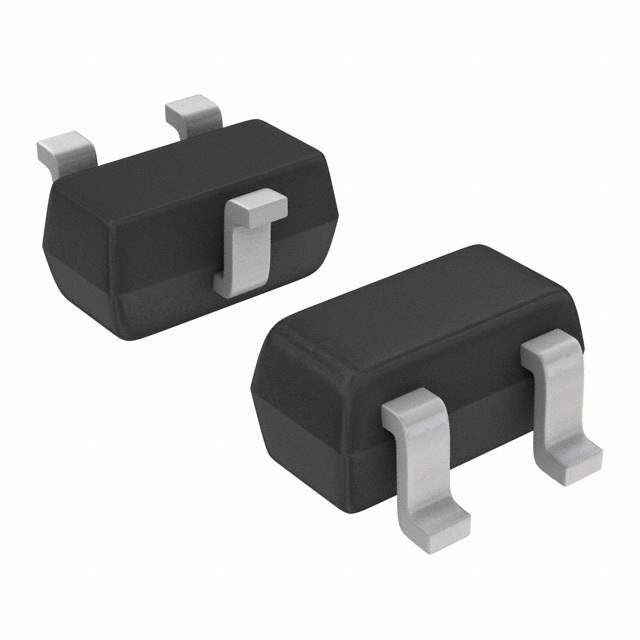
50V VCEO ceiling, 100mA collector limit, 200mW cap, SC-75 package
Quick Engineering Summary
| Field | Value |
|---|---|
| Manufacturer | ON Semiconductor |
| Category | Transistors (BJT) - Single, Pre - Biased |
| Package | SC-75 |
| Core function | TRANS PREBIAS NPN 50V 0. |
| Key electrical range | Collector Cut-off Current(Max): 500nA; Maximum Current Collector: 100mA; Maximum Power Dissipation: 200mW; Supply and Demand Status: Balance |
| Reported stock | 1 pcs reported — confirm on RFQ |
Not for new builds; still usable in small signal holdovers
Wrong for a new board spin. The lifecycle call is EOL, the risk level is high, and listed stock is 1, so this is sustaining material at best rather than something to anchor a fresh program.
It still has a narrow place in existing production that already expects a pre-biased NPN in SC-75. The built-in resistor network is the key fact: R1 is 47k and R2 is 22k, which keeps DTC144WET1G aligned with logic-drive housekeeping, level detect, and simple switching positions where that bias arrangement is already part of the circuit intent. The 50V VCEO ceiling leaves some rail headroom for modest high-side referenced sensing or low-current switching, but that number alone does not settle whether the device will live comfortably on the board once real dissipation and current are involved. The harder limits are the 100mA collector ceiling and the 200mW power ceiling, and in a package this small those two numbers close the case fast when the load is even slightly ambitious. EU RoHS is compliant. Lifecycle is the blocker.
Can you actually buy enough to keep a line moving?
Can you get enough to matter? No. Stock is 1, and DTC144WET1G is listed on reel - TR packaging, so this is not a practical replenishment position beyond a repair or very short sustaining need.
Quarantine that unit for an existing assembly only.
The useful numbers are ceilings, not comfort margins
The weak point comes first: 200mW is a very small dissipation ceiling for a transistor that might sit in saturation for long stretches. The useful part is that the listing still gives enough electrical limits to place it correctly.
VCEO is 50V, and that is a breakdown ceiling. It sets the collector-emitter voltage limit; it does not imply the device is comfortable switching any load placed on a 50V rail. The 100mA maximum collector current narrows the job further to light-load switching and signal conditioning. No surge or IFSM-style number is listed, so there is no basis here for treating that current figure as anything but a ceiling. The 250mV max VCE(sat) at 5mA, 10mA is useful because it ties conduction loss to a stated test point, but only to that point. The 500nA collector cut-off current ceiling also helps on leakage-sensitive nodes, especially where an off-state transistor must not disturb a high-impedance bias network.
What the listing still does not tell you
And that is where the page stops being enough. DTC144WET1G still needs a real datasheet pass for the details that decide edge behavior and layout fit.
The missing pieces are concrete: pinout, package drawing, thermal resistance, and switching figures such as rise, fall, or storage time. There is no derating curve either. In a tiny SC-75 body, those omissions decide whether the part merely matches the schematic or actually survives the board, the ambient, and the waveform you intend to throw at it.
View the Win-Source product page for DTC144WET1G.
Key Takeaways for Engineers & Buyers
- Block DTC144WET1G from new BOMs; lifecycle is EOL.
- Reserve the single listed unit for failure analysis or line-down recovery only.
- Check the 50V, 100mA, and 200mW ceilings against the actual load before using remaining stock.