
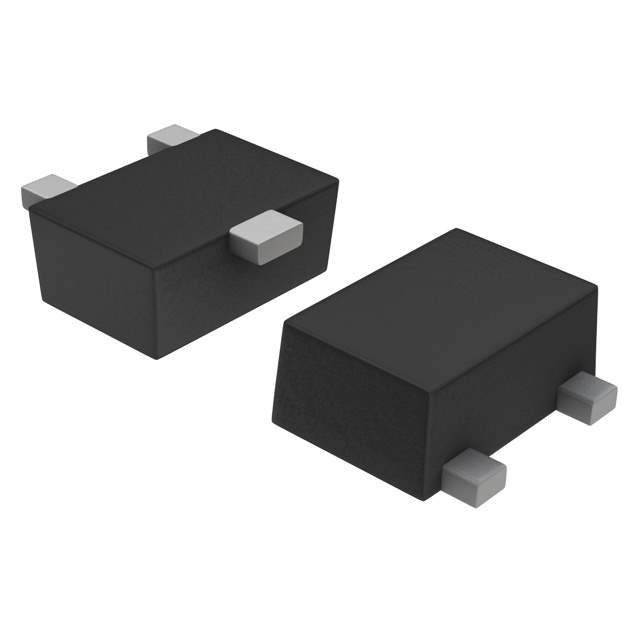
50 V, 100 mA, 260 mW in SOT-723; lifecycle and package matter more here than gain.
Quick Engineering Summary
| Field | Value |
|---|---|
| Manufacturer | ON Semiconductor |
| Category | RF Transistors (BJT) |
| Package | Tape & Reel (TR) |
| Core function | TRANS PREBIAS NPN 50V SOT723 |
| Key electrical range | Current - Collector (Ic) (Max): 100 mA; Current - Collector Cutoff (Max): 500nA; DC Current Gain (hFE) (Min) @ Ic, Vce: 80 @ 5mA, 10V; Power - Max: 260 mW |
| Reported stock | 1 pcs reported — confirm on RFQ |
50 V is useful, but the lifecycle already says no
50 V gets attention first, and for good reason: a pre-biased NPN in SOT-723 with that collector-emitter breakdown ceiling can cover small high-side or level-shift jobs where lower-voltage digital transistors drop out early. That number alone does not carry the design. The same listing sets a 100 mA collector-current ceiling and 260 mW maximum power, which keeps DTC144WM3T5G in light switching and biasing work rather than anything that leans on current or heat for long.
The real decision is lifecycle. It is already closed. DTC144WM3T5G is marked Discontinued, with an EOL signal alongside it, so it does not belong in a new design-in. For existing production, the stock position is effectively gone at 1 piece, and the package format is Tape & Reel with a standard package of 8,000, a reminder that the part was aimed at volume assembly even though volume supply is no longer there. EU RoHS is compliant, MSL 1 (Unlimited) removes one handling issue, and none of that changes the sourcing risk.
And the resistor network fixes the use case
And that fixed use case comes from the built-in network. R1 is 47 kOhms and R2 is 22 kOhms, so you get BOM reduction and placement density, but you also give up resistor choice.
Sustaining only
This is sustaining only.
The 250mV VCE(sat) maximum at 5mA, 10mA is the key switching number at that test point. Outside it, this listing does not show how saturation moves, so don't assume more than it states.
The 80 minimum hFE at 5mA, 10V says the device is characterized in small-signal territory. It does not predict every bias corner. DTC144WM3T5G is wrong for fresh platform work, wrong for anything that needs current headroom, and reasonable only when an existing board already committed to this exact resistor pair and package.
The constraint is missing second-order data
The constraint is incomplete second-order data. The electrical ceilings are enough to reject bad fits, but not enough to close a careful reuse review. The listing does not include pinout detail, a package drawing, or thermal resistance, leaving layout confirmation and ambient headroom unresolved.
Switching behavior is missing too. There is no transition frequency, no capacitance, and no switching-time data here, so if DTC144WM3T5G sits near edge-rate-sensitive logic or RF-adjacent bias control, those omissions are what decide whether the tiny package behaves cleanly or turns into the debug target.
View the Win-Source product page for DTC144WM3T5G.
Key Takeaways for Engineers & Buyers
- Block DTC144WM3T5G from new BOMs; lifecycle is Discontinued and stock shows 1.
- Check the rail against the 50 V collector-emitter breakdown ceiling before any reuse.
- Treat 260 mW and 100 mA as ceilings in SOT-723, not as a comfortable operating point.