
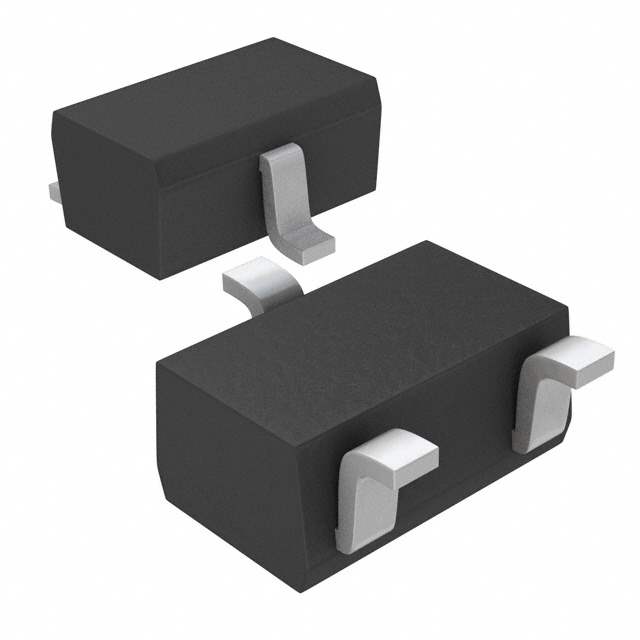
20V VCEO ceiling, 600mA collector ceiling, 200mW dissipation ceiling, UMT3 package
Quick Engineering Summary
| Field | Value |
|---|---|
| Manufacturer | Rohm Semiconductor |
| Category | Transistors (BJT) - Single, Pre - Biased |
| Package | UMT3 |
| Core function | TRANS PREBIAS NPN 20V 0. |
| Key electrical range | Collector Cut-off Current(Max): 500nA (ICBO); Frequency - Transition: 150MHz; Maximum Current Collector: 600mA; Maximum Power Dissipation: 200mW |
| Reported stock | 15400 pcs reported — confirm on RFQ |
Can you put DTC623TUT106 into a new build?
Can this go into a new build without creating a sourcing problem later? Yes. DTC623TUT106 is marked Active with no conflicting status signals, so it is a reasonable choice for new design-in as well as existing production. EU RoHS is compliant, and the package and mounting callout point to standard SMT assembly rather than any unusual handling path.
The real gate is electrical fit. This pre-biased NPN is listed with R1 at 2.2k in UMT3, so it suits circuits that want the built-in base resistor and do not need a discrete base network. If the rail can rise past 20V, or the dissipation budget is already tight in a small outline, it is the wrong part.
200mW is the number that keeps the 600mA claim honest
200mW is the ceiling that decides whether this small pre-biased transistor is comfortable or cornered. The listing also gives 600mA maximum collector current, but that is not a promise that DTC623TUT106 can run there under any switching condition. In a UMT3 body, power is the first limit that closes the door.
20V VCEO is just as hard a ceiling. That places DTC623TUT106 on low-voltage rails and small control nodes, not on lines that can ring or sit above 20V, because once that limit is crossed you are no longer talking about margin but about operating beyond the listed breakdown ceiling.
The saturation figure is useful, but only at its stated point: 150mV at 2.5mA and 50mA. That tells you the part can pull low with a modest drop there. It does not describe behavior across the full load range up to 600mA, and it does not stand in for a switching-loss picture.
The 500nA collector cut-off current ceiling is helpful for leakage-sensitive logic interfacing, but it is secondary next to voltage and dissipation. One more number matters because this is a digital transistor rather than a plain small-signal BJT: the built-in base resistor is 2.2k. When that value matches the circuit intent, drive from logic or bias nodes gets simpler. When it does not, the part is out.
So where does it actually belong?
So it belongs in low-voltage board-level switching and interface work: places where the 2.2k input resistor helps, the rail stays under 20V, and the board remains inside a 200mW ceiling. Not elsewhere.
The buying constraint is packaging, not lifecycle
Packaging is the constraint the numbers create. Reel - TR fits placement lines, and the listed stock of 15400 supports a running line better than a hand-build bench flow. Buy it for SMT consumption, not as a loose-piece convenience transistor.
A few concrete gaps still matter before DTC623TUT106 is closed in schematic and layout work: no pinout, no package drawing, no thermal resistance, and no resistor tolerance for the internal 2.2k R1. Those missing items set orientation, ambient headroom, and how tightly the built-in bias behaves from unit to unit.
View the Win-Source product page for DTC623TUT106.
Key Takeaways for Engineers & Buyers
- Keep VCE below the 20V ceiling; this listing does not buy rail margin above that.
- Treat 200mW as the thermal budget gate in UMT3 before leaning on the 600mA collector rating.
- Buy on reel if DTC623TUT106 is going to placement; listed stock is 15400.